Achilles' Immersion Myth Meaning & Symbolism
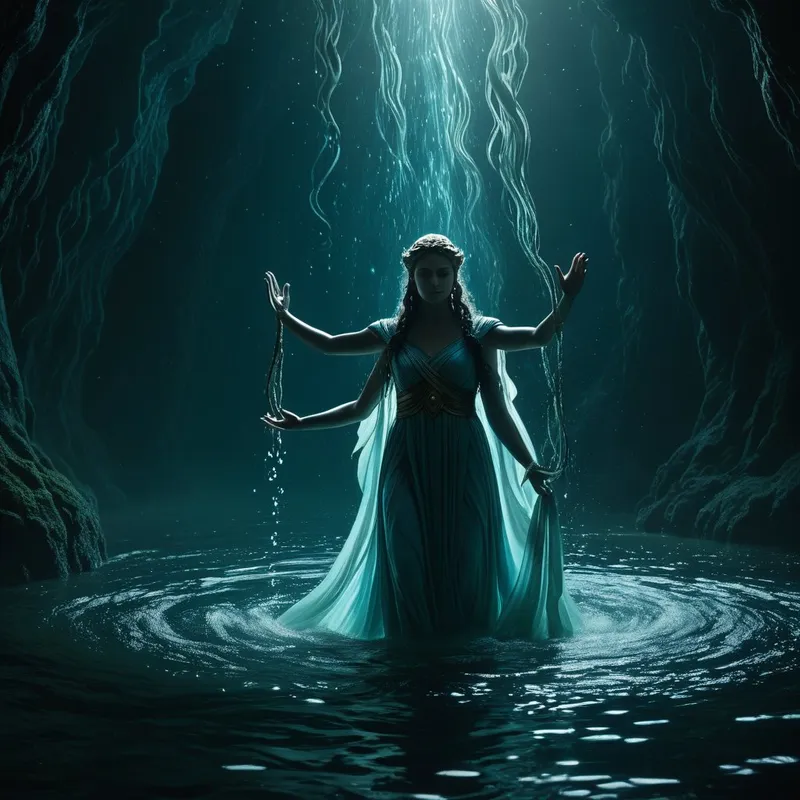
Thetis dips her infant son Achilles in the River Styx to grant him invulnerability, but the heel she holds remains untouched, becoming his fatal weakness.
The Tale of Achilles’ Immersion
Hear now the tale of a mother’s dread love, a love that sought to defy the very spindle of the [Moirai](/myths/moirai “Myth from Greek culture.”/). In the shadowed halls of [the sea](/myths/the-sea “Myth from Greek culture.”/), [Thetis](/myths/thetis “Myth from Greek culture.”/) wept. A prophecy, cold and sharp as sea-ice, had pierced her heart: her son, the glorious child she bore to the mortal king Peleus, was destined for a life brief as a mayfly’s wing, yet bright as a falling star. He would be the greatest of the Greeks, but he would not return from the plains of Troy.
This fate she could not bear. The divine blood in her veins, daughter of the ancient sea-god Nereus, raged against the mortal doom written for her boy. She would not surrender him to the common lot of men, to the decay of flesh and the finality of [Hades](/myths/hades “Myth from Greek culture.”/). A desperate plan, born of a love that touched the borders of madness, took shape in the deep.
When the infant [Achilles](/myths/achilles “Myth from Greek culture.”/) was but a babe, she carried him from his cradle, down, down through realms no mortal eye should see. She passed the sunless gates, where the sighs of the dead are the only wind. Her destination was not the bright Acheron, but its terrible twin, the Styx, [the river](/myths/the-river “Myth from Buddhist culture.”/) of unbreakable oath, whose black waters coiled through the bedrock of [the world](/myths/the-world “Myth from Tarot culture.”/).
The air was thick with the silence of endings. The waters did not splash or babble; they flowed with a heavy, primordial slowness, colder than [the void](/myths/the-void “Myth from Buddhist culture.”/) between stars. Holding her son firm, Thetis whispered a prayer to the chthonic powers, a plea against destiny itself. Then, steeling her heart, she plunged the tiny, squirming body into the current.
The waters did not embrace; they consecrated. They crawled over his skin, not as liquid, but as a creeping, dark fire—a [baptism](/myths/baptism “Myth from Christian culture.”/) into invulnerability. Where they touched, his mortal flesh was transmuted. Skin became like tempered adamant, muscle like woven bronze, sinew like immortal cord. The boy did not cry out; he was being remade, sealed against spear and sword, against all the pointed cruelties of the world.
But the mother’s hand, [the vessel](/myths/the-vessel “Myth from Alchemical culture.”/) of her saving love, became the instrument of fate. To keep him from being swept into [the abyss](/myths/the-abyss “Myth from Kabbalistic culture.”/), she gripped him tightly—by one small, perfect heel. The dark waters swirled around it, but could not kiss it. That one point of contact, that anchor of maternal safety, remained soft, pink, and utterly human.
She lifted him from the river. He glistened, a being of terrible potential, a god in all but one infinitesimal part. Thetis looked upon her work, and her [triumph](/myths/triumph “Myth from Roman culture.”/) was already a dirge. She had forged a demigod, but in doing so, she had inscribed his [death](/myths/death “Myth from Tarot culture.”/) warrant upon his own body. The love that sought to save him had, in its final, fearful clutch, marked the very spot where the world would one day claim its due. The hero was born, and with him, his doom.

Cultural Origins & Context
This potent myth finds its most famous telling in the Iliad of [Homer](/myths/homer “Myth from Greek culture.”/), though the specific detail of [the Styx](/myths/the-styx “Myth from Greek culture.”/) immersion is a later elaboration, crystallized in the Roman poet Ovid’s [Metamorphoses](/myths/metamorphoses “Myth from Greek culture.”/). It existed in the oral tradition long before, a piece of the vast tapestry of stories that explained the nature of heroism to the ancient Greeks.
The myth served a crucial societal function. In a culture that celebrated physical perfection, martial prowess, and the pursuit of kleos (glory), Achilles was the ultimate archetype. Yet, his story was not one of untrammeled triumph. It was a meditation on the limits of power and the inescapability of moira. The Greeks understood that greatness and tragedy were two sides of the same coin. The myth of the immersion taught that even the greatest hero is subject to a fundamental, often hidden, vulnerability. It was a narrative check on hubris, a reminder that mortality—the very condition that makes heroic acts meaningful—cannot be fully escaped, only postponed at a terrible cost.
Symbolic Architecture
The myth is a perfect symbolic [vessel](/symbols/vessel “Symbol: A container or structure that holds, transports, or protects something essential, representing the self, emotions, or life journey.”/), containing profound psychological truths. The [River](/symbols/river “Symbol: A river often symbolizes the flow of emotions, the passage of time, and life’s journey, reflecting transitions and movement in one’s life.”/) Styx represents not just [death](/symbols/death “Symbol: Symbolizes transformation, endings, and new beginnings; often associated with fear of the unknown.”/), but the transformative waters of the unconscious itself—the primal, chaotic [source](/symbols/source “Symbol: The origin point of something, often representing beginnings, nourishment, or the fundamental cause behind phenomena.”/) from which new forms of being emerge. Thetis’s act is an alchemical [ritual](/symbols/ritual “Symbol: Rituals signify structured, meaningful actions carried out regularly, reflecting cultural beliefs and emotional needs.”/): she dips the raw [material](/symbols/material “Symbol: Material signifies the tangible aspects of life, often representing physical resources, desires, and the physical world’s influence on our existence.”/) of mortal [life](/symbols/life “Symbol: The symbol of ‘Life’ represents a journey of growth, interconnectedness, and existential meaning, encompassing both the joys and challenges that define human experience.”/) (Achilles) into [the prima materia](/myths/the-prima-materia “Myth from Alchemical culture.”/) of the [underworld](/symbols/underworld “Symbol: A symbolic journey into the unconscious, representing exploration of hidden aspects of self, transformation, or confronting repressed material.”/) to create something transcendent.
The attempt to make the psyche invulnerable is the very act that creates its most sensitive point of entry.
The immersion symbolizes a profound, often traumatic, [initiation](/symbols/initiation “Symbol: A symbolic beginning or transition into a new phase, status, or awareness, often involving tests, rituals, or profound personal change.”/). It is the “toughening” process—the [childhood](/symbols/childhood “Symbol: Dreaming of childhood often symbolizes nostalgia, innocence, and unresolved issues from one’s formative years.”/) wounding, the parental attempt to [armor](/symbols/armor “Symbol: Armor represents psychological protection, emotional defense, and the persona presented to the world. It symbolizes both safety and the barriers that separate us from vulnerability.”/) the [child](/symbols/child “Symbol: The child symbolizes innocence, vulnerability, and potential growth, often representing the dreamer’s inner child or unresolved issues from childhood.”/) against the world’s pain. The resulting “invulnerability” is the [persona](/symbols/persona “Symbol: The social mask or outward identity one presents to the world, often concealing the true self.”/), the hardened [character](/symbols/character “Symbol: Characters in dreams often signify different aspects of the dreamer’s personality or influences in their life.”/) [armor](/symbols/armor “Symbol: Armor represents psychological protection, emotional defense, and the persona presented to the world. It symbolizes both safety and the barriers that separate us from vulnerability.”/) we present to the world: competent, strong, impenetrable. But the [heel](/symbols/heel “Symbol: Represents vulnerability, foundational support, and the point where pressure meets the ground. Often symbolizes weakness or being pursued.”/), the Achilles Heel, is the [shadow](/symbols/shadow “Symbol: The ‘shadow’ embodies the unconscious, repressed aspects of the self and often represents fears or hidden emotions.”/) of this process. It is the repressed [vulnerability](/symbols/vulnerability “Symbol: A state of emotional or physical exposure, often involving risk of harm, that reveals authentic self beneath protective layers.”/), the unhealed wound, the secret insecurity that was held apart from the transformative (or defensive) process. It is the part of [the self](/myths/the-self “Myth from Jungian culture.”/) that remains untouched by [consciousness](/symbols/consciousness “Symbol: Consciousness represents the state of awareness and perception, encompassing thoughts, feelings, and experiences.”/), and therefore, utterly exposed.
Achilles is thus the [archetype](/symbols/archetype “Symbol: A universal, primordial pattern or prototype in the collective unconscious that shapes human experience, behavior, and creative expression.”/) of the person who is brilliant, capable, and seemingly invincible in their domain, yet perpetually at risk of being undone by one specific, often irrational, trigger—a criticism, a [betrayal](/symbols/betrayal “Symbol: A profound violation of trust in artistic or musical contexts, often representing broken creative partnerships or artistic integrity compromised.”/), a forgotten tenderness.
The Dreamer’s Resonance
When this myth stirs in the modern dreamscape, it often signals a confrontation with one’s own sacred wound. To dream of being dipped in dark, magical waters suggests a process of profound psychological change is underway, perhaps a painful initiation into a new level of strength or responsibility. The dreamer may feel they are being “forged” by circumstances.
Conversely, dreams focusing on a vulnerable spot—an unarmored ankle, a patch of soft skin on an otherwise metallic body, a locked door with one broken hinge—point directly to the active complex. This is the somatic signal of the Achilles Heel. The dream is highlighting the specific area where the dreamer’s psychological defenses are absent, where they feel fundamentally unsafe and exposed. It is the place from which a seemingly minor slight can cause catastrophic psychic hemorrhage. The dream asks: What part of you did life’s toughening process fail to reach? What tenderness are you still gripping so tightly that it cannot be transformed?

Alchemical Translation
The path of individuation, of becoming whole, does not lie in making the heel invulnerable like the rest. That is the mother’s failed solution. The alchemical work is the reverse: to bring consciousness to the heel, to integrate the vulnerable spot into the totality of the self.
The goal is not to eradicate the flaw, but to be in conscious relationship with it, transforming a fatal weakness into a seat of unique humanity.
This requires a descent—not the mother’s desperate plunge, but a willing journey into one’s own personal Styx: the dark waters of memory, shame, and unmet need that surround the wound. One must examine the “grip” that created it—often a parental pattern of overprotection, anxiety, or conditional love that left a part of the [psyche](/myths/psyche “Myth from Greek culture.”/) untouched by genuine nurturing.
The alchemical translation is the realization that the heel is not a mistake, but a necessity. It is the point of connection. It is what kept Achilles human, tethered to the mortal world of feeling, loss, and love. In the end, it was not his invulnerable body that made him a hero, but the passionate, flawed, vulnerable humanity that flowed from that one unhardened place. To integrate the heel is to accept that our strength and our sensitivity are born from the same source. Our greatest power does not lie in being unbreakable, but in knowing precisely where, and why, we can be broken—and choosing to live from that truth anyway. The wound becomes not a secret to be hidden, but the very wellspring of compassion, depth, and authentic connection.
Associated Symbols
Explore related symbols from the CaleaDream lexicon: