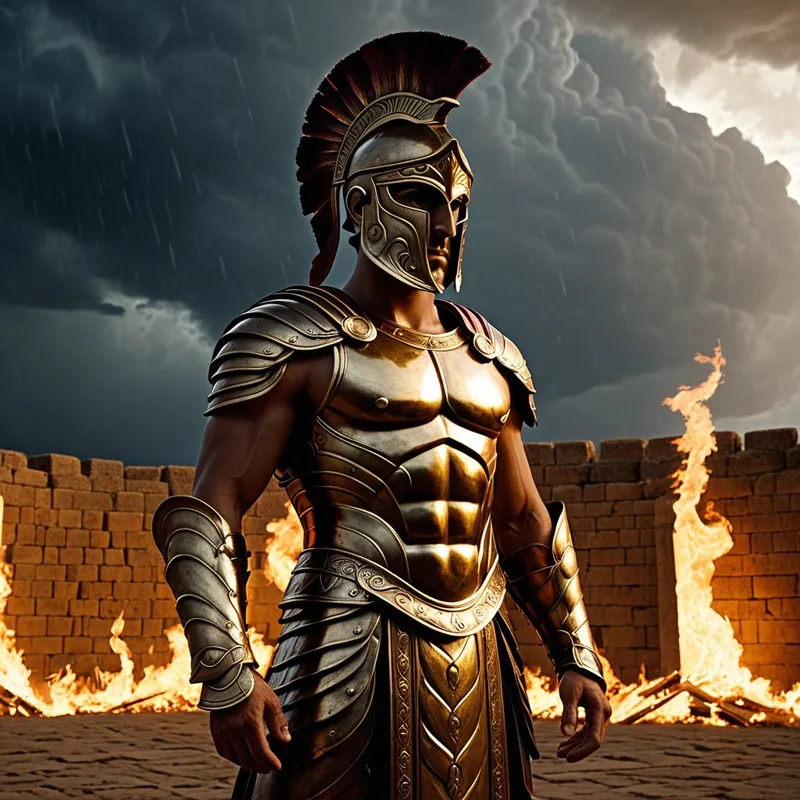
Achilles at Troy Myth Meaning & Symbolism
The greatest warrior of the Trojan War, invulnerable but for his heel, chooses a short, glorious life over a long, forgotten one.
The Tale of Achilles at Troy
Hear now the tale of swift-footed [Achilles](/myths/achilles “Myth from Greek culture.”/), the rage that doomed heroes, and the price of a name that echoes through eternity.
The salt wind howled across the wine-dark sea, carrying the stench of sweat, smoke, and decay to the high walls of Troy. For nine long years, the Achaean host had lain siege, and for nine years, the tide of battle ebbed and flowed like a fickle god’s breath. But the war turned on a king’s pride. Agamemnon, leader of the Greeks, seized Briseis, the war-prize of his greatest warrior. And in that moment, the fury of Achilles, son of [the sea](/myths/the-sea “Myth from Greek culture.”/)-nymph [Thetis](/myths/thetis “Myth from Greek culture.”/), was kindled—a cold, divine fire that would consume all before it.
“No more,” he swore, his voice cutting through the council like a blade. “No more will my spear fight for a man who dishonors me.” He withdrew. He, the lion of the Achaeans, retreated to his hollow ships, and with him went the hope of victory. The Greeks faltered. Without his terror on the field, the Trojans, led by shining Hector, drove them back, back, back to the very shore, where the waves lapped at the hulls of their beached ships, thirsty for the blood of men.
Yet Achilles sat in his tent, unmoved, plucking the lyre and singing of the glories of men. His beloved companion, Patroclus, could bear it no longer. “Let me wear your armor,” he begged. “Let the Trojans think you have returned, and I will turn the tide.” With a heavy heart, Achilles consented. He clasped the famed armor, forged by the god [Hephaestus](/myths/hephaestus “Myth from Global/Universal culture.”/), onto his friend’s shoulders, and sent him forth like a mirror of his own wrath.
For a time, it worked. The Trojans recoiled before the sight of the dreaded armor. But Zeus’s scales tipped. Hector found Patroclus on the chaotic plain, and with a thrust of his spear, he stripped the life and the armor from him. The news reached Achilles, and his grief was a sound beyond human ken—a raw, tearing cry that silenced the battlefield. Thetis heard her son’s agony from the ocean’s depths and came to him. She knew the prophecy: if he returned to slay Hector, his own [death](/myths/death “Myth from Tarot culture.”/) would swiftly follow.
“Then let me die,” Achilles said, his eyes holding the emptiness of [the abyss](/myths/the-abyss “Myth from Kabbalistic culture.”/). “My glory is ashes without him.”
Thetis went to Hephaestus, and through divine fire and divine tears, new armor was forged. When Achilles donned it, he was no longer a man but an incarnation of vengeance. He strode onto the plain, and the very earth shook. He did not fight for Greece, nor for Agamemnon. He fought for Patroclus. He carved a river of red through the Trojan ranks, so fierce that he clogged [the river](/myths/the-river “Myth from Buddhist culture.”/) Scamander with bodies and fought [the river](/myths/the-river “Myth from Buddhist culture.”/) god himself.
And then he found Hector before the Skaian Gates. The Trojan prince stood his ground, knowing his fate was sealed. They circled, bronze flashing in the dusty air. A cast, a miss, a final, fatal thrust. Achilles’ spear found its mark. Hector fell, and with him fell the last hope of Troy. But Achilles’ rage was not quenched. In a sacrilege that horrified gods and men alike, he tied Hector’s body to his chariot and dragged it through the dust around the tomb of Patroclus, day after day.
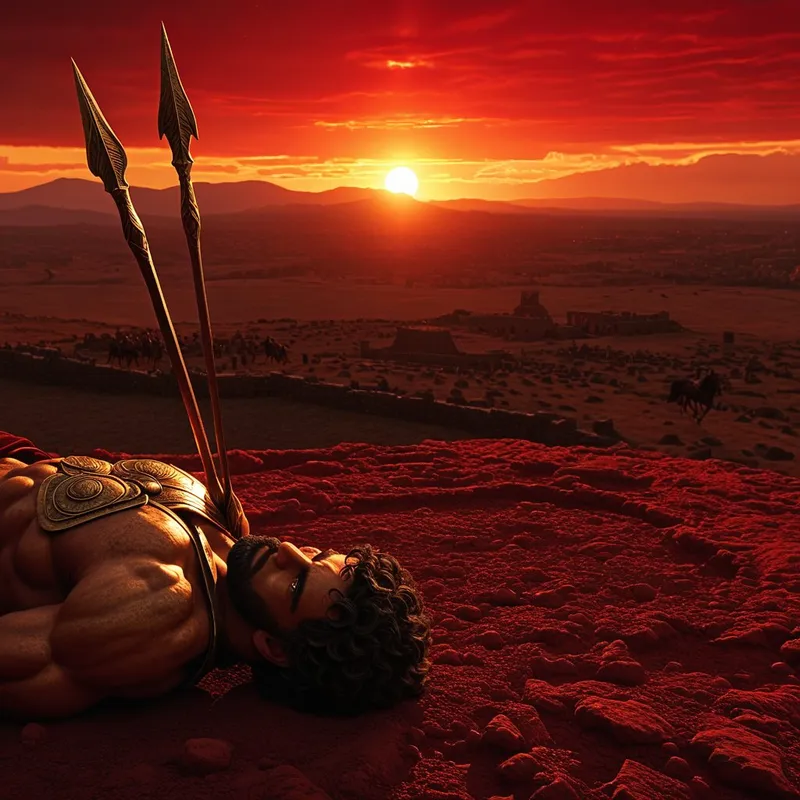
Only when Hector’s aged father, King Priam, came alone by night to the Greek camp—kissing the hands that killed his son—did the human flame rekindle in Achilles. He saw in Priam his own father, and in their shared grief, his divine rage finally broke. He returned Hector’s body for burial. The prophecy, however, was a wheel that could not be stopped. Soon after, guided by the god [Apollo](/myths/apollo “Myth from Global/Universal culture.”/), Paris’s arrow found the one place Thetis’s hand had not touched: the hero’s heel. The greatest of the Achaeans fell, his glory complete, his life brief, and his name eternal.
Cultural Origins & Context
This epic core of [the Trojan War](/myths/the-trojan-war “Myth from Greek culture.”/) cycle comes to us primarily from [Homer](/myths/homer “Myth from Greek culture.”/)’s Iliad, a monumental oral-formulaic poem crystallized in writing around the 8th [century](/myths/century “Myth from Biblical culture.”/) BCE. It was not mere entertainment; it was the foundational narrative of the Mycenaean heroic age, a cultural mirror and a pedagogical tool. [Bards](/myths/bards “Myth from Celtic culture.”/), or aoidoi, would perform these verses, accompanied by the lyre, at the feasts of aristocratic warriors, reinforcing a code of values: arete (excellence), kleos (glory won through great deeds), and the ever-present tension between individual honor and communal duty.
The myth functioned as a sacred history, connecting the audience to a grander, more tragic past. Achilles was the ultimate paradox of this worldview: the model of martial perfection, yet also a warning about the destructive potential of unchecked passion (ate). His story explored the human condition under the gaze of the gods, where fate (Moira) was inescapable, but the manner of meeting it defined a hero’s eternal reputation. The tale was a crucible in which Greek society examined the price of greatness, the nature of grief, and the fragile reconciliation between enemies in the shared recognition of mortality.
Symbolic Architecture
At its [heart](/symbols/heart “Symbol: The heart symbolizes love, emotion, and the core of one’s existence, representing deep connections with others and self.”/), the myth of Achilles is an anatomy of the heroic [psyche](/myths/psyche “Myth from Greek culture.”/) in [collision](/symbols/collision “Symbol: A sudden, forceful impact between objects or forces, often representing conflict, unexpected change, or the meeting of opposing elements in life.”/) with its own limits. He represents the [archetype](/symbols/archetype “Symbol: A universal, primordial pattern or prototype in the collective unconscious that shapes human experience, behavior, and creative expression.”/) of the [prodigy](/symbols/prodigy “Symbol: A person, often young, with exceptional natural talent or ability far beyond their years.”/), the individual whose gifts—here, literal invulnerability and preternatural skill—set him apart, creating a fatal disconnect from the communal [body](/symbols/body “Symbol: The body in dreams often symbolizes the dreamer’s self-identity, personal health, and the relationship they have with their physical existence.”/).
His “Achilles’ [heel](/symbols/heel “Symbol: Represents vulnerability, foundational support, and the point where pressure meets the ground. Often symbolizes weakness or being pursued.”/)” is not merely a physical flaw, but the symbolic locus of his humanity. It is the crack in the divine [armor](/symbols/armor “Symbol: Armor represents psychological protection, emotional defense, and the persona presented to the world. It symbolizes both safety and the barriers that separate us from vulnerability.”/), the point where the mortal son of Peleus connects to his inevitable [fate](/symbols/fate “Symbol: Fate represents the belief in predetermined outcomes, suggesting that some aspects of life are beyond human control.”/). It is the [vulnerability](/symbols/vulnerability “Symbol: A state of emotional or physical exposure, often involving risk of harm, that reveals authentic self beneath protective layers.”/) that makes his [choice](/symbols/choice “Symbol: The concept of choice often embodies decision-making, freedom, and the multitude of paths available in life.”/) meaningful.
The hero’s true wound is not in the heel, but in the heart. His rage is the fortress he builds around the part of himself that can still be broken.
His [wrath](/symbols/wrath “Symbol: Intense, often destructive anger representing repressed emotions, moral outrage, or survival instincts.”/), the menis that opens the Iliad, is the fire of a [soul](/symbols/soul “Symbol: The soul represents the essence of a person, encompassing their spirit, identity, and connection to the universe.”/) whose sacred order has been violated. When Agamemnon steals his geras (prize of honor), it is an attack on the symbolic economy of his [identity](/symbols/identity “Symbol: Identity represents the sense of self, encompassing personal beliefs, cultural background, and social roles.”/). His withdrawal is not cowardice, but a total psychic shutdown—the inner world refusing to participate in an outer world that has become meaningless. The [death](/symbols/death “Symbol: Symbolizes transformation, endings, and new beginnings; often associated with fear of the unknown.”/) of Patroclus is the shattering of his last [human](/symbols/human “Symbol: The symbol of a human represents individuality, complexity of emotions, and social relationships.”/) tether, transforming [grief](/symbols/grief “Symbol: A profound emotional response to loss, often manifesting as deep sorrow, yearning, and a sense of emptiness.”/) into a [berserker](/myths/berserker “Myth from Norse culture.”/)’s transcendence. His desecration of Hector’s body shows the [hero](/symbols/hero “Symbol: A hero embodies strength, courage, and the ability to overcome significant challenges.”/) become a force of [nature](/symbols/nature “Symbol: Nature symbolizes growth, connectivity, and the primal forces of existence.”/), no longer a man but pure, unchecked id. The final reconciliation with Priam is the return of the repressed humanity, the [empathy](/symbols/empathy “Symbol: The capacity to understand and share the feelings of others, often manifesting as emotional resonance or intuitive connection in dreams.”/) that must surface before his [story](/symbols/story “Symbol: The symbol of ‘Story’ represents the narrative woven through our lives, embodying experiences, lessons, and emotions that shape our identities.”/) can conclude.
The Dreamer’s Resonance
When the pattern of “Achilles at Troy” stirs in the modern unconscious, it often signals a profound crisis of identity and value. To dream of being an invulnerable warrior betrayed by an authority figure may point to a deep sense of one’s gifts being exploited or dishonored in work or life, leading to a powerful, internalized “withdrawal.”
Dreams of a specific, small vulnerability—a cracked ankle, a locked door with a single tiny keyhole—can symbolize the dreamer’s intuitive knowledge of their own psychological “heel”: the core wound, shame, or dependency that feels like it could unravel everything they have built. The dream of dragging a body or a heavy weight tied to a vehicle often mirrors the somatic feeling of being chained to an unprocessed grief or a rage that one cannot release, polluting one’s forward motion.
The appearance of a wise, sorrowful elder offering a plea in a dream (a Priam-figure) can be a profound invitation from the psyche, indicating that the time for raw vengeance has passed, and the path to healing lies in recognizing the shared humanity in one’s “enemy”—be it a person, a past self, or an internal complex.
Alchemical Translation
The journey of Achilles is a brutal map of the individuation process, where the leaden ego of raw potential must be dissolved in the fires of conflict and loss to be remade. The initial state is the “divine child” protected by the mother (Thetis’s immersion in [the Styx](/myths/the-styx “Myth from Greek culture.”/)), creating an inflation—a belief in one’s specialness and invulnerability.
The first alchemical operation, [nigredo](/myths/nigredo “Myth from Alchemical culture.”/), is his rage and withdrawal. This is the necessary descent into the blackness, the putrefaction of the old identity built on external honor. The death of Patroclus is the mortificatio, the death of the [anima/animus](/myths/animaanimus “Myth from Jungian culture.”/) bridge to the softer, relational self. What follows is not growth, but a fiery, destructive [separatio](/myths/separatio “Myth from Alchemical culture.”/)—Achilles as unbound fury, severing all connections.
The alchemy of the soul requires the murder of what you once loved most, so that you may love it truly, beyond possession.
The meeting with Priam is the pivotal [coniunctio](/myths/coniunctio “Myth from Alchemical culture.”/), not a romantic union, but the sacred conjunction of opposites: killer and father, victor and supplicant, rage and pity. In this tent, under the watch of the gods, the integrated psyche is glimpsed. Achilles sees himself in the other. This moment of empathy is the [albedo](/myths/albedo “Myth from Alchemical culture.”/), the whitening, the washing of the corpse. It prepares the spirit for the final sacrifice.
His death is the [rubedo](/myths/rubedo “Myth from Alchemical culture.”/), the reddening. It is not a failure, but the completion of [the opus](/myths/the-opus “Myth from Alchemical culture.”/). He consciously chose the short, glorious life—the fully realized, authentic self—over the long, anonymous one. His vulnerable heel accepted, he submits to the arrow of fate (Apollo’s guidance), transmuting his leaden mortality into the gold of eternal kleos. For the modern individual, the myth asks: Where is your rage protecting your grief? What is the “heel” you must acknowledge to be fully human? And what fate are you willing to accept to live a life that is truly, wholly your own?
Associated Symbols
Explore related symbols from the CaleaDream lexicon: