Abraham and the Three Visitors Myth Meaning & Symbolism
An elderly man offers profound hospitality to three mysterious strangers, unknowingly welcoming a divine promise that shatters the limits of his reality.
The Tale of Abraham and the Three Visitors
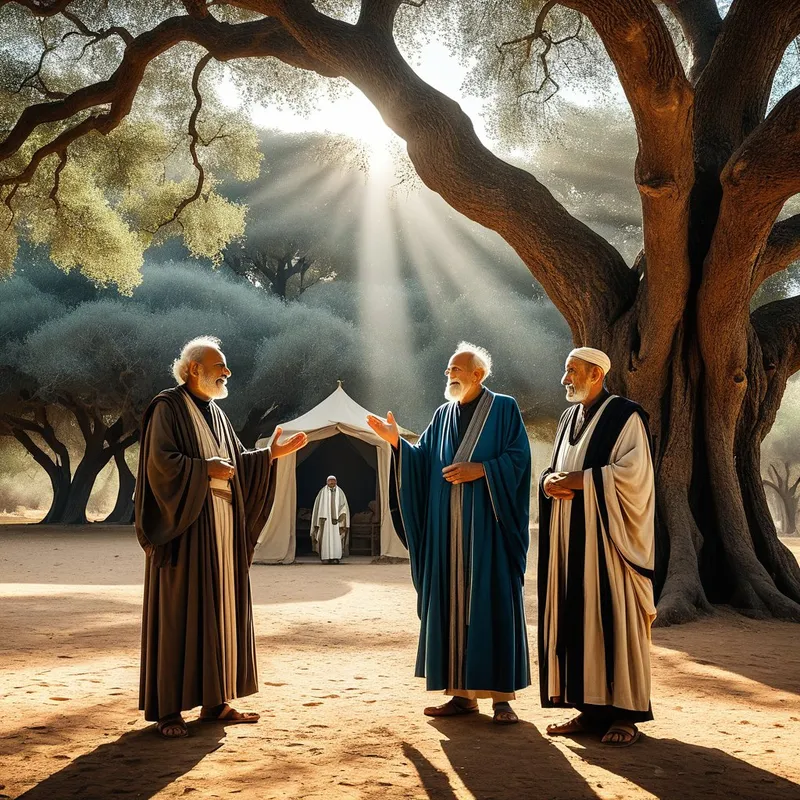
The heat was a physical weight, a hammer of brass upon the land of Mamre. At the door of his tent, in the heavy stillness of the day, [Abraham](/myths/abraham “Myth from Abrahamic culture.”/) sat. [The world](/myths/the-world “Myth from Tarot culture.”/) was reduced to shimmering haze and the slow breath of [the earth](/myths/the-earth “Myth from Hindu culture.”/). He was an old man, his life a map of journeys etched upon his face, his body a testament to a promise heard decades ago—a promise of descendants as countless as the stars, yet still unfulfilled. His wife, [Sarah](/myths/sarah “Myth from Biblical/Apocryphal culture.”/), was within, her own hope a quiet, private ember behind the tent’s flap.
Then, they appeared.
Out of the glare, three men. They did not walk so much as emerge from the fabric of the day itself. Abraham did not question their sudden presence; a deeper knowing stirred. He did not see travelers, but a sacred opportunity. He ran. This old man, weighed by years and sun, ran to meet them. He bowed low, his forehead touching the hot earth.
“My lords,” he breathed, the dust coating his lips. “If I have found favor in your sight, do not pass by your servant. Let a little [water](/myths/water “Myth from Chinese culture.”/) be brought, and wash your feet, and rest yourselves under the tree. Let me bring a morsel of bread, that you may refresh yourselves.”
They consented with a silence that was more profound than speech.
Abraham hurried into the tent to Sarah. “Quick! Three measures of fine flour! Knead it, and make cakes!” He himself ran to the herd, chose a tender and good calf, and gave it to a servant, who hastened to prepare it. He brought curds and milk and the calf he had prepared, and set it before them. He stood under the tree while they ate, a servant awaiting a sign, his heart a drum of unnameable anticipation.
Then one of them spoke, his voice cutting through the ordinary act of the meal. “Where is Sarah your wife?”
“She is in the tent,” Abraham replied.
And the visitor said—a statement, not a question—“I will surely return to you about this time next year, and Sarah your wife shall have a son.”
Sarah was listening at the tent door behind him. Abraham and Sarah were old, advanced in years; [the way](/myths/the-way “Myth from Taoist culture.”/) of women had ceased to be with Sarah. So Sarah laughed to herself, a silent, bitter chuckle of a hope long buried. After I am worn out, and my lord is old, shall I have pleasure?
The visitor, who was now unmistakably more than a man, spoke to Abraham. “Why did Sarah laugh? Is anything too wonderful for YHWH? At the appointed time I will return to you, about this time next year, and Sarah shall have a son.”
Terror and awe washed over Sarah. She denied it. “I did not laugh.” But he said, gentle yet inexorable, “No, but you did laugh.”
The meal was over. The men rose. Abraham, now understanding the gravity of the beings before him, walked with them to see them on their way. And as they looked down toward the cities of the plain, Sodom</abomrah, a judgment was spoken, and a negotiation for the fate of the righteous began. The visitors departed, and Abraham was left alone in the silence, the air still ringing with a promise that had just shattered the very laws of his world.
Cultural Origins & Context
This narrative is woven into the foundational text of Genesis (Chapter 18). It exists within the oral and written traditions of the ancient Israelites, a story told and retold to cement core cultural values. It is not a mere folktale but a theological and ethical [cornerstone](/myths/cornerstone “Myth from Biblical culture.”/). The story was preserved by priests, scribes, and storytellers for whom it encapsulated the essence of the [covenant](/myths/covenant “Myth from Christian culture.”/) relationship.
Its societal function was multifaceted. Primarily, it established the supreme virtue of hakhnasat orchim—hospitality to [the stranger](/myths/the-stranger “Myth from Biblical culture.”/)—as a sacred duty, a potential encounter with the divine. It also served to affirm the faithfulness of YHWH to his often-improbable promises, reinforcing the identity of a people born from a miraculous, late-life birth. The story bridges the personal promise to Abraham and Sarah with the cosmic [justice](/myths/justice “Myth from Tarot culture.”/) dealt to Sodom, linking intimate faith to communal morality.
Symbolic Architecture
The myth is a masterclass in symbolic [revelation](/symbols/revelation “Symbol: A sudden, profound disclosure of truth or insight, often through artistic or musical means, that transforms understanding.”/). The three visitors are the central [mystery](/symbols/mystery “Symbol: An enigmatic, unresolved element that invites curiosity and exploration, often representing the unknown or hidden aspects of existence.”/). They appear as men, are addressed as “lords,” and yet speak as one with the voice of the divine. This is the [paradox](/symbols/paradox “Symbol: A contradictory yet true concept that challenges logic and perception, often representing unresolved tensions or profound truths.”/) of the Trinity in embryonic form, a unity expressing itself in plurality. They represent the divine breaking into the mundane in a way that can be received—through [relationship](/symbols/relationship “Symbol: A representation of connections we have with others in our lives, often reflecting our emotional state.”/), through shared [meal](/symbols/meal “Symbol: A meal often symbolizes nourishment, not just physically but emotionally and spiritually, representing the aspects of sharing and community.”/), through [human](/symbols/human “Symbol: The symbol of a human represents individuality, complexity of emotions, and social relationships.”/) [ritual](/symbols/ritual “Symbol: Rituals signify structured, meaningful actions carried out regularly, reflecting cultural beliefs and emotional needs.”/).
The divine does not announce itself with thunder from a clear sky, but arrives dusty and tired at your door, asking for water. Revelation is an act of mutual participation.
The [tent](/symbols/tent “Symbol: A tent often symbolizes temporary shelter, transition, and the need for safety.”/) is the liminal [space](/symbols/space “Symbol: Dreaming of ‘Space’ often symbolizes the vastness of potential, personal freedom, or feelings of isolation and exploration in one’s life.”/), [the threshold](/myths/the-threshold “Myth from Folklore culture.”/) between the nomadic [life](/symbols/life “Symbol: The symbol of ‘Life’ represents a journey of growth, interconnectedness, and existential meaning, encompassing both the joys and challenges that define human experience.”/) of [faith](/symbols/faith “Symbol: A profound trust or belief in something beyond empirical proof, often tied to spiritual conviction or deep-seated confidence in people, ideas, or outcomes.”/) and the settled promise of a future. The oak of Mamre is the [axis](/symbols/axis “Symbol: A central line or principle around which things revolve, representing stability, orientation, and the fundamental structure of reality or consciousness.”/) mundi, the meeting point of [heaven](/symbols/heaven “Symbol: A symbolic journey toward ultimate fulfillment, spiritual transcendence, or connection with the divine, often representing life’s highest aspirations.”/) and [earth](/symbols/earth “Symbol: The symbol of Earth often represents grounding, stability, and the physical realm, embodying a connection to nature and the innate support it provides.”/). Sarah’s laugh is profoundly human—the [psyche](/myths/psyche “Myth from Greek culture.”/)’s [defense](/symbols/defense “Symbol: A protective mechanism or barrier against perceived threats, representing boundaries, security, and resistance to external or internal challenges.”/) against a hope so vast it threatens to dismantle a lifetime of resigned [adaptation](/symbols/adaptation “Symbol: The process of adjusting to new conditions, often involving psychological or physical change to survive or thrive.”/). It is not condemned but witnessed and transformed; her denied laugh is integrated into the [story](/symbols/story “Symbol: The symbol of ‘Story’ represents the narrative woven through our lives, embodying experiences, lessons, and emotions that shape our identities.”/) itself, becoming part of the sacred text.
The Dreamer’s Resonance
When this myth stirs in the modern unconscious, it often manifests as a dream of unexpected guests. The dreamer may be preparing a meal, cleaning a house, or suddenly finding strangers in their living room. The somatic feeling is one of anxious urgency mixed with a sense of profound duty.
Psychologically, this signals that the unconscious is presenting a content—a new possibility, a latent talent, a buried trauma—that demands hospitality. The “three visitors” are often three aspects of [the Self](/myths/the-self “Myth from Jungian culture.”/): perhaps [the Child](/myths/the-child “Myth from Alchemy culture.”/), the Adult, and the Sage; or Body, Mind, and Spirit, appearing in unified guise. The dreamer’s reaction is key. To turn the visitors away, to feel annoyance, is to reject a nascent wholeness. To welcome them, despite the inconvenience, is to begin a process of integration. Sarah’s laugh echoes here as the dreamer’s initial skepticism, [the ego](/myths/the-ego “Myth from Jungian culture.”/)’s resistance to a transformative truth that seems biologically or logically impossible.

Alchemical Translation
The alchemical process modeled here is the transmutation of the mundane into [the vessel](/myths/the-vessel “Myth from Alchemical culture.”/) of the sacred. Abraham, the Caregiver archetype, does not perform a grand ritual but the most basic human acts: offering water, bread, and shelter. This is the opus—[the great work](/myths/the-great-work “Myth from Alchemical culture.”/)—in its most grounded form. The promise of a son, [Isaac](/myths/isaac “Myth from Biblical culture.”/), represents the birth of the conscious, destined Self from the barren union of aged instincts (Abraham) and a creativity that believes itself exhausted (Sarah).
Individuation begins not with a quest for the extraordinary, but with the sacred attention brought to the ordinary guest at your threshold.
The process demands that we, like Abraham, run toward the unknown with eager hospitality. It requires that we, like Sarah, allow our secret, cynical laughter to be heard and transformed by a reality greater than our limitations. The psychic transmutation is the realization that the divine promise—the call to our fullest life—is not delivered as a finished product but is conceived in the very act of offering ourselves in humble, present-moment service. The three visitors depart, but they leave behind a world forever altered, a timeline now pregnant with a future that was, moments before, an impossibility. The alchemy is complete: bread and meat have been exchanged for a destiny.
Associated Symbols
Explore related symbols from the CaleaDream lexicon: