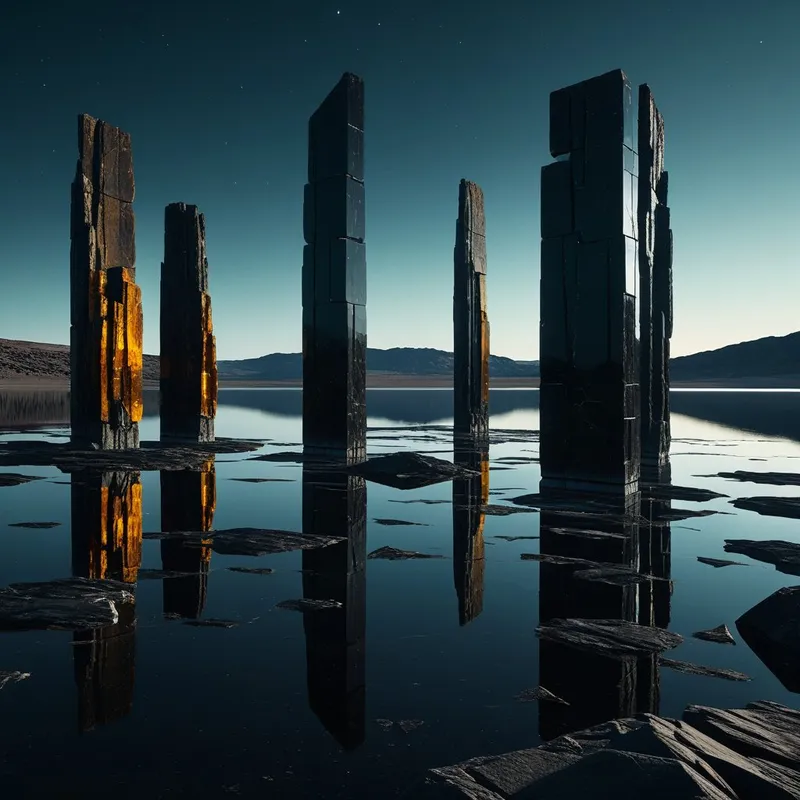
The Dream of Stagnation: The Somatic Pressure of a Psyche in Chrysalis
The Somatic Echo
It begins not as a thought, but as a density. A weight in the chest that feels less like sadness and more like sediment settling in a forgotten aquifer. The breath becomes shallow, a cautious guest in a room that has grown too still. The muscles, especially along the spine and jaw, hold a low-grade hum of tension—not the alert tension of fear, but the weary tension of a structure bearing a load it was never meant to carry indefinitely. Time itself thickens in the body; minutes feel viscous, hours congeal. This is the visceral signature of stagnation: the somatic echo of a life pattern that has crystallized. The psyche is not idle here. It is in a state of profound, silent compression, like carbon under the continental plate, awaiting the impossible heat required to become diamond.
The Dreamer's Log
The dreamer stands in a cavernous, abandoned server farm. Blue lights pulse from endless racks, but the air is dead still. They approach a terminal, its screen a frozen cascade of corrupted data—a beautiful, intricate fractal that will not resolve, will not complete its calculation. Their fingers hover over the keys, but no command is recognized. The system is waiting for an input it has forgotten how to process.
This is the alchemical nigredo, the blackening: the necessary putrefaction of an old operating logic before the new code can be written.

The False Lead
Stagnation is not laziness. Laziness is often a rebellion, a refusal of a demand. Stagnation is an acquiescence to an internal governance that has outlived its purpose. It is not a lack of movement, but movement within a sealed loop—a psychic ouroboros eating its own tail. It is not bad luck or external blockage, though it will project itself as such. The true blockade is architectural, a foundational belief—often one of safety or identity—that has become the very wall of the prison. To mistake this profound structural inertia for simple procrastination is to apply grease to a rusted hinge when the entire gate needs to be dissolved.
Psychological Architecture
Beneath the felt sense of "stuckness" lies a silent civil war within the internal family. One faction, often a Manager part forged in early adaptation, has successfully enforced a ceasefire by freezing the entire system. It believes it is preventing chaos, conflict, or exile. "Do not feel that ambition, it leads to failure." "Do not express that anger, it leads to abandonment." "Do not desire that change, it is not for you." This Manager has barricaded the doors and windows, creating a sterile, timeless peace. But exiled in the basement are the very energies—the fiery Rebel, the curious Explorer, the passionate Creator—whose movement is life itself. Stagnation is the symptom of this successful coup. The Shadow work here is not to storm the barricades, but to diplomatically, compassionately, confront the terrified Manager with a simple, somatic truth: This peace is killing us. The Individuation process is the slow, courageous negotiation to reintegrate the exiles, not as chaotic invaders, but as rightful citizens of a larger, more sovereign psyche.
Mythic Resonance
We see this in the Greek myth of Arachne. The supremely gifted weaver, challenged by the goddess Athena, creates a tapestry of flawless, breathtaking beauty. Yet her fate, for her hubris, is not destruction, but a terrible transformation: she is turned into a spider, condemned to weave perfect, intricate webs forever in the shadows. This is the nightmare of the Creator archetype trapped in stagnation—endlessly reproducing a masterpiece that has become its own cage. Similarly, the Buddhist parable of the Second Arrow speaks to our plight. The first arrow is the pain of the situation—the frozen terminal, the sediment in the chest. The second arrow, the one we shoot ourselves, is the story we tell about it: "I am broken. This is permanent. I should be different." Stagnation is often the compound wound of the initial freeze and the subsequent, relentless self-judgment for being frozen.
Symbolic Nodes
- Frozen or Still Water: Ponds without ripples, ice that never thaws, a bathtub of cold, murky liquid.
- Broken or Unresponsive Technology: Phones with dead batteries, cars that won't start, computers stuck on a loading screen.
- Mazes with No Exit or Circular Paths: Especially familiar ones where the dreamer knows every turn but never reaches the center or the way out.
- Waiting Rooms, Empty Stations, Desks: Places of pure potential transition that have become permanent residences.
- Thick, Impenetrable Substances: Mud, tar, amber, gelatin—matter that holds and preserves, but does not allow flow.
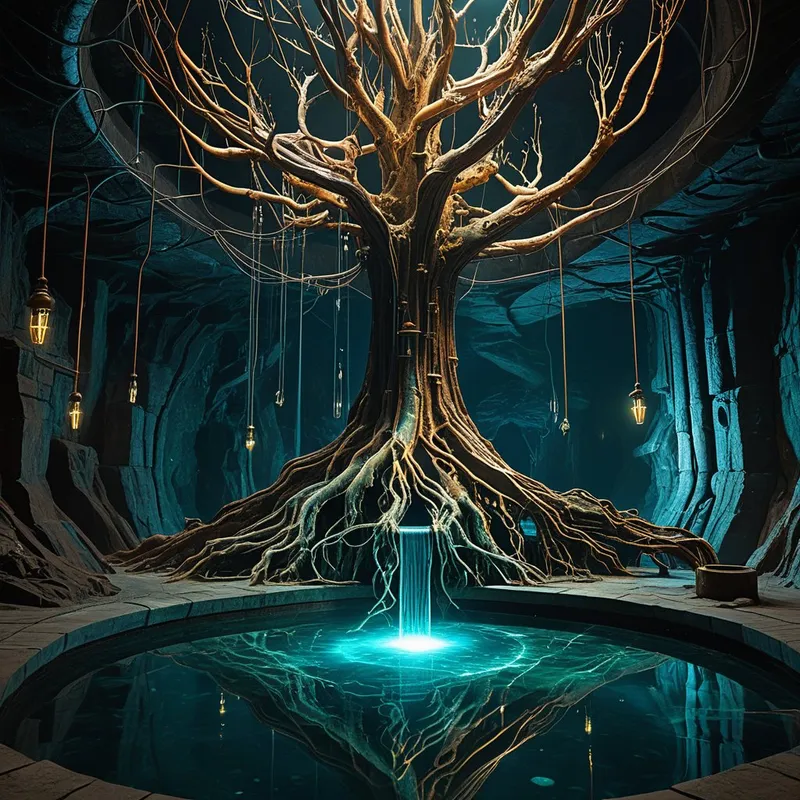
- Wilted or Petrified Plants: Flowers in a vase with stagnant water, trees turned to stone.
Archetypal Resonance
The energy most active in the heart of stagnation is The Shadow Ruler.
This is not the Ruler who creates order for flourishing, but the Shadow Ruler in its role as the Control-Freak and Tyrant. Its core energy is the imposition of a rigid, fear-based order to eliminate all threat of chaos, change, or loss of power. In stagnation, this archetype has seized the internal throne. It governs through the somatic echo—the clenched jaw is its edict, the sediment in the chest its enforced peace. Its "kingdom" is the sealed loop, the sterile server room, where nothing enters or leaves without its permission. The alchemical potential lies in the fact that even a tyrant acts from a twisted desire for stability. The path forward is not anarchy, but a dethronement and reintegration: to transform the fearful Control-Freak into a wise, inner Sovereign who can govern a dynamic, flowing system with confidence rather than terror.
The Alchemical Process
The transmutation of stagnation requires the most counterintuitive of fires: the heat of conscious, embodied acceptance. We instinctively want to fight the freeze, to thrash against the mud. Alchemy asks for the opposite: to sink into it. To feel the full weight of the sediment, the exact texture of the stillness, without the second arrow of judgment. This is the solve—the dissolution. The pressure cooker of psychotherapy, deep reflection, or somatic practice applies this heat. As you fully consent to the feeling of being stuck, a miraculous shift occurs: you are no longer fused with the stuckness. A sliver of space opens between you and the experience. In that space, the old, crystalline structure—the Manager's fear, the Shadow Ruler's decree—begins to soften. From this liquefied state (coagula), a new form can precipitate. Sovereignty is born from this precise sequence: not from breaking the crystal, but from applying the precise heat that allows it to melt and recrystallize under a new, self-authored pattern.
The Integration Protocol
Question 1: Where in my body do I feel the "yes" to my current life pattern, and where do I feel the "no"? Don't think it—sense it. Is the "no" a clench, a hollow, a weight?
Question 2: What ancient, forgotten law is my internal Manager enforcing by keeping things frozen? What catastrophe does it believe it is preventing?
Question 3: If this stagnation were not a block, but a protective cocoon, what is it that is meant to gestate and transform within it?
Action 1 (Somatic Thaw): For five minutes, sit in stillness and focus only on the sensation of your breath entering and leaving your nostrils. Do not change your breath. Do not judge it. Simply be the witness to this one, unstoppable movement that continues even in stagnation. This grounds you in a flow that never ceased.
Action 2 (Unstructured Script): Set a timer for 10 minutes. Write from the perspective of the "stuck" object in your dream (the frozen screen, the still water, the broken car). Let it speak. What is its function? What does it hold? What does it need? Do not edit or analyze. This gives voice to the exiled part.
Action 3 (Ritual of Flow): Take a small, natural object—a stone, a leaf, a twig. Go to a body of moving water (a stream, the sea, even a fountain). Hold the object and imbue it with the feeling of your stagnation. Then, with intention, place it in the water and let it go. Watch it be carried away, or sink, or float. Do not retrieve it. This is an external ritual of surrendering the crystal to the solvent.
Final Validation
The agony of stagnation is real. It is the agony of a soul that has outgrown its form, pressing against the walls of its own becoming. To feel this is not a failure of will, but a testament to the life force within you that refuses to settle for the counterfeit peace of the sealed room. This pressure, this density, this unbearable stillness—it is the gathering dark before the dawn of a new architecture. You are not stuck. You are in chrysalis. And the work now is not to tear at the shell, but to listen, with unbearable tenderness, for the subtle crack that signals you are ready to meet the light in a shape you have never dared to wear.