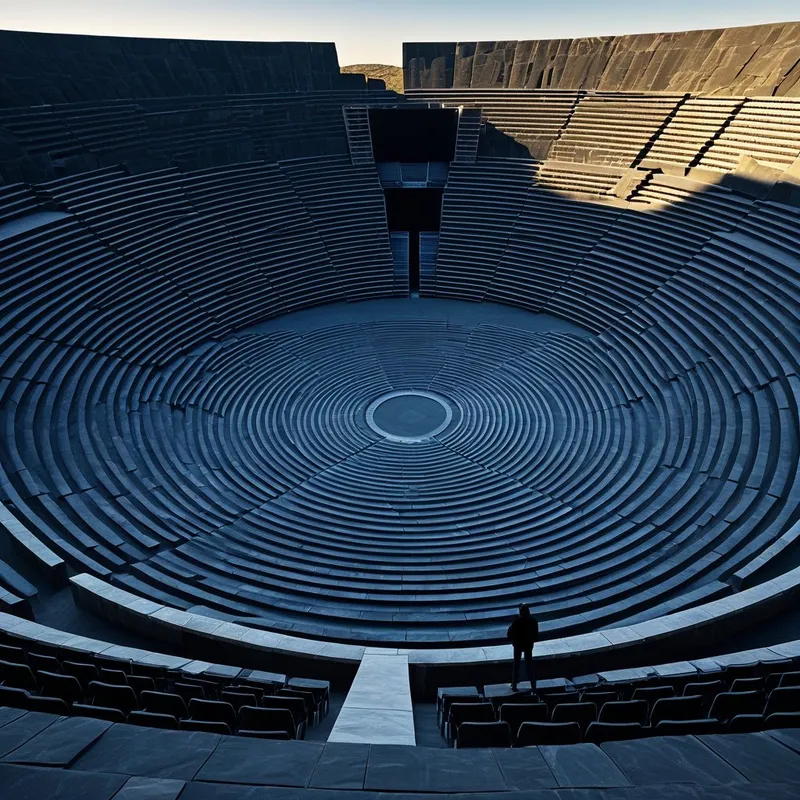
The Inner Council: Alchemy of the Collective in Dreams
The Somatic Echo
Before the images form, the body knows. It is a low-frequency hum in the solar plexus, a subtle pressure in the chest cavity as if the air has thickened. It’s the sensation of being in a crowded room where no one has spoken yet—a chorus of potential, a parliament of the unsaid. Your breath becomes shallow, listening. Your shoulders may tense, anticipating a role to be assigned, a mask to be worn. This is the somatic ground from which dreams of groups, teams, families, and faceless crowds arise. It is the visceral echo of your internal family system—the exiled orphans, the tyrannical rulers, the nurturing caregivers, and the silent sages—all gathering in the chamber of your unconscious, seeking audience.
The Dreamer's Log
You are in a cavernous, forgotten server room, the air cool and humming. Rows of crystalline data cores pulse with soft, colored light. A colleague you barely know hands you a complex, holographic schematic of a family tree, but the roots are tangled in exposed wiring on the floor. "You need to reroute the primary connection," they say, their voice echoing, "or the whole network will fragment."
To be handed the tangled genealogy of your own psyche is the first call to sovereignty—the dream asks you to become the systems administrator of your soul.

The False Lead
This theme is not a simple reflection of your day’s social anxieties or a literal prophecy about your workplace. The dreaming mind is not a mere reporter. A dream of a fracturing team is not necessarily about the team; it is about the internal coalition required to face a challenge. A dream of a harmonious choir is not a prediction of social success, but a glimpse of the possible symphony within. The false lead is to project the dream outward, seeking to fix the external group. The true direction is inward, toward the integration of your own disparate parts. It is the difference between managing a committee and becoming its conscious chairperson.
Psychological Architecture
Beneath the narrative lies the shadow work of belonging and autonomy. Every group in a dream represents a cluster of psychic sub-personalities—what we might call your Inner Council. The domineering boss figure might be your inner Shadow Ruler, enforcing rigid control out of a fear of chaos. The lost child in the crowd could be your Innocent, feeling abandoned by your adult cynicism. The silent, judging audience often embodies the Shadow Sage, holding you to an impossible standard.
The individuation process here is one of diplomatic recognition. You are not dissolving these parts; you are inviting them from the shadowy periphery of the crowd into the lighted circle of conscious awareness. It is the arduous, beautiful work of moving from a democracy of conflicting impulses (where the loudest or most wounded part wins) to a benevolent sovereignty, where each voice is heard, its needs acknowledged, and its energy integrated into a cohesive whole. The grief in these dreams is the grief of self-abandonment. The terror is the terror of true, responsible self-possession.
Mythic Resonance
Consider the Arthurian Round Table. It was not just a piece of furniture, but a sacred geometry designed to dissolve hierarchy. Each knight—the passionate Lancelot, the pure Galahad, the wounded Fisher King—represented a facet of the kingdom’s (and the individual’s) soul. The myth isn’t about the glory of the group, but the perpetual, fragile effort to hold these powerful, conflicting archetypes in a cohesive circle around a central, unifying principle (the Grail, the Sovereign Self). The table is always on the verge of fracture, because the self always is. The work is in the continual realignment.
Symbolic Nodes
- A Committee or Jury: The psyche's internal debate, often highlighting indecision or self-judgment.
- A Sports Team: The coordination (or lack thereof) between your drives, skills, and strategies toward a shared goal.
- A Faceless Crowd: The anonymous pressure of societal expectations, or the unindividuated masses of your own unlived potentials.
- A Choir or Orchestra: The potential for harmony when disparate internal voices align under a shared purpose or vision.
- A Fracturing Alliance: The conflict between core values or sub-personalities within you.
- Being Assigned a Role/Costume: The feeling of being forced to wear a "mask" or persona that does not fit your authentic self.
Archetypal Resonance
The energy most active in the alchemy of group dynamics is that of The Ruler Archetype. Not the shadow tyrant who dominates the inner council, but the sovereign in potentia—the one who must emerge to create order, allocate resources, and establish a realm where all parts of the self can thrive.
The somatic echo of the unintegrated group is the chaos of a kingdom without a king, a body without a governing consciousness. The Ruler’s core energy is not control, but responsible stewardship. Its activation is the alchemical potential: to move from being a passive participant in the internal drama (the orphan in the crowd) to the conscious author of your inner world’s laws and culture. This archetype calls you to build a stable, just, and prosperous inner kingdom from the warring factions and neglected exiles. It demands you take the throne not to subjugate, but to serve the wholeness of your being.
The Alchemical Process
The prima materia here is the raw, chaotic data-stream of your internal group chat—the fears, desires, criticisms, and longings. The alchemical vessel is your conscious attention. The heat and pressure are applied through a simple, profound act: holding the tension of opposites without rushing to a false resolution.
This is the nigredo, the blackening. It feels like sitting in the discomfort of the dream’s committee meeting, allowing the inner critic to voice its fears, the orphan its grief, the rebel its rage, without immediately silencing one to appease another. You apply the heat of non-judgmental observation. As you hold this tension, a separation occurs—the albedo, or whitening. You begin to see each part clearly, in its own right, understanding its original protective function. The transmutation (rubedo, the reddening) is the moment of integration: you realize the critic’s sharpness can be discernment, the orphan’s need can guide you to self-care, the rebel’s fire can fuel authentic action. The fragmented group finds its common purpose in serving the sovereignty of the emerging Self. The leaden feeling of being pulled apart is turned into the gold of cohesive, compassionate self-governance.
The Integration Protocol
Question 1: In the dream group, which figure held the most emotional charge for me? If that figure were a part of me, what is its primary function? (e.g., to protect, to criticize, to desire, to grieve)
Question 2: What is the central, unspoken tension or unresolved decision that the entire dream group is gathered to address? What in my waking life feels like that?
Question 3: If I could appoint a compassionate leader to this inner council, one who listens to all voices before acting, what would their first decree be for the kingdom of my life?
Action 1 (Somatic Mapping): Sit quietly and recall the dream's group. Scan your body. Where do you feel each major "character" or group energy located? Place a gentle hand there. Breathe into that space, acknowledging its presence without trying to change it. This grounds the psychic drama in the physical vessel.
Action 2 (Council Dialogue - Creative Expression): Take a large sheet of paper. Draw a circle. Around it, sketch or write names for the different "members" of your inner council from the dream (e.g., The Worrier, The Pleaser, The Visionary). Let each have a "seat." In the center, draw a symbol for your conscious self. Then, with a different colored pen, let each member "speak" by writing its core concern or desire around its seat. Do not censor. This externalizes the internal parliament.
Action 3 (Ritual of Re-alignment): Find three small stones. Holding the first, state aloud one internal voice that has been dominant or oppressive. Place it down. Holding the second, state a voice that has been silenced or neglected. Place it beside the first. Holding the third, state your intention to listen to both with equal respect, and to find the wise action that honors the truth in each. Place this stone between and slightly above the other two, forming a triangle of acknowledgment. This simple ritual marks the shift from conflict to conscious governance.
Final Validation
To dream of group dynamics is to be confronted with the magnificent, exhausting complexity of being human. It is a sign not of fragmentation, but of a psyche rich enough to contain multitudes, now straining toward a higher order of unity. The chaos you feel is the raw material of your sovereignty. It is difficult because creation always is—the ordering of a world is the task of gods and kings. You are both the chaotic kingdom and the unborn ruler. The dream is your summons to the throne. Take it not as a burden, but as the ultimate creative act: the slow, loving assembly of your own complete and sovereign self.