The Dream of Ecstasy: Dissolving into the Current
The Somatic Echo
It begins not as an idea, but as a tide. A warmth that is not heat, a vibration that is not sound, a pressure that is not weight. It rises from the marrow, a liquid light flooding the conduits of the body, dissolving the familiar map of skin, muscle, and bone. The mind, that diligent cartographer, scrambles to name it—joy, terror, orgasm, panic—but the sensation defies its library. This is the somatic echo of ecstasy: the visceral, pre-verbal experience of the self’s boundaries becoming permeable. It is the feeling of the dam breaking, not from outside pressure, but from an inner ocean remembering its true, boundless volume. The nervous system sings a chord for which there is no name, a frequency that simultaneously shatters and makes whole. You are not having an experience; you are being experienced by a current older than your name.
The Dreamer's Log
She held her cracked phone, its screen a web of black lightning. But through the fractures, a warm, honeyed light pulsed, thick and slow. It pooled in her palm, heavy and sweet, and as it dripped to the floor, the entire room dissolved into a silent, expanding nebula of gold and violet. She was the nebula.
The shattered interface of daily life becomes the aperture for a luminous, essential self to pour forth, transmuting fragmented reality into a unified field of being.

The False Lead
This is not mere euphoria. It is not the cheap currency of a dopamine spike, the transient high of achievement or chemical escape. To mistake the dream of ecstasy for simple pleasure is to confuse the ocean for a wave. Nor is it a spiritual bypass, a fluffy denial of life’s grit. The ecstatic current does not avoid the shadow; it includes it, dissolving the resistance that makes pain feel solid and separate. This theme is the antithesis of control, and thus, the ego will often mislabel its approach as a threat, a system failure, a psychosis. It is not chaos, but a more complex order revealing itself. The terror that sometimes rides its wake is not the message, but the echo of the old structure protesting its own glorious, necessary dissolution.
Psychological Architecture
To understand ecstasy is to engage in the deepest Shadow work: the work of surrendering the central, organizing fiction of the separate self. Our psychological architecture is built upon partitions—the internal family of exiles, managers, and firefighters, each a sub-self with a role, a trauma, a territory. Ecstasy is the experience of the space between these partitions dissolving. It is the “I” that observes the internal system suddenly realizing it is also the room in which the system is housed, and the air that fills it, and the silence that holds it all.
This is the individuation process in its most fiery phase. It is not about adding a new, better part to the committee of the self. It is the alchemical solve: the melting down of the committee itself into its original, undifferentiated substance. The grief here is for the loss of a familiar, if painful, cohesion. The terror is of infinity. But the process reveals that what you truly are is not any single part, nor even the sum of parts, but the boundless awareness in which all parts arise and play. Sovereignty is not achieved by a better-managed kingdom, but by remembering you are the land, the sky, and the law of gravity itself.
Mythic Resonance
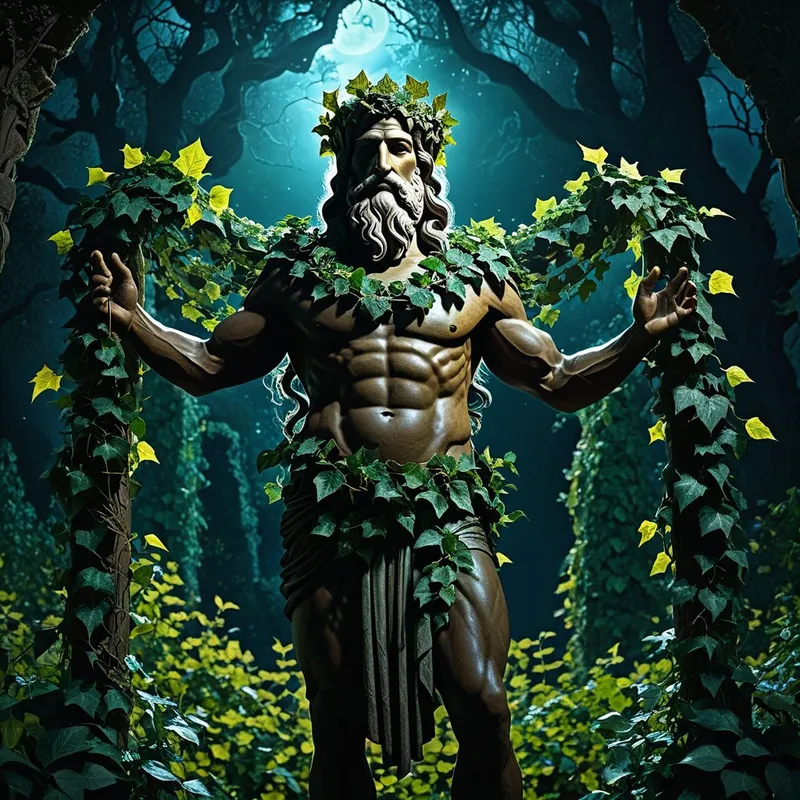
We see this in the story of Dionysus, the god who arrives not as a concept but as a presence—a frenzy, a vine, a tearing apart. His followers, the Maenads, are not merely partying; they are undergoing sparagmos, a ritual rending. This is not random violence, but the mythic enactment of ecstatic dissolution. The rigid, civilized ego (represented by those who resist the god, like Pentheus) is literally torn limb from limb to reveal the raw, divine life force beneath the social persona. The myth tells us that ecstasy is a force of nature that cannot be governed by the rational mind; it must be met, surrendered to, and in that surrender, one is reconstituted at a more fundamental, authentic level. It is creation through de-creation.
Symbolic Nodes
- Uncontainable Light/Liquid: Light that behaves like honey, water, or lava; glowing substances spilling from containers, screens, or the body itself.
- Structural Dissolution: Walls turning to mist, floors becoming water, solid objects melting or transforming into light or energy.
- Cosmic Vistas: Suddenly being in space, inside a nebula, or merged with a star; the perspective shifting from personal to galactic.
- Shattered Interfaces: Cracked mirrors, broken glass, fractured screens—where the break is not an end, but a beginning, a portal.
- Overwhelming Natural Force: Being caught in a silent storm, a wave of warmth, a flood of color, or a vibration that transforms everything it touches.
Archetypal Resonance
The energy of ecstasy resonates most powerfully with The Lover Archetype, specifically in its shadow aspect of dissolution into the All. The Lover’s core drive is for connection, communion, and the transcendence of separation through passion. In its ecstatic expression, this passion is not directed at an external other, but turns inward and outward simultaneously, seeking union with existence itself. The somatic echo—the melting, the flooding warmth—is the Lover’s language, the body’s attempt to consummate its marriage with the cosmos. The alchemical potential here is the ultimate intimacy: to lose the self not in another person, but in the fabric of being, transforming the hunger for connection into the lived reality of non-separation. This is the shadow’s gold—where obsession with union becomes the actual event of merging.
The Alchemical Process
The alchemy of ecstasy is sublimation in its truest sense: the direct transformation of a solid into a vapor, bypassing the liquid state. The psychological “solid” is the crystallized self-concept, the ego’s fortress. The required heat and pressure are generated by a life, or a moment, that makes that fortress unbearable—not through attack, but through a profound, undeniable call from the vastness within its own walls. The process is one of yield. It is not a fight, but a allowing. The grief and terror are the final protests of the structure as it sublimates.
You do not transmute the ecstasy; the ecstatic current transmutes you. It applies the heat of unbearable aliveness and the pressure of infinite connection until the boundaries you thought were “you” undergo a phase shift. They do not break apart into chaos, but become transparent, porous, and ultimately, recognized as illusions. The sovereignty gained is not of control, but of identity with the controlling force. You become the alchemical fire itself, not the thing being burned.

The Integration Protocol
Question 1: In the waking moments after such a dream, where in your body does the echo linger? Can you describe its texture, temperature, and movement without naming it an emotion?
Question 2: What rigid structure in your life—a belief, a role, a daily routine—feels most like a brittle shell that the luminous substance within is pressing against?
Question 3: If the ecstatic state could speak its purpose in one sentence, not to comfort you, but to declare its truth, what would it say?
Action 1 (Somatic Anchoring): For one minute, place your hands where you felt the dream-echo in your body. Do not massage or change it. Simply offer the weight and warmth of your hands as a witness to the sensation, as if holding space for a mysterious, internal weather pattern.
Action 2 (Unstructured Mapping): With non-dominant hand, or with eyes closed, let your hand move across a large paper. Use colors, lines, smudges—not to depict the dream images, but to trace the path of the feeling itself from its point of origin to its point of dissipation. Let the map be abstract, a cartography of the current.
Action 3 (Threshold Ritual): Identify a literal threshold in your home—a doorway, a window sill. For three days, each time you cross it, pause for one full breath. On the inhale, feel the solidity of your form. On the exhale, feel the space around you and within you as part of that same substance. Cross not as a separate body moving through space, but as a localized density in a continuous field.
Final Validation
To encounter this dream is to be invited to a frontier that can feel like an abyss. The mind’s instinct to pathologize or trivialize the encounter is a testament to its shattering significance. It is difficult because it asks for the one thing the constructed self fears most: its own generous, glorious cessation as a separate thing. Yet this dissolution is not an annihilation, but a homecoming to a scale of being so vast it initially feels like nothing. You are not breaking. You are remembering how to flow. The sovereignty that awaits on the other side of that surrender is not a tighter grip on life, but the profound, unshakable peace of knowing yourself as the ocean from which every wave, no matter how turbulent, is born and to which it returns.