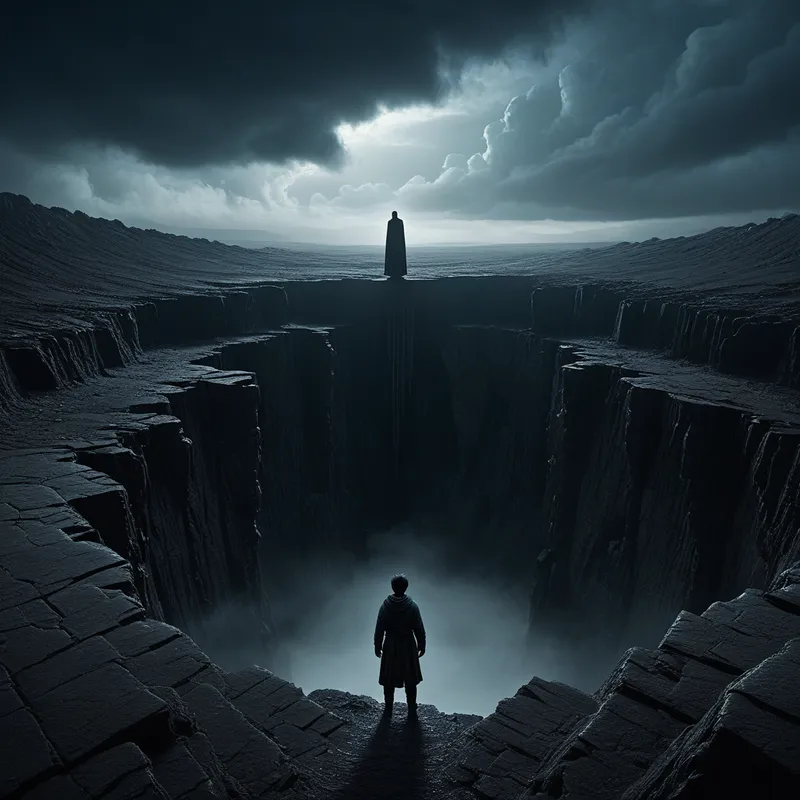
The Alchemy of Despair: When the Dream World Cracks Open
The Somatic Echo
It begins not as a thought, but as a gravity. A cold, dense weight settling in the marrow of your bones, a silent pull that makes your own skeleton feel like an anchor. The breath becomes shallow, a thin currency in a collapsing economy of hope. This is the somatic signature of despair: a profound, cellular resignation. It is the body’s silent agreement with a truth the conscious mind is still scrambling to deny. The world doesn’t end with a bang here, but with a slow, internal leak—a sense of pressure dropping in the inner atmosphere until all light seems to bleed out, leaving only the monochrome hum of futility. You feel it in the slackening of your posture, the way your hands lie inert, as if all the scripts they were meant to enact have been erased.
The Dreamer's Log
I am in a vast, abandoned library. The shelves stretch into darkness, but every book I pull is blank. The pages are pristine, empty. I run my fingers over the smooth paper, feeling a panic that curdles into a bottomless, quiet grief. There is nothing here to read, nothing to learn, no story left to tell.
This dream is not about a lack of knowledge, but the alchemical dissolution of the known. The blank pages represent the terrifying, fertile void that appears when all inherited narratives and personal mythologies have been exhausted.

The False Lead
Despair is not situational sadness, nor is it the transient grief of a loss. It is not "bad luck" or a pessimistic mood. To mistake it for these is to pathologize a sacred process. Despair, in its profound dream form, is the ego’s confrontation with its own existential limits. It is the feeling that arises when the persona—the mask you built to navigate the world—has reached the end of its useful life and is beginning to petrify. It is the death rattle of an outgrown identity, often misinterpreted as the death of the Self. This is the critical distinction: despair signals an ending, not of you, but of a version of you that can no longer contain the truth of your becoming.
Psychological Architecture
When despair visits in a dream, it performs a brutal but necessary function: demolition. The psyche’s internal family system is in revolt. The inner Orphan, who learned to adapt and survive, is terrified because its old strategies of seeking rescue or belonging have failed. The inner Ruler, who maintained order and control, faces a kingdom in ruins, its decrees echoing in empty halls. This collapse of internal governance is the Shadow work of despair. It forces every sub-personality, every “part” of you that managed a fraction of your life, to lay down its tools and confess its insufficiency.
This is the Individuation process in its most harrowing phase. The conscious ego, which believed itself to be the captain of the ship, is brought to the rail and shown the abyssal depth of the unconscious. It is a humbling so total it feels like annihilation. The architecture of your assumed self—the walls of ambition, the floors of relationship, the windows of perception—is revealed to be built on a foundation that cannot hold the weight of your soul’s true calling. Despair is the quiet, cataclysmic tremor that brings it all down, not out of malice, but to make space for a structure built on bedrock, not borrowed belief.
Mythic Resonance
We see this in the Norse myth of the god Odin, who hangs himself on the World Tree, Yggdrasil, pierced by his own spear, for nine nights. He gives his own eye to drink from the Well of Wisdom. This is not a tale of martyrdom, but of alchemical despair. Odin voluntarily enters a state of total suspension—between life and death, knowing and unknowing—to gain a deeper sight. The price is everything he was. The old, sovereign Odin must die in that hanging to be reborn as the god of poetry, magic, and hidden runes. His despair is the crucible. Similarly, the Buddhist concept of dukkha, often translated as suffering, points to the inherent unsatisfactoriness of a life built on transient, egoic attachments. The realization of dukkha is not a pessimistic end, but the necessary, despair-inducing first step on the Noble Eightfold Path toward liberation. It is the shattering of the illusion that the current configuration of self can lead to peace.
Symbolic Nodes
- Endless, Empty Corridors or Staircases: The futile search for an exit or a higher level within a collapsed system.
- Frozen or Barren Landscapes: Emotional and creative life force in stasis, a winter of the soul.
- Broken or Useless Tools/Instruments: The failure of known skills and methods to effect change.
- Muffled or Absent Sound: A profound disconnect from intuition, guidance, or inner voice.
- Sinking or Being Buried in Dry Earth: The feeling of being crushed by the weight of one’s own existential reality, suffocated by meaninglessness.
- Windows That Look Out Onto a Blank Wall or Void: The perception that there is no future, no horizon, no point of reference.
Archetypal Resonance
The Shadow Ruler is the archetype most active in the heart of despair. This is not the Sovereign who creates order from wisdom, but the Tyrant whose kingdom is failing. Its core energy is absolute control meeting absolute powerlessness. The somatic echo—the heavy, frozen inertia—is the body of a deposed king locked in his own empty throne room. The alchemical potential here is immense: the Shadow Ruler must be dethroned. Its desperate, rigid grip on a reality that is dissolving is the source of the torture. The transformation occurs when this inner tyrant exhausts itself, when the fight to control the uncontrollable finally ceases. In that surrender, the true, authentic sovereignty of the Ruler can begin to emerge—not from dominating one’s world, but from a profound, humble alignment with what is.
The Alchemical Process
The transmutation of despair is not an act of positive thinking. It is an operation of solutio and coagulatio—dissolution and re-coagulation. The intense psychological heat and pressure are generated by one simple, unbearable mandate: to stay present in the feeling without seeking an escape. This is the fire. You must let the cold weight settle. You must allow the internal family system to fall apart without rushing to reassemble it in the old image. You must witness the Shadow Ruler’s tantrum of control until it runs out of energy and weeps.
In this liminal, liquefied state—where you are no longer who you were, and not yet who you will be—the alchemy happens. The grief and terror of despair, when fully felt and not resisted, begin to break down their own chemical structure. The heavy lead of hopelessness separates. The dross—the attachments to specific outcomes, the need for a certain story, the identification with a particular role—falls away. What remains in the bottom of the crucible is a pure, dense grain of truth: the indestructible, non-negotiable core of the Self that exists beyond all narratives. This grain is the philosopher’s stone of this process. It is the seed of a new sovereignty, born not from ambition, but from the humble, unshakable fact of your own existence, stripped bare.

The Integration Protocol
Question 1: If the feeling of despair in my dream had a physical shape and location in my body, what would it be? Describe its texture, temperature, and weight without using emotional labels.
Question 2: What old story, role, or expectation of myself is this despair forcing me to finally, completely, give up on?
Question 3: If this emptiness is not an end, but a cleared space, what is one tiny, true thing—not a goal, but a quality (like curiosity, stillness, or honesty)—that could exist in this space now?
Action 1 (Grounding in the Echo): For five minutes, sit quietly and physically mimic the posture of your dream-despair. Let your body be heavy, your gaze unfocused. Do not try to change it. Simply breathe into the shape of the feeling, acknowledging its physical reality without following its mental story.
Action 2 (Creative Cartography of the Void): Take a large piece of paper and draw, paint, or collage the landscape of your despair from the dream. Focus on the environment, the textures, the light (or lack thereof). Do not draw figures. The task is to externalize and objectify the "where" of the feeling, making it a territory you can observe, not just a state you are lost inside.
Action 3 (Ritual of the Hollow Vessel): Find a small, natural object—a stone, a twig, a seed. Hold it and consciously project into it all the brittle, controlling energy of the inner Shadow Ruler—the need to fix, to know, to force an outcome. Then, go to a body of water (a sink, a tub, a river) and place the object in the water. Let it float, sink, or be carried away. The water represents the solutio—the dissolving, accepting, flowing state that the psyche is asking you to trust.
Final Validation
To feel this in a dream is to touch the deepest strata of the human experience. It is terrifying because it is real. It is the psyche doing the hardest work on your behalf, dismantling a prison you may have mistaken for a palace. Honor the difficulty. You are not broken for encountering this void; you are brave for existing at its edge. The despair is not the truth of you. It is the fierce, loving, and ruthless process that burns away everything that is not you, until all that remains is the unadorned, sovereign, and utterly authentic Self, standing in the clear, cold dawn of its own making.