The Slough of Despond Myth Meaning & Symbolism
A pilgrim's soul sinks into a bog of its own sorrows, a mythic ordeal where despair must be faced and transcended to continue the sacred journey.
The Tale of The Slough of Despond
Hear now the tale of the wayfarer and the mire, a story not of old gods on high mountains, but of the spirit in the valley of shadows.
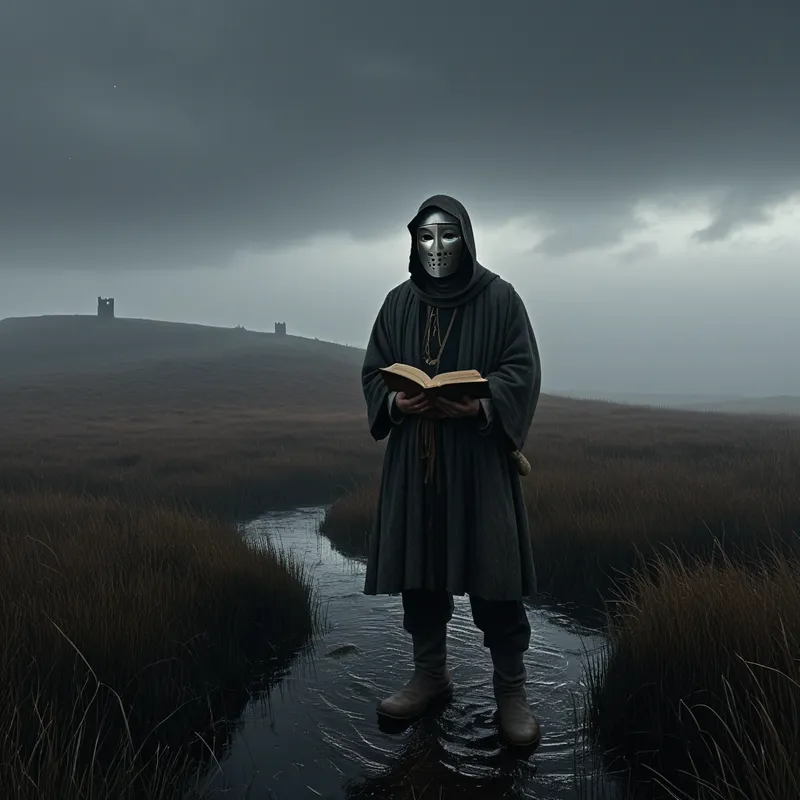
There was a man, a pilgrim, who bore a terrible weight upon his back—a burden of knowing, of sin perceived, of a world’s scorn made flesh in his own soul. He had read a Book, a shining, fearful Book, and it had lit a fire in him that burned away all comfort. It spoke of a Celestial City, a place of rest beyond the sun, and he knew he must find it or perish in the trying.
His journey began not on a road, but at a crumbling wall. Behind him lay the City of Destruction, smoking with its own false comforts. Before him, through a narrow wicket-gate, lay a path. But between the wall and the path, spread a wide, dismal fen, a place forgotten by the sun. This was the Slough of Despond.
It was not water, nor was it earth, but a foul, sucking quagmire born from the endless seepage of a million fears, the guilty sighs of generations, and the scum of vain, broken hopes. The air above it hung thick with the miasma of despair. The pilgrim, driven by his urgent need, stepped forward. For a few paces, the ground held. Then, with a sickening, greedy sigh, it gave way.
The mire took him. It was cold, a chill that stole into the marrow. It was heavy, clinging to his legs like the hands of drowned men pulling him down. The burden on his back seemed to double in weight, pressing him deeper. He flailed, but every struggle only worked him further into the clinging filth. He cried out, but the thick air swallowed his voice. Here was the heart of it: a place where movement was impossible, where hope drowned in the mud of one’s own making. He saw the wicket-gate, clear and bright, but it seemed a thousand leagues away across an impassable sea of black despair.
He sank, until the foul waters lapped at his chest, and the weight promised to drag him under forever. In that moment, poised on the brink of silent dissolution, a figure appeared at the solid edge of the bog. It was a man named Help, drawn by the pilgrim’s stifled cries. “But why did you not look for the steps?” Help asked, his voice cutting through the fog.
“Steps?” gasped the pilgrim, through lips caked with grime.
“There are,” said Help, “good and substantial steps, placed through the midst of this slough by the decree of the Lord of the Hill. But the filth of this place and the mists that rise from it hide them from men’s eyes.” And with that, Help reached out a strong arm. The pilgrim grasped it, and with a mighty heave, was drawn out of the clinging deep and set upon solid ground, trembling but free, his burden still upon his back, but the slough now behind him.

Cultural Origins & Context
This tale is not drawn from the canonical scriptures of the Old or New Testaments, but from the rich soil of Pilgrim's Progress, published by John Bunyan in 1678. Bunyan, a Puritan preacher who wrote much of his great work while imprisoned for unlicensed preaching, crafted an allegory that became a second Bible for generations of English-speaking Protestants. The Slough of Despond is one of its most enduring and visceral images.
The myth was passed down not around ancient campfires, but from pulpits, in family readings, and through the immense popularity of Bunyan’s book. Its societal function was multifaceted: it was a tool of theological instruction, a map of the Puritan spiritual journey from conviction of sin to salvation, and a profound comfort. It told every believer that the terrifying, isolating experience of despair and spiritual doubt was not a unique failure, but a documented stage on the path. It normalized the struggle, giving a name—The Slough—to the formless terror of the soul’s dark night. In a culture deeply concerned with individual salvation and the state of one’s soul, this myth provided both a warning and a promise: the bog awaits, but so does the helping hand.
Symbolic Architecture
The Slough is not a place one finds on a map, but a state one finds in the soul. It is the psychological and spiritual crisis point where intellectual understanding crashes into emotional and existential reality.
The Slough of Despond is the soul’s first true encounter with its own shadow, the moment theory becomes trench warfare in the psyche.
The Burden the pilgrim carries is the conscious awareness of one’s own fragmentation, failings, and separation—what the tradition calls sin, but what psychology might term the integrated awareness of the ego’s limitations and the pain of the personal and collective unconscious. The Slough itself is the swamp that forms when the waters of conviction (the realization of this burden) meet the low ground of the ego’s defensiveness and fear. It is the depression, anxiety, and paralysis that follows a genuine awakening; the “why try?” that negates the “I must.”
The figure of Help is crucial. He does not remove the Burden. He does not drain the Slough. He provides the critical, external leverage—grace, community, a wise word, a sudden insight—that allows the individual to find the hidden Steps (the enduring principles or truths obscured by emotion) and escape the cycle of futile struggle. The myth asserts that the way through despair is not solely by one’s own power, but through reaching out and accepting aid, often from an unexpected source.

The Dreamer's Resonance
When this myth stirs in the modern unconscious, it rarely appears as a pilgrim in a bog. Its pattern manifests in dreams of profound stuckness and visceral dread. The dreamer may be trapped in a car that sinks into a tar pit on a familiar street. They may be in their own home, but the floor has become a thick, sucking mud. They are trying to run from a threat, but their legs move with impossible slowness, as if wading through cement.
The somatic experience is one of crushing weight, constriction, and helpless frustration. Psychologically, this dream pattern signals that the dreamer is in a genuine Slough in their waking life. It could be a depressive episode, a career paralysis, the stagnation of a relationship, or the aftermath of a trauma. The dream is not causing the stuckness; it is giving it its true, mythic form. It is the psyche’s way of saying, “You are not just ‘in a rut.’ You are in the Slough. This is an archetypal ordeal.” The feeling of being weighed down by an invisible burden is a direct resonance with the pilgrim’s pack. The dream asks the crucial question posed by Help: “Where are the steps?” It pushes the dreamer to look for the hidden support, the solid truth, or the necessary help they have been unable to see through the “mists” of their distress.

Alchemical Translation
In the alchemy of individuation—the process of becoming a whole, integrated Self—the Slough of Despond represents the essential stage of nigredo: the blackening, the putrefaction, the descent into the primal murk. It is the necessary dissolution of the old, naive ego-structure that believed the journey would be simple.
One cannot bypass the swamp to reach the mountain. The soul must be humbled in the mud of its own illusions before it can be cleansed and strengthened for the ascent.
The pilgrim’s initial, headlong rush into the mire is the ego, armed with conscious knowledge but devoid of wisdom, attempting to force its way through an unconscious process. It fails spectacularly. The saving grace is the intervention of Help, which in psychological terms, represents the first conscious relationship with a guiding aspect of the psyche beyond the ego—the Senex (the wise old man) or perhaps the transcendent function beginning to stir. This help does not do the work for the individual, but enables the individual to do the work themselves.
The “good and substantial steps” are the core, enduring patterns of the Self—the archetypal truths—that exist even in the midst of chaos. Finding them requires stopping the frantic, ego-led struggle and accepting guidance. Emerging from the Slough, the pilgrim is not the same man who entered it. He is wet, filthy, and shaken, but he has undergone his first great death and rebirth. The Burden remains, but he now knows its true weight and has had his first experience of deliverance. He has learned that the path to wholeness is not a sprint on a dry road, but a arduous trek through landscapes that will test the very fabric of his being, beginning with the terrifying, fertile, and utterly necessary Slough of Despond.
Associated Symbols
Explore related symbols from the CaleaDream lexicon: