
The Somatic Echo: The Body That Dreams Itself
Before the image forms, there is a feeling. It is not a thought of being too large or too small, but a deep, cellular dissonance. A sense that the container you inhabit is not calibrated to the frequency of the inhabitant. It might feel like a suit of armor three sizes off, its plates grinding with every breath. Or like being a ghost, your essence spilling through porous, undefined boundaries. This is the somatic echo—the body’s pre-verbal report on the state of the soul’s housing. It is the visceral truth that the relationship between your consciousness and its physical vessel is undergoing a profound, often terrifying, negotiation. The dream is where this negotiation becomes visible.
The Dreamer's Log: The Mirror of Nebulae
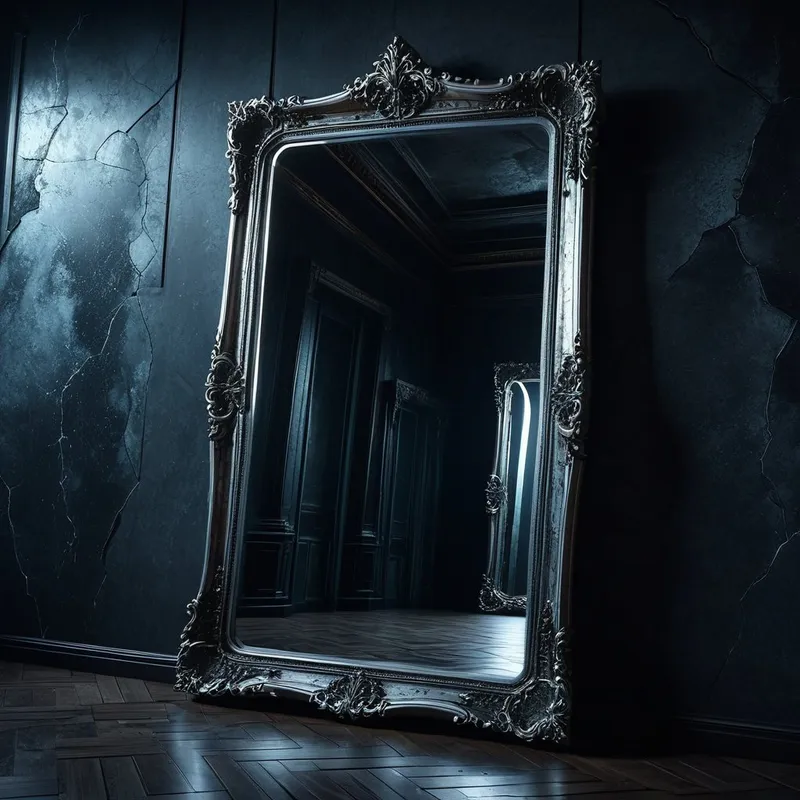
She stands before her bedroom mirror, but the reflection is not her own. It is a swirling cosmos—a nebula of stardust and dark matter held in the rough outline of a human form. She reaches out to touch the glass, and her hand passes through, feeling only a cold, electric void.
This dream is not a nightmare about appearance, but a direct vision of the Self in its unintegrated, primordial state—a call to recognize the vast, creative chaos within before forcing it into a fixed, familiar shape.
The False Lead: It Is Not About Vanity
To interpret a body image dream as a simple anxiety about weight, age, or societal beauty standards is to mistake the symphony for a single, sour note. The dream is not commenting on the body’s aesthetics, but on its psychic integrity. A dream of a crumbling limb is not about fitness; it’s about a loss of support or function in waking life. A dream of an expanding body is rarely about food; it’s about uncontained emotion, unexpressed presence, or a boundary so porous it cannot hold the core self. These are dreams of structural psychology, not superficial critique. They point to where the architecture of the personality is under renovation, or where its foundations have cracked.
Psychological Architecture: The Shadow in the Flesh
When the body appears strange in a dream, you are meeting what depth psychology calls the shadow—but not as an abstract concept. You are meeting it as lived, somatic reality. This is the part of you that has been disowned, exiled, or deemed unacceptable, and it has taken up residence in the very image of your form. That grotesque feature, that missing piece, that terrifying transformation? That is a piece of your wholeness, screaming for recognition from the dungeon of your unconscious.
The individuation process here is a brutal and beautiful homecoming. It demands you stop looking at the body and start listening from it. The distorted dream-body is not an error to be corrected, but a truth to be embodied. It is the psyche’s attempt to make the invisible conflict visible, to give tangible form to the internal exile. To integrate this shadow is not to "fix" the dream-image, but to allow its message to alter your conscious stance—to reclaim the power in the exaggerated feature, the autonomy in the shrunken form, the sacredness in the perceived flaw.
Mythic Resonance: The Sculptor and the Clay
We see this eternal process in the myth of Pygmalion, but with a crucial, often-missed inversion. Pygmalion sculpts his ideal woman from ivory, and the gods grant her life. We focus on the miracle of Galatea’s animation, but the deeper alchemy is in Pygmalion’s surrender. He must release his static, perfect creation to the messy, unpredictable reality of a living being. The dream of the distorted body is our Galatea moment—the universe animating a form that does not match our idealized blueprint, demanding we love the living reality, not the sterile fantasy.
Similarly, the Norse myth of the god Odin speaks volumes. To drink from the Well of Wisdom, he must sacrifice an eye. The price of profound, internal knowing is an accepted, permanent alteration to the perceived self—a willing distortion that grants deeper sight.
Symbolic Nodes: Common Dream Images
- Distorted/Missing Reflections: The psyche refusing to show you the familiar mask, forcing a confrontation with the unknown self.
- Malleable/Fluid Bodies: Signals a state of high psychic plasticity, where identity is not fixed but in a state of becoming.
- Exaggerated or Shrinking Body Parts: Points to an imbalance in the function that part symbolizes (e.g., giant hands = issues with grasp/control/work; tiny feet = unstable foundations).
- Transparent or Hollow Bodies: Indicates a feeling of being unseen for one’s true substance, or a fear of having no core, solid self.
- Body Covered in Symbols or Text: The unconscious is literally "writing on the wall" of your self-concept, inscribing messages directly onto your somatic experience.
Archetypal Resonance: The Sovereign Vessel
The core energy at play in the body image dream is that of The Ruler Archetype. This is not about ruling others, but about the ultimate responsibility: sovereignty over the inner kingdom of the self. The distorted body is the report from a realm in chaos or rebellion, where the sovereign’s authority—the ego’s ability to integrate and govern the totality of the psyche—has broken down. The somatic echo is the feeling of a kingdom in disarray. The alchemical potential lies in moving from the Shadow Ruler—the tyrannical inner critic that seeks to control, punish, and exile "unacceptable" parts—to the true Ruler. The true Ruler does not dominate the body’s landscape but listens to its provinces, makes treaties with its shadows, and administers with the goal of harmonious, integrated function for the entire realm.
The Alchemical Process: Transmuting Shame into Form
The alchemy here is one of re-embodiment. The base material is often shame or alienation—the leaden feeling of being wrong in one’s own skin. The heat and pressure required are generated by a radical, counter-instinctual act: turning toward the distortion with curiosity instead of away with horror. This is the nigredo, the blackening—the dissolution of the old, idealized self-image.
The process involves holding the terrifying dream image in conscious awareness without fleeing into analysis or denial. As you do, the grief of exile and the terror of fragmentation surface. This is the fire. If you stay present, the image itself begins to shift, not because you force it, but because your relationship to it changes. The grotesque reveals its function; the missing piece reveals what it protected. This is the albedo, the whitening—the insight that the distortion was a protector, a messenger, or a disowned power. The new form that emerges (rubedo, the reddening) is not a "perfect" body, but a true one: a somatic experience of wholeness that includes all that was once rejected. You are no longer a tenant in a faulty vessel, but the conscious architect of your own flesh.

The Integration Protocol
Question 1: If the distorted part of your dream-body could speak, what one-sentence truth is it trying to deliver to the part of you that feels shame?
Question 2: What function does this "flaw" or distortion serve? How might it have protected you, or what power might it be holding in exile?
Question 3: If you were to welcome this dream-image as a permanent, valued part of your internal council, what role would it play? (The Guardian? The Truth-Teller? The Liberator?)
Action 1 (Somatic Re-Mapping): In a quiet space, close your eyes and recall the dream-body sensation. Instead of visualizing it, feel where that dissonance or distortion lives in your actual body now. Place a hand there. Breathe into that space for five minutes with no goal other than acknowledging its presence without judgment.
Action 2 (Unstructured Clay Work): Without planning, use modeling clay or dough. Let your hands shape the feeling of the dream-body, not its literal image. Allow the form to be abstract, grotesque, broken. Do not sculpt a "fix." When finished, sit with this physical manifestation of the inner image. What do you notice?
Action 3 (Ritual of Embodied Declaration): Stand before a mirror (or simply feel your own presence). Speak aloud, directly to your reflection or your felt sense: "This form is my current territory. I am the sovereign here. I listen to its reports." Do this daily for a week, noting any shifts in the feeling of somatic echo.
Final Validation
This work is not for the faint of heart. To confront the image in the glass and see not a familiar face, but the swirling, chaotic truth of your own becoming, is one of the most disorienting journeys the psyche can undertake. It requires the courage to deconstruct the very map by which you have navigated your selfhood. Yet, this is the precise point of transmutation. Your body, in its dream-language, is not criticizing its shape; it is demanding a more honest, more complete, and more sovereign occupant. It is calling you home—not to a prettier house, but to one whose doors are open to every room, whose foundations are laid upon the bedrock of all that you are, and whose architecture finally, mercifully, fits the magnificent and strange spirit it was built to hold.