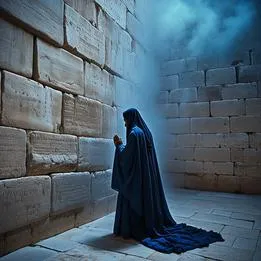
Western Wall Dream Meaning
A sacred remnant of the Second Temple in Jerusalem, representing divine connection, historical continuity, and collective Jewish longing.
Common Appearances & Contexts
| Context | Emotion | Interpretation |
|---|---|---|
| Touching the stones | awe | Seeking tangible, physical connection to the sacred or to history. |
| Placing a note in a crack | hope | Entrusting a deep wish or prayer to a higher power. |
| Praying at the wall | devotion | Engaging in deep, focused spiritual communication. |
| The wall is crumbling | despair | Fear that foundational beliefs or support systems are failing. |
| The wall is impossibly large | overwhelm | Feeling dwarfed by history, tradition, or spiritual obligation. |
| Being barred from the wall | frustration | Feeling excluded from spiritual community or ancestral connection. |
| Finding a personal item in the wall | surprise | Discovering a lost part of your identity or heritage. |
| The wall is the only structure standing | solace | Finding the one thing that remains stable amidst chaos. |
| Cleaning or repairing the wall | duty | Feeling responsible for maintaining tradition or spiritual practice. |
| A crowd is praying, but you are silent | isolation | Feeling disconnected from collective faith or shared grief. |
| The wall emits a warm light | comfort | Experiencing divine presence or acceptance of prayers. |
| The wall is behind a barrier | yearning | Longing for a connection that feels just out of reach. |
Interpretive Themes
Connection to the Divine
highThe wall is a physical conduit for prayers.
Historical Continuity & Legacy
highRepresents unbroken tradition and survival.
Collective Longing & Mourning
mediumSite of lamentation for the destroyed Temple.
Foundation & Support
mediumThe last standing support of a sacred structure.
Petition & Hope
lowNotes placed in cracks symbolize hopes entrusted.
Cultural Lenses
Jungian Perspective
View Context →Symbolizes the Self or the psychical foundation of the personality; the remaining, indestructible core of the psyche that connects the individual to the collective unconscious and archetypal history.
Freudian Perspective
View Context →May represent the superego or the father figure; a rigid, imposing structure of law, tradition, and prohibition that one both venerates and feels repressed by, often linked to paternal authority.
Gestalt Perspective
View Context →The wall is an aspect of the self. What part of you is this enduring, foundational remnant? It may represent a firm belief, a grief held onto, or a part of your identity you present to the world.
Cognitive Perspective
View Context →Represents a core schema or deeply held belief system ('foundational wall'). Dreaming of it may indicate cognitive processing related to identity, tradition, or seeking support for one's worldview.
Evolutionary Perspective
View Context →Could tap into adaptive mechanisms for social cohesion and group identity. The wall symbolizes a safe, defensible ingroup boundary and a ritual site that strengthens tribal bonds and shared memory.
Middle Eastern Perspective
View Context →Primarily a Jewish symbol of divine covenant and national mourning for the Temple's destruction. For Muslims, it is the Wall of al-Buraq, where Prophet Muhammad tethered his steed, making it sacred in Islam as well.
Modern Western Perspective
View Context →Often seen as a powerful tourist destination and symbol of enduring faith. It can represent the search for authenticity, a connection to ancient roots, or the complexities of holy sites in geopolitics.
European Perspective
View Context →May evoke imagery of ancient ruins, historical permanence, and the 'Wailing Wall' as a symbol of profound, collective lamentation. Can parallel concepts of national monuments or sites of memory.
Global/Universal Perspective
View Context →A universal archetype of a sacred remnant—the last piece of a lost wholeness. It speaks to the human need for a tangible connection to the divine, to history, and to communal grief and hope.
North American Perspective
View Context →Might be interpreted through lenses of pilgrimage, heritage tourism, or symbolic solidarity. Can represent a longing for deep historical roots or a monument to resilience and survival.
African Perspective
View Context →Could parallel concepts of ancestral shrines or sacred groves—places where the community connects with the spiritual realm and the wisdom of ancestors through ritual and prayer at a specific, hallowed location.
East Asian Perspective
View Context →May be viewed analogously to a revered ancestral tablet or temple wall where prayers are offered. Emphasizes continuity with ancestors, fulfilling ritual duty, and the weight of historical legacy.
Interpret Your Full Dream
Beyond this symbol, every dream carries a unique story. Share your dream for a personalized AI-powered interpretation.