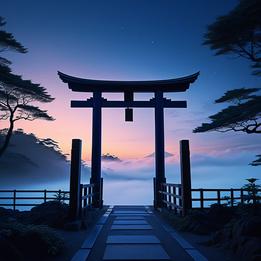
Torii Gate
A traditional Japanese gate marking the transition from the mundane to the sacred, symbolizing passage into a spiritual realm.
Torii Gate Dream Meaning
A traditional Japanese gate marking the transition from the mundane to the sacred, symbolizing passage into a spiritual realm.
Interpretive Themes
Mythological Resonance
Izanagi and Izanami
JapaneseThe primordial couple who stood on the Floating Bridge of Heaven and stirred the ocean with a spear to create the Japanese islands, representing the first threshold between chaos and creation.
The Veil
CelticThe thin boundary between mortal world and Otherworld that thins during Samhain, allowing passage between realms, similar to Torii's function as a spiritual gateway.
Cultural Lenses
Jungian Perspective
View Context →Archetype of the threshold between conscious and unconscious realms. Represents individuation process, with red color symbolizing life force and psychological transformation.
Freudian Perspective
View Context →Phallic symbol representing sexual energy and desire. The passage through suggests sexual initiation or repression, with gate symbolism relating to birth trauma.
Gestalt Perspective
View Context →Represents the boundary between self and environment. The dreamer's relationship to the gate reveals attitudes toward transitions and personal growth opportunities.
Cognitive Perspective
View Context →Mental schema for transition and change. The brain processes this as a marker for significant life events, helping organize memories of important passages.
Evolutionary Perspective
View Context →Ancient boundary marker triggering territorial instincts. Red color activates primal alertness, while threshold concept relates to safe passage rituals in human evolution.
East Asian Perspective
View Context →Shinto symbol marking entrance to kami (spirit) dwellings. Historically used since 10th century, representing purification before worship and connection between human and divine realms.
Modern Western Perspective
View Context →Exotic spiritual symbol representing Eastern wisdom. Often divorced from religious context, seen as aesthetic element representing mindfulness and cultural appreciation.
Global/Universal Perspective
View Context →Universal threshold archetype found in many cultures as portal between worlds. Represents human need for ritual passages marking life transitions and spiritual boundaries.
European Perspective
View Context →Similar to church portals or triumphal arches. Medieval cathedral entrances served similar transitional functions, marking passage from secular to sacred space.
South Asian Perspective
View Context →Comparable to Hindu temple gopurams or Buddhist toranas. These gateways mark sacred boundaries and represent passage from material to spiritual consciousness.
Middle Eastern Perspective
View Context →Echoes ancient city gates and temple entrances. In Islamic architecture, elaborate portals (pishtaq) mark transitions into sacred spaces for prayer and reflection.
Oceanian Perspective
View Context →Similar to Maori waharoa (gateway) or Polynesian ceremonial entrances. These mark sacred spaces (tapu) and transitions between ordinary and spiritual realms.
Historical Authorities
Want a deeper analysis?
Get a personalized interpretation of your entire dream including this symbol.
Interpret My DreamThe Oracle's Prediction
Combine multiple symbolsYou will experience a significant spiritual awakening or insight.
Timeframe
Lunation (~29 Days)
Intensity
Deep
A new connection will form that bridges different aspects of your life.
Timeframe
Seasonal (~3 Months)
Intensity
Deep
Common Appearances & Contexts
| Context | Emotion | Interpretation |
|---|---|---|
| Context Passing through a torii gate | Emotion Reverence | Interpretation Entering a new spiritual phase with respect. |
| Context Seeing a torii from afar | Emotion Longing | Interpretation Yearning for spiritual connection or guidance. |
| Context Multiple torii gates in a row | Emotion Determination | Interpretation Progressive spiritual journey requiring persistence. |
| Context A damaged or fallen torii | Emotion Anxiety | Interpretation Spiritual barriers or disrupted connections. |
| Context Building a torii gate | Emotion Purposefulness | Interpretation Actively creating spiritual pathways. |
| Context Torii gate at a crossroads | Emotion Uncertainty | Interpretation Spiritual decision point requiring choice. |
| Context Torii gate in water | Emotion Serenity | Interpretation Emotional purification and spiritual flow. |
| Context Torii gate at sunset | Emotion Contemplation | Interpretation Ending one phase, preparing for spiritual renewal. |
| Context Unable to pass through torii | Emotion Frustration | Interpretation Spiritual blocks or unreadiness for transition. |
| Context Torii gate glowing | Emotion Awe | Interpretation Divine presence or spiritual enlightenment. |
| Context Torii gate in urban setting | Emotion Nostalgia | Interpretation Seeking spirituality in modern life. |
| Context Passing back through torii | Emotion Relief | Interpretation Returning from spiritual journey transformed. |
Interpret Your Full Dream
Beyond this symbol, every dream carries a unique story. Share your dream for a personalized AI-powered interpretation.