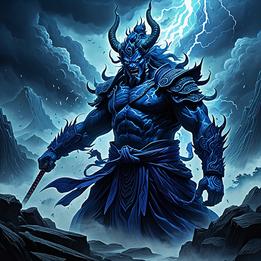
Susanoo Storm
A Japanese Shinto storm god representing chaotic destruction, purification, and creative renewal through violent natural forces.
Susanoo Storm Dream Meaning
A Japanese Shinto storm god representing chaotic destruction, purification, and creative renewal through violent natural forces.
Interpretive Themes
Mythological Resonance
Typhon
GreekPrimordial storm giant whose chaotic power challenged the Olympian order, representing nature's untamable fury.
Thor
NorseGod of thunder whose hammer Mjölnir brings both destructive storms and protective, purifying power.
Cultural Lenses
Jungian Perspective
View Context →Shadow archetype manifesting as chaotic, destructive unconscious forces that must be integrated. Represents the necessary turmoil of individuation, where psychic storms precede self-realization and wholeness.
Freudian Perspective
View Context →Sublimated aggressive or sexual impulses breaking through repression. The storm symbolizes id forces overwhelming ego defenses, often related to paternal authority conflicts or unexpressed rage.
Gestalt Perspective
View Context →Projection of internal conflict onto external storm imagery. The dreamer IS the storm - all elements represent disowned aspects of self needing acknowledgment for psychological integration.
Cognitive Perspective
View Context →Brain processing overwhelming stimuli or emotional regulation failure. The storm metaphor helps organize chaotic experiences into manageable narrative, aiding threat assessment and problem-solving.
Evolutionary Perspective
View Context →Ancient threat-detection system activating for survival. Storm imagery triggers primal fear responses hardwired from ancestors facing natural disasters, preparing mind for danger.
East Asian Perspective
View Context →Susanoo-no-Mikoto, Shinto god of sea and storms who slays Yamata-no-Orochi. Historically worshipped for protection, now symbolizes necessary destruction in martial arts and pop culture as chaotic hero.
Global/Universal Perspective
View Context →Cross-cultural storm deity archetype representing nature's uncontrollable power. From Zeus to Indra, storms symbolize divine intervention, purification rituals, and humanity's vulnerability to cosmic forces.
European Perspective
View Context →Thor's thunderstorms or Zeus' lightning as divine justice. Medieval tempests represented God's wrath; Romantic era saw storms as sublime nature, reflecting inner emotional turbulence.
Modern Western Perspective
View Context →Climate anxiety metaphor or superhero power trope. Represents systemic collapse fears in eco-discourse, while in media symbolizes anti-hero energy and transformative personal power.
African Perspective
View Context →Shango's thunder in Yoruba tradition or Mbaba Mwana Waresa's storms in Zulu mythology. Storm deities govern justice, fertility, and ancestral communication through ritual drumming and dance.
South Asian Perspective
View Context →Indra's Vajra thunderbolt in Hinduism or Maruts' storm winds. Storms represent dharma enforcement, cosmic order maintenance, and spiritual purification in monsoon rituals.
Middle Eastern Perspective
View Context →Ba'al's storms in Canaanite myth or Teshub's Hurrian thunder. Ancient storm gods symbolized fertility and kingship; in Islam, storms demonstrate Allah's power and mercy through rain.
Historical Authorities
Want a deeper analysis?
Get a personalized interpretation of your entire dream including this symbol.
Interpret My DreamThe Oracle's Prediction
Combine multiple symbolsA profound internal or external disruption will clear away old patterns, creating space for spiritual rebirth.
Timeframe
Seasonal (~3 Months)
Intensity
Deep
Uncontrolled emotional outburst or external conflict may cause collateral damage to relationships or projects.
Timeframe
Immediate (Next 48h)
Intensity
Deep
Common Appearances & Contexts
| Context | Emotion | Interpretation |
|---|---|---|
| Context Facing conflict | Emotion Anger | Interpretation Internal rage manifesting. |
| Context Life transition | Emotion Anxiety | Interpretation Fear of change. |
| Context Personal failure | Emotion Shame | Interpretation Self-punishment imagery. |
| Context Creative block | Emotion Frustration | Interpretation Breakthrough through chaos. |
| Context Relationship ending | Emotion Grief | Interpretation Emotional cleansing storm. |
| Context Career change | Emotion Uncertainty | Interpretation Forced new beginning. |
| Context Spiritual awakening | Emotion Awe | Interpretation Divine intervention felt. |
| Context Natural disaster | Emotion Terror | Interpretation Powerlessness against fate. |
| Context Moral dilemma | Emotion Guilt | Interpretation Cosmic judgment approaching. |
| Context Sudden inspiration | Emotion Exhilaration | Interpretation Creative energy surge. |
| Context Facing authority | Emotion Defiance | Interpretation Rebellious power fantasy. |
| Context Healing process | Emotion Hope | Interpretation Purification through pain. |
Interpret Your Full Dream
Beyond this symbol, every dream carries a unique story. Share your dream for a personalized AI-powered interpretation.