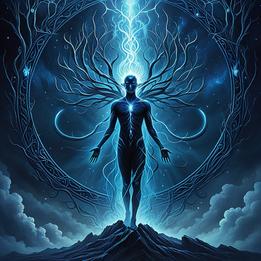
Reincarnation
The belief or experience of the soul's rebirth into a new body after death, representing cycles, transformation, and spiritual continuity.
Reincarnation Dream Meaning
The belief or experience of the soul's rebirth into a new body after death, representing cycles, transformation, and spiritual continuity.
Interpretive Themes
Cultural Lenses
Jungian Perspective
View Context →Archetype of the eternal return; represents individuation process where psyche integrates past experiences into wholeness. Modern context: symbolic of personal transformation cycles in therapy.
Freudian Perspective
View Context →Wish-fulfillment against death anxiety; regression to infantile omnipotence fantasies. Modern context: manifests as desire for do-overs in psychoanalysis of repetition compulsions.
Gestalt Perspective
View Context →Projection of unfinished business onto imagined future existences; avoidance of present responsibility. Modern context: therapeutic focus on completing current life gestalts.
Cognitive Perspective
View Context →Mental schema for processing mortality; narrative construction giving life coherence. Modern context: studied as cognitive bias toward continuity in thanatology research.
Evolutionary Perspective
View Context →Adaptive belief reducing death anxiety to promote group cohesion and procreation. Modern context: evolutionary psychology explains its cross-cultural persistence as survival mechanism.
South Asian Perspective
View Context →Central to Hinduism/Buddhism as samsara - cycle of birth/death driven by karma. Historical: detailed in Upanishads (800-200 BCE). Modern: basis for dharma and moksha/nirvana pursuits.
East Asian Perspective
View Context →Taoist/Buddhist integration with ancestor veneration; rebirth as continuation of familial duty. Historical: Chinese texts like Bao Puzi (4th century CE). Modern: influences funeral rites and memorial practices.
Middle Eastern Perspective
View Context →Mostly rejected in Abrahamic traditions but appears in Druze, Alevi, and pre-Islamic Persian traditions. Historical: Manichaeism (3rd century CE) taught light particles' transmigration. Modern: esoteric Sufi interpretations exist.
European Perspective
View Context →Pythagorean/Platonic soul transmigration (metempsychosis) influencing Renaissance esotericism. Historical: Celtic rebirth myths like Taliesin. Modern: New Age adaptations in neo-paganism and Theosophy.
African Perspective
View Context →Ancestral return through naming and resemblance; cyclical time in Yoruba, Akan traditions. Historical: Egyptian ka/ba concepts. Modern: maintained in diaspora religions like Candomblé and Vodou.
North American Perspective
View Context →Varied Indigenous concepts like Hopi emergence cycles, Inuit name-soul transmission. Historical: Iroquois condolence rituals. Modern: blended with environmental consciousness in contemporary interpretations.
Modern Western Perspective
View Context →Secular metaphor for career changes, recovery narratives; pop culture trope in films/books. Historical: 19th-century Spiritualism. Modern: surveyed belief (~25% in US) often divorced from religious doctrine.
Want a deeper analysis?
Get a personalized interpretation of your entire dream including this symbol.
Interpret My DreamCommon Appearances & Contexts
| Context | Emotion | Interpretation |
|---|---|---|
| Context Being reborn | Emotion Hope | Interpretation Fresh start opportunity. |
| Context Meeting past self | Emotion Nostalgia | Interpretation Revisiting old lessons. |
| Context Choosing next life | Emotion Anxiety | Interpretation Fear of wrong path. |
| Context Remembering past life | Emotion Clarity | Interpretation Understanding current patterns. |
| Context Breaking reincarnation cycle | Emotion Liberation | Interpretation Achieving spiritual freedom. |
| Context Witnessing others' rebirth | Emotion Awe | Interpretation Observing cosmic process. |
| Context Karmic debt collection | Emotion Dread | Interpretation Facing past actions. |
| Context Animal reincarnation | Emotion Humility | Interpretation Connection to nature. |
| Context Failed reincarnation | Emotion Despair | Interpretation Stuck in limbo. |
| Context Guided rebirth | Emotion Peace | Interpretation Divine assistance present. |
| Context Multiple simultaneous lives | Emotion Confusion | Interpretation Parallel existence overload. |
| Context Choosing parents | Emotion Responsibility | Interpretation Pre-birth soul contracts. |
Interpret Your Full Dream
Beyond this symbol, every dream carries a unique story. Share your dream for a personalized AI-powered interpretation.