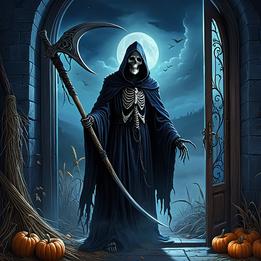
Reaper
A personification of death, often depicted as a cloaked figure with a scythe, harvesting souls and symbolizing the end of life's journey.
Reaper Dream Meaning
A personification of death, often depicted as a cloaked figure with a scythe, harvesting souls and symbolizing the end of life's journey.
Interpretive Themes
Cultural Lenses
Global/Universal Perspective
View Context →A nearly universal archetype of death, often as a skeletal figure with a scythe, representing the harvest of souls and the inevitable end of life across many mythologies and folklores.
Jungian Perspective
View Context →Represents the archetype of death and rebirth, the shadow, or the psychopomp guiding the soul. Symbolizes the necessary end of a psychological phase for transformation and integration of the unconscious.
Freudian Perspective
View Context →May symbolize the death drive (Thanatos), repressed fears of mortality, or castration anxiety. Could represent a punitive father figure or the ultimate return to an inorganic state.
Gestalt Perspective
View Context →Seen as a projection of the dreamer's own aspects—perhaps a part that 'cuts away' the old, enforces endings, or represents a fear of annihilation. The dreamer is the Reaper.
Cognitive Perspective
View Context →A mental schema for processing mortality, endings, and transitions. The brain uses this familiar image to conceptualize abstract concepts of finality, time pressure, or significant life changes during sleep.
Evolutionary Perspective
View Context →A cognitive adaptation for recognizing and preparing for threat, loss, and the end of resources or life. The symbol triggers survival mechanisms related to danger, group mortality, and life cycle awareness.
European Perspective
View Context →Deeply rooted in medieval Christian iconography as the Grim Reaper, a personification of the Black Death. Evolved into a folk symbol of mortality, often depicted in art like the Danse Macabre.
East Asian Perspective
View Context →In some traditions, analogous figures like the Japanese Shinigami or the Chinese Ox-Head and Horse-Face guides. Often less fearsome, more bureaucratic, part of a structured afterlife journey and karmic reckoning.
Middle Eastern Perspective
View Context →In Islamic tradition, Azrael is the Angel of Death, a divine agent who separates the soul from the body with compassion. Viewed with respect as part of God's will, not a malevolent harvester.
North American Perspective
View Context →In modern pop culture, often a sanitized or humorous figure (e.g., cartoons, video games). Also appears in contexts discussing healthcare, disaster, or as a metaphor for deadlines and finality in a fast-paced society.
Latin American Perspective
View Context →Influenced by both Catholic imagery (La Parca) and indigenous views of death as cyclical. Celebrated in traditions like Día de los Muertos, where death is seen as a natural, familiar part of life's continuum.
Modern Western Perspective
View Context →A pervasive pop culture icon in film, music, and games, often stripped of religious terror. Used metaphorically for burnout, deadlines, or climate change—representing man-made or abstract endings.
Want a deeper analysis?
Get a personalized interpretation of your entire dream including this symbol.
Interpret My DreamCommon Appearances & Contexts
| Context | Emotion | Interpretation |
|---|---|---|
| Context Chasing you | Emotion Terror | Interpretation Avoiding inevitable change. |
| Context Harvesting fields | Emotion Awe | Interpretation Natural life cycles. |
| Context Standing still | Emotion Dread | Interpretation Impending transformation. |
| Context Passing by | Emotion Relief | Interpretation Narrow escape. |
| Context Conversing with | Emotion Curiosity | Interpretation Seeking understanding. |
| Context In a crowd | Emotion Anxiety | Interpretation Shared mortality. |
| Context At a door | Emotion Apprehension | Interpretation Threshold crossing. |
| Context With a clock | Emotion Urgency | Interpretation Time running out. |
| Context Reaping weeds | Emotion Satisfaction | Interpretation Removing negativity. |
| Context In a mirror | Emotion Shock | Interpretation Self-confrontation. |
| Context Guiding someone | Emotion Sadness | Interpretation Loss acceptance. |
| Context Laughing | Emotion Unease | Interpretation Morbid irony. |
Interpret Your Full Dream
Beyond this symbol, every dream carries a unique story. Share your dream for a personalized AI-powered interpretation.