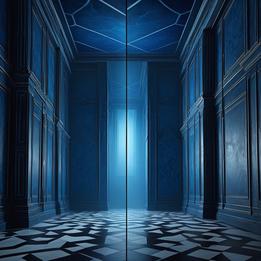
Proportion
The relationship between parts and whole in architectural spaces, representing harmony, balance, and the mathematical principles underlying physical reality.
Proportion Dream Meaning
The relationship between parts and whole in architectural spaces, representing harmony, balance, and the mathematical principles underlying physical reality.
Interpretive Themes
Mythological Resonance
The Golden Ratio (Phi)
GreekThe divine proportion found throughout nature and classical architecture, believed to embody perfect aesthetic harmony and cosmic order.
The Demiurge
PlatonicThe divine craftsman who fashioned the cosmos according to eternal, mathematical Forms, imposing proportion and order on primordial chaos.
Cultural Lenses
Jungian Perspective
View Context →Represents the Self archetype's quest for wholeness and individuation. The mandala principle in architecture reflects psychic integration and the balance between conscious and unconscious elements.
Freudian Perspective
View Context →Symbolizes sexual symbolism and body image. Architectural proportions represent phallic and yonic forms, with measurement reflecting castration anxiety and the superego's imposition of order.
Gestalt Perspective
View Context →Illustrates the figure-ground relationship and perceptual organization. Proportions show how we organize sensory input into meaningful wholes, revealing cognitive patterns in environmental perception.
Cognitive Perspective
View Context →Demonstrates mental schemas for spatial reasoning and pattern recognition. Dream proportions reveal how the brain processes environmental information and creates cognitive maps of reality.
Evolutionary Perspective
View Context →Reflects adaptive preferences for symmetry and balance developed for mate selection and environmental navigation. Proportional spaces signal safety, resources, and reproductive fitness in ancestral environments.
Global/Universal Perspective
View Context →Cross-cultural recognition of golden ratio and symmetry as aesthetically pleasing. From ancient pyramids to modern skyscrapers, proportion represents humanity's search for mathematical perfection in physical spaces.
East Asian Perspective
View Context →Feng shui principles of spatial harmony and energy flow. Architectural proportions balance yin-yang forces, with specific ratios determining auspiciousness and spiritual alignment in traditional design.
South Asian Perspective
View Context →Vastu Shastra's sacred geometry in temple architecture. Precise mathematical proportions connect earthly structures to cosmic order, with mandala-based designs representing spiritual enlightenment.
Middle Eastern Perspective
View Context →Islamic geometric patterns reflecting divine perfection. Architectural proportions avoid human representation while creating infinite patterns that symbolize Allah's mathematical perfection and unity.
European Perspective
View Context →Classical orders (Doric, Ionic, Corinthian) establishing aesthetic standards. Renaissance rediscovery of Vitruvian Man proportions represents humanism's ideal balance between art, science, and spirituality.
African Perspective
View Context →Traditional architecture's proportional relationships to natural elements and community needs. Spatial arrangements reflect social hierarchies, ancestral connections, and harmony with environmental rhythms.
Modern Western Perspective
View Context →Architectural modernism's emphasis on functional proportions and minimalist aesthetics. Contemporary focus on ergonomic design and sustainable scaling reflects technological precision and environmental consciousness.
Historical Authorities
Want a deeper analysis?
Get a personalized interpretation of your entire dream including this symbol.
Interpret My DreamThe Oracle's Prediction
Combine multiple symbolsA project or endeavor will reach a critical point of balance or re-alignment.
Timeframe
Seasonal (~3 Months)
Intensity
Deep
An insight into how disparate parts of your life or psyche fit into a coherent whole.
Timeframe
Lunation (~29 Days)
Intensity
Deep
Common Appearances & Contexts
| Context | Emotion | Interpretation |
|---|---|---|
| Context Building measurement | Emotion Anxious | Interpretation Life feels unbalanced. |
| Context Perfect symmetry | Emotion Peaceful | Interpretation Inner harmony achieved. |
| Context Distorted rooms | Emotion Confused | Interpretation Reality perception altered. |
| Context Golden ratio | Emotion Awestruck | Interpretation Divine perfection witnessed. |
| Context Out-of-scale | Emotion Overwhelmed | Interpretation Life proportions wrong. |
| Context Measuring spaces | Emotion Focused | Interpretation Seeking life clarity. |
| Context Architectural plans | Emotion Hopeful | Interpretation Future life design. |
| Context Collapsing structures | Emotion Terrified | Interpretation Life foundation crumbling. |
| Context Perfect alignment | Emotion Satisfied | Interpretation Everything fits perfectly. |
| Context Changing dimensions | Emotion Disoriented | Interpretation Life perspective shifting. |
| Context Sacred geometry | Emotion Reverent | Interpretation Spiritual connection felt. |
| Context Mathematical formulas | Emotion Curious | Interpretation Seeking life patterns. |
Interpret Your Full Dream
Beyond this symbol, every dream carries a unique story. Share your dream for a personalized AI-powered interpretation.