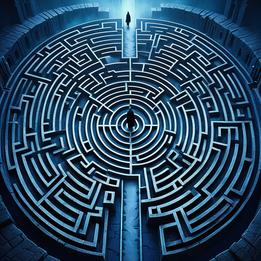
Ordered Labyrinth
A structured, purposeful maze symbolizing a spiritual journey with a clear path toward enlightenment or self-discovery.
Ordered Labyrinth Dream Meaning
A structured, purposeful maze symbolizing a spiritual journey with a clear path toward enlightenment or self-discovery.
Interpretive Themes
Mythological Resonance
Theseus
GreekNavigated the Cretan labyrinth to slay the Minotaur, guided by Ariadne's thread—a journey of heroic transformation through structured challenge.
Chartres Cathedral Labyrinth
ChristianA medieval stone labyrinth used for pilgrimage in miniature, symbolizing the soul's path to God through contemplative walking.
Cultural Lenses
Jungian Perspective
View Context →Represents the individuation process - a structured journey toward wholeness where the conscious ego navigates the unconscious according to archetypal patterns. Modern therapy uses labyrinth walking for integration.
Freudian Perspective
View Context →Symbolizes structured repression and sublimation - orderly navigation of forbidden desires through socially acceptable channels. The path represents controlled expression of libido toward civilized goals.
Gestalt Perspective
View Context →Represents the structured process of awareness - each turn is a new perspective integration. The whole pattern emerges from conscious steps, emphasizing present-moment navigation toward completion.
Cognitive Perspective
View Context →Metaphor for structured problem-solving and schema development. The brain creates orderly mental maps to navigate complex life situations, with the path representing cognitive strategies for goal achievement.
Evolutionary Perspective
View Context →Represents adaptive navigation strategies - structured exploration of environment for survival advantage. The ordered path mimics optimal foraging patterns and territory mapping essential for human evolution.
Global/Universal Perspective
View Context →Ancient symbol of structured spiritual journey found in cultures worldwide. From Chartres Cathedral to Hopi medicine wheels, represents universal human need for purposeful transformation through ritualized movement.
East Asian Perspective
View Context →In Taoist and Buddhist traditions, represents the structured path to enlightenment - like mandalas for meditation. The I Ching's hexagrams form an ordered labyrinth of cosmic principles guiding life decisions.
South Asian Perspective
View Context →In Hindu and Buddhist mandalas, represents structured meditation paths toward enlightenment. The Sri Yantra's geometric labyrinth guides practitioners through cosmic principles to spiritual realization.
Middle Eastern Perspective
View Context →In Islamic tradition, represents the structured path to Allah through geometric patterns in mosques. The maze-like arabesques guide spiritual focus, while Sufi whirling dances trace ordered spiritual ascent.
European Perspective
View Context →Medieval cathedral labyrinths like Chartres represented structured pilgrimage substitute. Celtic maze patterns symbolized structured life journey, while Greek mythology's structured labyrinths housed divine mysteries.
African Perspective
View Context →In Dogon cosmology, represents the structured descent of Nommo spirits. Sand drawings and initiation rituals use ordered maze patterns to guide spiritual knowledge transmission and community cohesion.
Modern Western Perspective
View Context →Therapeutic labyrinth walking for structured mindfulness. Corporate training uses 'career labyrinths' for professional development. Digital algorithms create ordered paths through information complexity.
Historical Authorities
Want a deeper analysis?
Get a personalized interpretation of your entire dream including this symbol.
Interpret My DreamThe Oracle's Prediction
Combine multiple symbolsA breakthrough in mindfulness or therapeutic progress.
Timeframe
Seasonal (~3 Months)
Intensity
Deep
Common Appearances & Contexts
| Context | Emotion | Interpretation |
|---|---|---|
| Context Walking confidently | Emotion Purposeful | Interpretation Embracing spiritual path. |
| Context Following a guide | Emotion Trusting | Interpretation Accepting spiritual mentorship. |
| Context Seeing from above | Emotion Awestruck | Interpretation Understanding divine pattern. |
| Context Finding center | Emotion Triumphant | Interpretation Achieving spiritual breakthrough. |
| Context Retracing steps | Emotion Reflective | Interpretation Reviewing life lessons. |
| Context Encountering symbols | Emotion Curious | Interpretation Decoding spiritual messages. |
| Context Hearing instructions | Emotion Attentive | Interpretation Receiving divine guidance. |
| Context Measuring progress | Emotion Satisfied | Interpretation Tracking spiritual growth. |
| Context Choosing paths | Emotion Decisive | Interpretation Making spiritual choices. |
| Context Light at end | Emotion Hopeful | Interpretation Approaching enlightenment. |
| Context Patterns emerging | Emotion Enlightened | Interpretation Seeing life's design. |
| Context Guiding others | Emotion Empowered | Interpretation Sharing spiritual wisdom. |
Interpret Your Full Dream
Beyond this symbol, every dream carries a unique story. Share your dream for a personalized AI-powered interpretation.