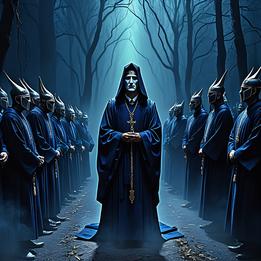
Officiant
A person who conducts formal ceremonies, rituals, or legal proceedings, often representing authority, tradition, and societal structure.
Officiant Dream Meaning
A person who conducts formal ceremonies, rituals, or legal proceedings, often representing authority, tradition, and societal structure.
Interpretive Themes
Authority and Legitimacy
highRepresents societal or spiritual endorsement.
Rites of Passage
highMarks beginnings, endings, or transformations.
Tradition and Conformity
mediumMay reflect pressure to follow rules.
Spiritual Mediation
mediumConnects personal experience to higher meaning.
Personal Responsibility
lowCould symbolize self-judgment or duty.
Cultural Lenses
Jungian Perspective
View Context →Represents the archetype of the Wise Old Man or animus, symbolizing spiritual authority, inner wisdom, and the Self guiding the individuation process through symbolic rituals.
Freudian Perspective
View Context →May symbolize the superego or paternal authority, representing internalized societal rules, moral judgments, or unresolved conflicts with father figures and societal expectations.
Gestalt Perspective
View Context →Could represent a disowned part of the self that holds authority or performs rituals, inviting exploration of personal responsibility, authenticity, and integration of formal aspects.
Cognitive Perspective
View Context →Likely reflects waking concerns about social roles, decision validation, or life transitions, with the brain processing authority structures and ritual significance through symbolic representation.
Evolutionary Perspective
View Context →Rooted in human need for ritual leaders to establish social cohesion, mark transitions, and reinforce group norms, reflecting adaptive mechanisms for community stability and hierarchy.
Global/Universal Perspective
View Context →Cross-cultural figure presiding over life transitions (birth, marriage, death), representing communal authority, spiritual connection, and the human need for ritualized meaning-making across societies.
East Asian Perspective
View Context →In Confucian-influenced cultures, represents hierarchical authority and ritual propriety (li); in Shinto/Buddhist contexts, priests mediate between human and spiritual realms during ceremonies.
South Asian Perspective
View Context →Pandit or priest conducting Vedic rituals (samskaras), embodying dharma (duty), spiritual authority, and the preservation of ancient traditions through precise ceremonial actions.
Middle Eastern Perspective
View Context →Imam, rabbi, or religious leader conducting Islamic/Jewish rituals, representing divine law (Sharia/Halakha), community leadership, and the intersection of spiritual and legal authority.
European Perspective
View Context →Historically clergy or nobility conducting Christian sacraments and state ceremonies; modern secular officiants blend legal authority with personal or cultural ritual traditions.
African Perspective
View Context →Elders, priests, or traditional healers conducting rites of passage, ancestor veneration, and community rituals, embodying ancestral wisdom, spiritual mediation, and communal authority.
North American Perspective
View Context →Diverse figures from judges to non-denominational celebrants, reflecting pluralistic society's blend of legal authority, personal spirituality, and cultural tradition in life ceremonies.
Want a deeper analysis?
Get a personalized interpretation of your entire dream including this symbol.
Interpret My DreamCommon Appearances & Contexts
| Context | Emotion | Interpretation |
|---|---|---|
| Context Wedding ceremony | Emotion Joy | Interpretation Commitment and union. |
| Context Legal proceeding | Emotion Anxiety | Interpretation Judgment or accountability. |
| Context Religious ritual | Emotion Awe | Interpretation Spiritual connection. |
| Context Graduation ceremony | Emotion Pride | Interpretation Achievement recognition. |
| Context Funeral service | Emotion Grief | Interpretation Endings and closure. |
| Context Oath-taking | Emotion Determination | Interpretation Promise or vow. |
| Context Initiation rite | Emotion Fear | Interpretation Transformation challenge. |
| Context Community gathering | Emotion Belonging | Interpretation Social cohesion. |
| Context Conflict mediation | Emotion Tension | Interpretation Resolution seeking. |
| Context Personal vow | Emotion Hope | Interpretation New beginning. |
| Context Secret ceremony | Emotion Mystery | Interpretation Hidden knowledge. |
| Context Ceremony interruption | Emotion Chaos | Interpretation Disrupted order. |
Interpret Your Full Dream
Beyond this symbol, every dream carries a unique story. Share your dream for a personalized AI-powered interpretation.