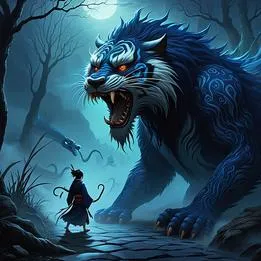
Nue Monster Dream Meaning
A chimera-like yokai from Japanese folklore, often depicted with a monkey's head, tanuki's body, tiger's limbs, and snake's tail, symbolizing ominous change and hidden threats.
Common Appearances & Contexts
| Context | Emotion | Interpretation |
|---|---|---|
| Being chased | Terror | Avoiding confronting fears. |
| Taming the Nue | Empowerment | Mastering inner conflicts. |
| Nue transforming | Anxiety | Fear of change. |
| Multiple Nues | Overwhelm | Feeling besieged by problems. |
| Nue speaking | Curiosity | Subconscious message emerging. |
| Killing the Nue | Relief | Overcoming a major obstacle. |
| Nue as guide | Confusion | Ambiguous path forward. |
| Nue in home | Violation | Personal space threatened. |
| Nue flying | Awe | Transcendent fear or power. |
| Nue dissolving | Peace | Resolution of inner turmoil. |
| Nue attacking others | Guilt | Fear of harming others. |
| Nue in mirror | Shock | Confronting shadow self. |
Interpretive Themes
Transformation
highSymbolizes impending personal or situational shift.
Hidden Threat
highRepresents subconscious fears or external risks.
Integration
mediumChallenges of accepting complex aspects of self.
Omen
highWarns of coming turmoil or revelation.
Chaos
mediumSymbolizes overwhelming, multifaceted problems.
Cultural Lenses
Jungian Perspective
View Context →Represents the shadow archetype—unconscious, repressed aspects of the self that manifest as a terrifying hybrid. Integration leads to wholeness. Modern context: symbolizes confronting complex psychological fragmentation.
Freudian Perspective
View Context →Symbolizes repressed sexual or aggressive instincts, with hybrid form representing conflict between id, ego, and superego. The monstrous appearance masks taboo desires. Modern: manifests in anxiety dreams.
Gestalt Perspective
View Context →Each animal part represents a disowned aspect of the dreamer's personality. The whole monster signifies unresolved internal conflict. Modern: encourages owning fragmented self-parts for integration.
Cognitive Perspective
View Context →Represents cognitive dissonance or overwhelming problem-solving where multiple concerns merge into one threatening entity. Modern: symbolizes information overload or decision paralysis in complex situations.
Evolutionary Perspective
View Context →Triggers primal fear responses to predator ambiguity—the hybrid form exploits multiple threat detection systems. Modern: manifests as anxiety about unpredictable, multifaceted dangers in complex environments.
East Asian Perspective
View Context →In Japanese folklore, the Nue is a nocturnal harbinger of misfortune, defeated by legendary archer Minamoto no Yorimasa. Historically associated with imperial illness; modernly appears in media as complex antagonist.
European Perspective
View Context →Parallels chimera myths—composite beasts symbolizing impossible combinations or heresy. Historically represented moral corruption; modernly signifies genetic engineering anxieties or identity confusion in multicultural societies.
Global/Universal Perspective
View Context →Hybrid monsters appear worldwide (e.g., sphinx, griffin) representing boundary-crossing, taboo, or cosmic disorder. Historically served as cultural warnings; modernly symbolizes globalization's blending of traditions and identities.
South Asian Perspective
View Context →Resembles composite beings in Hindu mythology like Narasimha (man-lion avatar), representing divine fury against disorder. Historically signifies dharmic intervention; modernly symbolizes righteous anger against corruption.
Modern Western Perspective
View Context →Represents anxiety about hybrid identities in multicultural societies or fear of technological chimeras (AI, genetic modification). Historically absent but now symbolizes postmodern fragmentation of self and society.
African Perspective
View Context →Echoes shape-shifting trickster deities like Anansi, representing adaptability and ambiguous morality. Historically served as moral lessons; modernly symbolizes navigating complex social landscapes with cunning.
Latin American Perspective
View Context →Parallels Nahual shapeshifter traditions where humans transform into animal composites, representing hidden powers or curses. Historically linked to shamanic practices; modernly symbolizes cultural syncretism tensions.
Interpret Your Full Dream
Beyond this symbol, every dream carries a unique story. Share your dream for a personalized AI-powered interpretation.