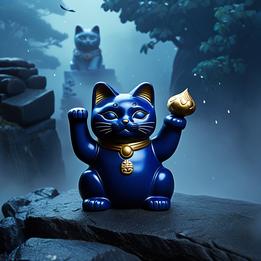
Maneki-neko Cat
A Japanese beckoning cat figurine believed to bring good luck, wealth, and prosperity to its owner.
Maneki-neko Cat Dream Meaning
A Japanese beckoning cat figurine believed to bring good luck, wealth, and prosperity to its owner.
Interpretive Themes
Fortune & Abundance
highDirect link to financial or business luck.
Invitation & Opportunity
highThe beckoning paw symbolizes calling in good things.
Protection & Warding
mediumSome legends tie it to protecting from disaster.
Anima/Animus Integration
lowCat as a feminine symbol inviting masculine action.
Adaptability
mediumModern symbol merging tradition with capitalism.
Mythological Resonance
The Beckoning Cat of Gotokuji Temple
Japanese FolkloreA legendary cat beckoned a samurai into a temple, saving him from a lightning strike. The grateful samurai made the temple prosperous, originating the Maneki-neko as a talisman of good fortune and protection.
Bastet
EgyptianThe lioness/cat goddess of home, fertility, and protection, whose benevolent yet fierce nature guarded against evil spirits and disease.
Cultural Lenses
Jungian Perspective
View Context →The Maneki-neko may represent the 'Self' archetype integrating opposites (beckoning/stillness), or an anima/animus figure inviting the dreamer toward individuation and wholeness.
Freudian Perspective
View Context →Could symbolize latent desires for wealth (oral fixation on prosperity) or a paternal/maternal figure (the cat) offering gratification and wish-fulfillment.
Gestalt Perspective
View Context →The dreamer likely projects their own desire to 'beckon' something (luck, love, success) into their life. The cat is a part of the self inviting change.
Cognitive Perspective
View Context →The symbol may activate schemas related to 'luck' or 'opportunity,' reflecting the dreamer's waking cognitive processes about risk, reward, and agency in pursuing goals.
Evolutionary Perspective
View Context →Taps into ancient adaptive mechanisms for seeking resources (prosperity) and social connection (beckoning). The cat's gaze and gesture may trigger innate attention and approach responses.
East Asian Perspective
View Context →Rooted in Japanese folklore (e.g., the Gotokuji Temple legend), it's a talisman for business success and protection. Colors and paw positions carry specific meanings for wealth or customers.
Global/Universal Perspective
View Context →Widely recognized as a symbol of good luck and fortune, transcending its Japanese origins to become a global icon in commercial and spiritual contexts.
Modern Western Perspective
View Context →Often viewed as a kitschy or decorative item, its spiritual meaning is frequently commercialized, though it retains charm as a token of optimism and material aspiration.
South Asian Perspective
View Context →May resonate with concepts of Lakshmi (goddess of wealth) or similar deities, where beckoning gestures invite divine blessing and abundance into the home or business.
European Perspective
View Context →Historically, cats have been ambivalent symbols (e.g., associated with witchcraft). The Maneki-neko recontextualizes the cat as a positive, inviting force for fortune.
North American Perspective
View Context →Common in immigrant-owned businesses and pop culture, symbolizing the 'American Dream' ethos of attracting success through hard work and a bit of luck.
Latin American Perspective
View Context →May align with syncretic beliefs like Santería, where similar figurines are used to attract positive energies (aché) or with folk saints associated with prosperity.
Historical Authorities
Want a deeper analysis?
Get a personalized interpretation of your entire dream including this symbol.
Interpret My DreamThe Oracle's Prediction
Combine multiple symbolsAn unexpected opportunity for gain or resource will present itself.
Timeframe
Immediate (Next 48h)
Intensity
Deep
Common Appearances & Contexts
| Context | Emotion | Interpretation |
|---|---|---|
| Context Seeing a Maneki-neko in a shop window | Emotion curious | Interpretation May signal a new business opportunity or financial prospect approaching. |
| Context Receiving a Maneki-neko as a gift | Emotion grateful | Interpretation Suggests incoming support or blessing from others in your endeavors. |
| Context A Maneki-neko's paw stops moving | Emotion anxious | Interpretation Could indicate stalled progress or a missed opportunity in waking life. |
| Context Multiple Maneki-neko cats beckoning | Emotion overwhelmed | Interpretation May reflect multiple competing opportunities or choices requiring discernment. |
| Context A broken or damaged Maneki-neko | Emotion concerned | Interpretation Might symbolize fractured luck or protection, urging reassessment of resources. |
| Context A Maneki-neko with its right paw raised | Emotion optimistic | Interpretation Traditionally attracts money and fortune; a positive financial omen. |
| Context A Maneki-neko with its left paw raised | Emotion welcoming | Interpretation Traditionally attracts customers or people; signifies social or relational opportunities. |
| Context A Maneki-neko that seems to look directly at you | Emotion noticed | Interpretation Suggests the fortune or opportunity is personally intended for you. |
| Context Ignoring a beckoning Maneki-neko | Emotion regretful | Interpretation May point to consciously or unconsciously rejecting an offer of help or luck. |
| Context A Maneki-neko in an unexpected place (e.g., nature) | Emotion surprised | Interpretation Hints that good fortune may come from an unconventional or unexpected source. |
| Context A Maneki-neko that changes color | Emotion puzzled | Interpretation Different colors have different meanings (e.g., gold for wealth, white for purity). |
| Context Trying to make a Maneki-neko wave but it won't | Emotion frustrated | Interpretation Could symbolize feelings of powerlessness in attracting desired outcomes. |
Interpret Your Full Dream
Beyond this symbol, every dream carries a unique story. Share your dream for a personalized AI-powered interpretation.