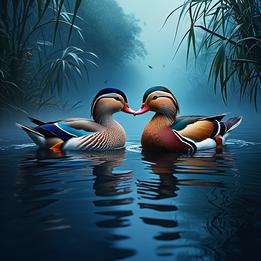
Mandarin Duck
A symbol of lifelong love, fidelity, and harmonious partnership in Chinese culture, often representing spiritual union and divine blessings.
Mandarin Duck Dream Meaning
A symbol of lifelong love, fidelity, and harmonious partnership in Chinese culture, often representing spiritual union and divine blessings.
Interpretive Themes
Mythological Resonance
Yuanyang (Mandarin Duck Pair)
ChineseMythical symbols of conjugal love and fidelity, often depicted in art and literature as inseparable companions blessed by the gods, sometimes representing the union of yin and yang.
Swan Lake Parallel
GlobalLike swans, mandarin ducks are monogamous birds in folklore, their pairing seen as a divine model of eternal, romantic partnership.
Cultural Lenses
Jungian Perspective
View Context →Represents the syzygy - the divine couple archetype symbolizing wholeness through union of masculine and feminine principles within the psyche, indicating integration of anima/animus.
Freudian Perspective
View Context →Symbolizes sexual union and reproductive instincts, with paired birds representing genital symbolism and the desire for monogamous sexual partnership as societal ideal.
Gestalt Perspective
View Context →Represents the dreamer's relationship to partnership itself - each duck may symbolize different aspects of self needing integration for relational wholeness and balance.
Cognitive Perspective
View Context →Reflects mental schemas about ideal relationships, possibly indicating cognitive processing of attachment patterns, commitment expectations, or social learning about partnership models.
Evolutionary Perspective
View Context →Represents adaptive advantages of pair-bonding for offspring survival, symbolizing deep-seated biological drives toward monogamy and cooperative parenting strategies.
East Asian Perspective
View Context →In Chinese tradition, represents marital bliss and fidelity - given as wedding gifts since Tang Dynasty, believed to bring lifelong happiness and protection from marital discord.
Global/Universal Perspective
View Context →Cross-cultural symbol of monogamous love, appearing in various traditions as emblem of devoted partnership, though specific meanings vary by cultural context and historical period.
South Asian Perspective
View Context →In Hindu-Buddhist contexts, represents divine couples like Shiva-Parvati, symbolizing spiritual union and the balance of complementary energies necessary for cosmic harmony.
European Perspective
View Context →In Western heraldry and literature, symbolizes faithful love and constancy, though less prominent than swans or doves, appearing in romantic poetry and courtly love traditions.
Modern Western Perspective
View Context →Popular in wedding decor and romantic gifts, representing ideal monogamous relationships, though increasingly questioned as unrealistic standard in contemporary relationship discourse.
Middle Eastern Perspective
View Context →In Persian poetry and miniature art, symbolizes lovers' eternal bond, often appearing in romantic narratives as emblem of faithful devotion despite separation or adversity.
African Perspective
View Context →In some traditions, represents ancestral blessings on marriage, with paired birds seen as messengers ensuring fertility and harmony in family lineages.
Historical Authorities
Want a deeper analysis?
Get a personalized interpretation of your entire dream including this symbol.
Interpret My DreamThe Oracle's Prediction
Combine multiple symbolsA deepening of an existing partnership or the arrival of a significant romantic connection.
Timeframe
Seasonal (~3 Months)
Intensity
Deep
Common Appearances & Contexts
| Context | Emotion | Interpretation |
|---|---|---|
| Context Flying together | Emotion Joyful | Interpretation Relationship flourishing. |
| Context Separated ducks | Emotion Anxious | Interpretation Fear of separation. |
| Context Nesting together | Emotion Content | Interpretation Domestic harmony achieved. |
| Context Single duck | Emotion Lonely | Interpretation Seeking partnership. |
| Context Feeding each other | Emotion Nurturing | Interpretation Mutual care present. |
| Context In water | Emotion Peaceful | Interpretation Emotional flow smooth. |
| Context Bright colors | Emotion Excited | Interpretation Passionate connection. |
| Context Faded colors | Emotion Sad | Interpretation Relationship fading. |
| Context With chicks | Emotion Proud | Interpretation Family expansion coming. |
| Context In cage | Emotion Trapped | Interpretation Relationship feels restrictive. |
| Context Attacked | Emotion Fearful | Interpretation Relationship threatened. |
| Context Leading others | Emotion Confident | Interpretation Model relationship example. |
Interpret Your Full Dream
Beyond this symbol, every dream carries a unique story. Share your dream for a personalized AI-powered interpretation.