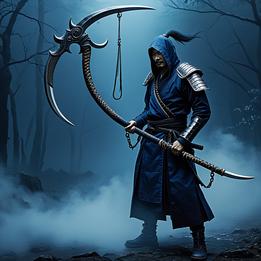
Kusarigama
A traditional Japanese weapon combining a sickle and weighted chain, symbolizing duality, adaptability, and the integration of opposing forces.
Kusarigama Dream Meaning
A traditional Japanese weapon combining a sickle and weighted chain, symbolizing duality, adaptability, and the integration of opposing forces.
Interpretive Themes
Dual Nature
highSickle and chain represent contrasting aspects.
Strategic Control
highWeapon requires precision and foresight.
Adaptability
mediumVersatile weapon for various ranges.
Restraint and Release
mediumChain binds while sickle cuts.
Hidden Potential
lowUnconventional weapon with surprise element.
Cultural Lenses
Jungian Perspective
View Context →Represents the union of opposites (sickle as anima/conscious, chain as animus/unconscious) and the process of individuation through integrating shadow aspects into the whole self.
Freudian Perspective
View Context →Symbolizes phallic aggression (sickle) and binding maternal connections (chain), reflecting unresolved conflicts between sexual drives and restrictive societal or familial bonds.
Gestalt Perspective
View Context →The whole weapon represents the self; parts (sickle, chain, handle) symbolize different aspects of personality needing integration for complete functioning and awareness.
Cognitive Perspective
View Context →Represents problem-solving strategies where multiple tools (chain for distance, sickle for close) are combined, reflecting adaptive thinking and mental flexibility in facing challenges.
Evolutionary Perspective
View Context →Symbolizes the human development of composite tools for survival advantage, reflecting ancestral memory of weapon innovation and strategic adaptation against threats.
East Asian Perspective
View Context →In Japanese history, a ninja weapon symbolizing cunning, adaptability, and the integration of agricultural (sickle) and martial (chain) life, now representing traditional skill in modern martial arts.
Global/Universal Perspective
View Context →A composite tool representing human ingenuity in combining elements for greater effectiveness, symbolizing the universal theme of integration and adaptation across cultures.
European Perspective
View Context →Viewed through medieval weaponry lens as an exotic, unconventional armament, symbolizing foreign ingenuity and the strategic value of combining different combat approaches.
Modern Western Perspective
View Context →Primarily encountered in pop culture (anime, games) as a cool, specialized weapon representing niche expertise, strategic thinking, and sometimes anti-hero aesthetics.
South Asian Perspective
View Context →May evoke similar composite weapons like the urumi (flexible sword), symbolizing the divine union of Shiva's trident and chain concepts, representing cosmic balance.
African Perspective
View Context →Could parallel throwing weapons with retrieval cords, symbolizing community ties (chain) and individual action (sickle), reflecting balance between autonomy and connection.
Latin American Perspective
View Context →Might recall bolas or lasso tools, representing the integration of Indigenous hunting techniques with colonial influences, symbolizing cultural synthesis and adaptive resistance.
Want a deeper analysis?
Get a personalized interpretation of your entire dream including this symbol.
Interpret My DreamCommon Appearances & Contexts
| Context | Emotion | Interpretation |
|---|---|---|
| Context Fighting an opponent | Emotion Determined | Interpretation Confronting challenges directly. |
| Context Weapon breaks | Emotion Vulnerable | Interpretation Feeling unprepared or fragile. |
| Context Mastering the weapon | Emotion Empowered | Interpretation Gaining control over situation. |
| Context Chain tangles | Emotion Frustrated | Interpretation Complications hindering progress. |
| Context Giving it away | Emotion Relieved | Interpretation Letting go of burdens. |
| Context Finding it abandoned | Emotion Curious | Interpretation Discovering unused potential. |
| Context Teaching someone | Emotion Confident | Interpretation Sharing knowledge or skills. |
| Context Weapon transforms | Emotion Awed | Interpretation Unexpected change occurring. |
| Context Defending home | Emotion Protective | Interpretation Guarding personal boundaries. |
| Context Dropping the chain | Emotion Panicked | Interpretation Losing control suddenly. |
| Context Polishing the sickle | Emotion Focused | Interpretation Refining skills or ideas. |
| Context Chain extends endlessly | Emotion Overwhelmed | Interpretation Responsibilities feel infinite. |
Interpret Your Full Dream
Beyond this symbol, every dream carries a unique story. Share your dream for a personalized AI-powered interpretation.