Esker
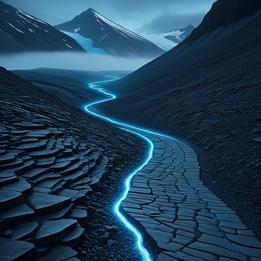
A winding, serpentine ridge of gravel and sand deposited by glacial meltwater, symbolizing ancient pathways, hidden structures, and natural persistence.
Esker Dream Meaning
A winding, serpentine ridge of gravel and sand deposited by glacial meltwater, symbolizing ancient pathways, hidden structures, and natural persistence.
Interpretive Themes
Mythological Resonance
The Labyrinth
GreekDaedalus's winding structure that both conceals and reveals, with a single true path through complexity.
Spider Woman
Native AmericanCreator who weaves the world into being along intricate pathways that connect all things.
Cultural Lenses
Jungian Perspective
View Context →Represents the collective unconscious's ancient, winding pathways—the serpentine ridge symbolizes the process of individuation, where glacial forces (archetypal pressures) deposit psychic material into conscious awareness.
Freudian Perspective
View Context →A phallic symbol formed by fluid (meltwater), suggesting repressed sexual energy or childhood developmental pathways frozen in time and later revealed through analysis.
Gestalt Perspective
View Context →The esker is a whole greater than its parts (gravel, sand); dreaming of it may reflect how the dreamer organizes fragmented experiences into a coherent, persistent life path.
Cognitive Perspective
View Context →A mental model for processing memory and navigation—the esker acts as a cognitive map, helping the brain simulate pathways through complex life situations based on past 'glacial' events.
Evolutionary Perspective
View Context →Taps into ancestral adaptations for landscape navigation and resource finding; eskers provided real pathways and water sources, so dreaming of them may activate survival-related spatial memory.
North American Perspective
View Context →In Indigenous traditions, eskers are seen as sacred trails or serpent spirits left by glaciers, used historically for travel and in rituals as connections to the Ice Age ancestors and land spirits.
European Perspective
View Context →In Norse and Celtic lore, eskers are often 'elf roads' or fairy paths—linear landscape features believed to be supernatural highways, with taboos against building on them to avoid otherworldly conflict.
East Asian Perspective
View Context →Resonates with Daoist concepts of 'shanshui' (mountain-water); the esker's form reflects the flow of qi, representing natural harmony and the winding, persistent path (Dao) through life's challenges.
African Perspective
View Context →In regions with glacial history (e.g., East Africa), eskers may be viewed as ancient riverbeds or serpent deities' trails, symbolizing ancestral migration routes and the land's memory in oral traditions.
Modern Western Perspective
View Context →Seen through environmental and archaeological lenses—eskers are linear archives of climate history, metaphors for data streams or highways, and symbols of humanity's impact on ancient natural forms.
Global/Universal Perspective
View Context →A cross-cultural symbol of natural persistence and hidden guidance; eskers appear worldwide where glaciers existed, often revered as spiritual pathways or practical routes, uniting human awe for geological time.
Oceanian Perspective
View Context →In glacial areas like New Zealand, eskers are part of Maori narratives as trails of ancestral heroes or taniwha (water spirits), representing the land's whakapapa (genealogy) and navigational wisdom.
Historical Authorities
Want a deeper analysis?
Get a personalized interpretation of your entire dream including this symbol.
Interpret My DreamThe Oracle's Prediction
Combine multiple symbolsYou will discover hidden connections between past experiences and current challenges.
Timeframe
Lunation (~29 Days)
Intensity
Deep
An old connection will resurface with new significance.
Timeframe
Seasonal (~3 Months)
Intensity
Deep
Common Appearances & Contexts
| Context | Emotion | Interpretation |
|---|---|---|
| Context Crossing an esker | Emotion Determination | Interpretation Overcoming ancient obstacles. |
| Context Viewing from above | Emotion Awe | Interpretation Seeing life's pattern. |
| Context Digging into esker | Emotion Curiosity | Interpretation Seeking buried truths. |
| Context Esker collapsing | Emotion Anxiety | Interpretation Foundation feels unstable. |
| Context Following esker path | Emotion Hope | Interpretation Trusting natural guidance. |
| Context Esker in urban area | Emotion Disorientation | Interpretation Past intrudes present. |
| Context Building on esker | Emotion Pride | Interpretation Creating on history. |
| Context Esker as map | Emotion Clarity | Interpretation Finding direction. |
| Context Esker melting away | Emotion Loss | Interpretation Letting go past. |
| Context Esker glowing | Emotion Wonder | Interpretation Ancient wisdom revealed. |
| Context Multiple eskers converging | Emotion Overwhelm | Interpretation Many paths intersect. |
| Context Esker as barrier | Emotion Frustration | Interpretation Blocked by history. |
Interpret Your Full Dream
Beyond this symbol, every dream carries a unique story. Share your dream for a personalized AI-powered interpretation.