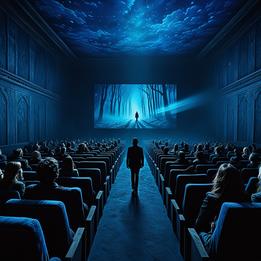
Cinema
A place of projected narratives and collective viewing, symbolizing escape, storytelling, and the interplay between reality and illusion.
Cinema Dream Meaning
A place of projected narratives and collective viewing, symbolizing escape, storytelling, and the interplay between reality and illusion.
Interpretive Themes
Cultural Lenses
Jungian Perspective
View Context →Represents the collective unconscious where archetypal stories are projected. The dark room symbolizes the shadow self, while the screen shows anima/animus projections. Modern context: therapy through cinematic metaphor.
Freudian Perspective
View Context →Symbolizes wish fulfillment and regression to infantile pleasure states. The dark, womb-like space represents maternal security, while projected images manifest repressed desires. Modern: escapism as neurosis.
Gestalt Perspective
View Context →Every element represents dreamer's aspects: screen as conscious mind, projector as unconscious, seats as social roles. Empty seats are disowned parts. Modern: self-integration through projection.
Cognitive Perspective
View Context →Reflects memory consolidation and problem-solving through narrative simulation. The cinema environment facilitates cognitive processing of daily experiences. Modern: brain's storytelling mechanism.
Evolutionary Perspective
View Context →Modern extension of campfire storytelling for social bonding and threat rehearsal. Dark environment triggers ancestral night-vigilance instincts. Modern: evolved narrative processing.
East Asian Perspective
View Context →In Chinese tradition, represents yin (darkness) and yang (light projection) balance. Historically linked to shadow puppetry rituals. Modern: harmony through controlled illusion.
South Asian Perspective
View Context →Echoes ancient Sanskrit drama (natya) as divine revelation. The screen is maya (illusion), the light is consciousness. Modern: Bollywood as cultural dream factory.
Middle Eastern Perspective
View Context →Historically viewed with suspicion as Western imposition, now culturally integrated. Relates to ancient storytelling traditions in coffeehouses. Modern: tension between tradition and modernity.
European Perspective
View Context →Originates from 19th century magic lantern shows and early film pioneers. Symbolizes technological mastery over light. Modern: art cinema as intellectual discourse.
African Perspective
View Context →Connects to oral storytelling under moonlit skies. Cinema buildings often community centers. Modern: Nollywood's rapid storytelling reflects oral tradition pace.
North American Perspective
View Context →Epitomizes Hollywood dream factory mythology. Drive-in cinemas represent automotive culture. Modern: multiplex as consumer choice temple.
Latin American Perspective
View Context →Telenovela melodrama meets magical realism. Cinemas as political spaces during dictatorships. Modern: cinema as social critique vehicle.
Want a deeper analysis?
Get a personalized interpretation of your entire dream including this symbol.
Interpret My DreamCommon Appearances & Contexts
| Context | Emotion | Interpretation |
|---|---|---|
| Context Empty cinema | Emotion Loneliness | Interpretation Isolation in shared space. |
| Context Film breaking | Emotion Anxiety | Interpretation Narrative disruption fear. |
| Context Being on screen | Emotion Exposure | Interpretation Public self-scrutiny. |
| Context Choosing a film | Emotion Indecision | Interpretation Life path uncertainty. |
| Context Talking during film | Emotion Guilt | Interpretation Social rule breaking. |
| Context Cinema transforming | Emotion Wonder | Interpretation Reality shift potential. |
| Context Projector malfunction | Emotion Frustration | Interpretation Creative block symbol. |
| Context Childhood cinema | Emotion Nostalgia | Interpretation Past self connection. |
| Context Cinema as classroom | Emotion Curiosity | Interpretation Learning through stories. |
| Context End credits rolling | Emotion Melancholy | Interpretation Cycle completion feeling. |
| Context Finding secret cinema | Emotion Discovery | Interpretation Hidden aspect revelation. |
| Context Cinema flooding | Emotion Overwhelm | Interpretation Emotional inundation symbol. |
Interpret Your Full Dream
Beyond this symbol, every dream carries a unique story. Share your dream for a personalized AI-powered interpretation.