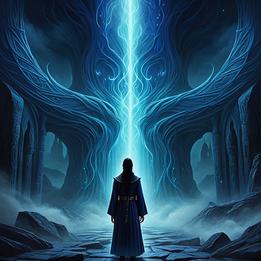
Channeler
A spiritual intermediary who connects with otherworldly entities or energies, often serving as a conduit for messages, healing, or guidance.
Channeler Dream Meaning
A spiritual intermediary who connects with otherworldly entities or energies, often serving as a conduit for messages, healing, or guidance.
Interpretive Themes
Communication with the Unseen
highSuggests seeking hidden knowledge.
Surrender of Control
mediumMay indicate vulnerability or trust.
Spiritual Authority
highReflects power or responsibility.
Transformation
mediumPersonal growth through contact.
Boundary Dissolution
lowPotential identity concerns.
Cultural Lenses
Global/Universal Perspective
View Context →A cross-cultural archetype of the shaman, oracle, or medium who accesses spiritual realms for community benefit, reflecting humanity's universal quest for connection with the divine or ancestral wisdom.
Jungian Perspective
View Context →Symbolizes the psyche's connection to the collective unconscious, where the channeler acts as an ego conduit for archetypal energies, facilitating individuation through integration of unconscious contents.
Freudian Perspective
View Context →May represent repressed desires or childhood wishes manifesting through displacement, where spiritual messages symbolize unconscious conflicts seeking expression in disguised, socially acceptable forms.
Gestalt Perspective
View Context →Seen as a projection of the dreamer's disowned parts—the channeler represents aspects of self that feel foreign or external, inviting re-ownership of these qualities for wholeness.
Cognitive Perspective
View Context →Reflects the brain's pattern-making and agency-detection systems, where the channeler symbolizes attempts to make sense of random neural activity or externalize internal thought processes.
Evolutionary Perspective
View Context →May tap into adaptive mechanisms for social cohesion and threat detection, where channeling behaviors historically reinforced group bonds through shared supernatural narratives and authority structures.
East Asian Perspective
View Context →In traditions like Chinese Wuism or Japanese Miko, channelers mediate between humans and kami/spirits, often through trance states in rituals for healing, divination, or maintaining cosmic balance.
South Asian Perspective
View Context →Linked to sadhus, gurus, or tantrikas who channel deities like Kali or Shiva, serving as living vessels for darshan (sacred sight) and transmitting spiritual energy (shakti) to devotees.
Middle Eastern Perspective
View Context →Historically seen in Zoroastrian magi or Islamic Sufi mystics who channel divine presence (fana), though often viewed cautiously to avoid shirk (idolatry) in orthodox contexts.
European Perspective
View Context →From Celtic druids and Norse volvas to medieval Christian mystics, channelers accessed otherworldly knowledge through altered states, often persecuted as witches during early modern periods.
African Perspective
View Context →Central to traditions like Vodun or Santería, where channelers (e.g., houngans) embody loa/orishas in possession rituals, bridging community with ancestral spirits for healing and justice.
Modern Western Perspective
View Context →Often secularized as psychics or mediums in spiritualist movements, channelers now appear in therapeutic contexts (e.g., channeling inner child) or entertainment media, blending ancient practice with contemporary self-help.
Want a deeper analysis?
Get a personalized interpretation of your entire dream including this symbol.
Interpret My DreamCommon Appearances & Contexts
| Context | Emotion | Interpretation |
|---|---|---|
| Context Receiving a message | Emotion Curiosity | Interpretation Seeking guidance. |
| Context Channeling a spirit | Emotion Fear | Interpretation Loss of control. |
| Context Becoming a channeler | Emotion Empowerment | Interpretation Discovering inner ability. |
| Context Watching a channeler | Emotion Awe | Interpretation Witnessing the miraculous. |
| Context Channeler speaking | Emotion Confusion | Interpretation Unclear messages. |
| Context Channeler healing | Emotion Hope | Interpretation Desire for restoration. |
| Context Channeler in danger | Emotion Protectiveness | Interpretation Vulnerability of conduit. |
| Context Channeler teaching | Emotion Inspiration | Interpretation Learning to connect. |
| Context Channeler fading | Emotion Loss | Interpretation Connection ending. |
| Context Channeler transforming | Emotion Wonder | Interpretation Metamorphosis through spirit. |
| Context Channeler rejected | Emotion Isolation | Interpretation Gift unrecognized. |
| Context Channeler in ritual | Emotion Reverence | Interpretation Sacred ceremony. |
Interpret Your Full Dream
Beyond this symbol, every dream carries a unique story. Share your dream for a personalized AI-powered interpretation.