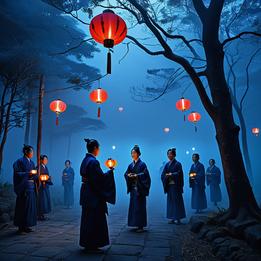
Bon Festival
A Japanese Buddhist festival honoring ancestral spirits, celebrating their temporary return to the living world with rituals, dances, and offerings.
Bon Festival Dream Meaning
A Japanese Buddhist festival honoring ancestral spirits, celebrating their temporary return to the living world with rituals, dances, and offerings.
Interpretive Themes
Mythological Resonance
Obon
JapaneseOriginates from the story of Mokuren, a disciple of Buddha who used his spiritual powers to see his deceased mother suffering in the Realm of Hungry Ghosts. Buddha instructed him to make offerings to monks, which freed her, leading to the festival of gratitude and remembrance.
The Feast of the Dead / Día de Muertos
GlobalParallel traditions worldwide where the veil between worlds thins, and the living commune with, honor, and provide for the spirits of the departed through offerings, altars, and celebration.
Cultural Lenses
Jungian Perspective
View Context →Represents the collective unconscious's ancestral archetypes, integrating personal lineage with universal human experience of death and memory through ritual symbolism.
Freudian Perspective
View Context →Symbolizes unresolved feelings toward deceased parental figures, with rituals acting as sublimated expressions of guilt, longing, or unresolved Oedipal conflicts.
Gestalt Perspective
View Context →Encourages exploring the dreamer's relationship with endings and connections, asking what parts of the self feel ancestral or need honoring and release.
Cognitive Perspective
View Context →Reflects memory processing and schema about family, loss, and tradition, possibly triggered by recent thoughts about heritage or seasonal cues.
Evolutionary Perspective
View Context →Taps into adaptive behaviors for social cohesion and ancestor veneration, reinforcing group identity and coping mechanisms for mortality awareness.
East Asian Perspective
View Context →A Buddhist-Confucian fusion honoring ancestors (Obon), with rituals like Toro Nagashi (floating lanterns) to guide spirits, emphasizing filial piety and cyclical remembrance in modern secular celebrations.
Global/Universal Perspective
View Context →Represents cross-cultural practices of honoring the dead, seen in festivals like Dia de los Muertos or All Souls' Day, reflecting human need to connect with lineage beyond life.
South Asian Perspective
View Context →Parallels Pitru Paksha or Shraddha rituals in Hinduism, where ancestors are fed and honored to ensure their peace and familial blessings, blending Vedic and local traditions.
Modern Western Perspective
View Context →Often viewed as an exotic cultural event or aesthetic, sometimes appropriated in wellness contexts for 'ancestor work,' detached from its religious roots but valued for community aspects.
European Perspective
View Context →Echoes pagan harvest festivals like Samhain, later Christianized as All Saints' Day, where communities appease spirits with offerings, blending pre-Christian and medieval rituals.
Latin American Perspective
View Context →Resonates with Dia de los Muertos, where altars (ofrendas) and festivities celebrate deceased loved ones, merging Indigenous Mesoamerican beliefs with Catholic influences in vibrant modern celebrations.
African Perspective
View Context →Aligns with ancestor veneration in traditions like Yoruba or Akan, where rituals communicate with ancestral spirits for guidance and protection, maintaining cultural continuity through diaspora practices.
Historical Authorities
Want a deeper analysis?
Get a personalized interpretation of your entire dream including this symbol.
Interpret My DreamThe Oracle's Prediction
Combine multiple symbolsA reconnection or deepened understanding with family or chosen kin.
Timeframe
Seasonal (~3 Months)
Intensity
Deep
Receiving intuitive guidance or a sense of profound support from beyond the personal self.
Timeframe
Lunation (~29 Days)
Intensity
Deep
Common Appearances & Contexts
| Context | Emotion | Interpretation |
|---|---|---|
| Context Dancing at festival | Emotion Joyful | Interpretation Embracing tradition and community. |
| Context Lighting lanterns | Emotion Peaceful | Interpretation Guiding spirits respectfully. |
| Context Offering food | Emotion Reverent | Interpretation Honoring ancestors with care. |
| Context Seeing departed relatives | Emotion Nostalgic | Interpretation Reconnecting with lost loved ones. |
| Context Festival ending | Emotion Melancholic | Interpretation Accepting temporary connections. |
| Context Preparing altars | Emotion Focused | Interpretation Ritual preparation for spirits. |
| Context Watching Bon Odori | Emotion Awestruck | Interpretation Cultural immersion and beauty. |
| Context Floating lanterns away | Emotion Bittersweet | Interpretation Letting go gracefully. |
| Context Family gathering | Emotion Connected | Interpretation Strengthening familial bonds. |
| Context Missing the festival | Emotion Longing | Interpretation Yearning for tradition or home. |
| Context Spirits departing | Emotion Resigned | Interpretation Accepting natural cycles. |
| Context Cleaning graves | Emotion Respectful | Interpretation Maintaining ancestral ties. |
Interpret Your Full Dream
Beyond this symbol, every dream carries a unique story. Share your dream for a personalized AI-powered interpretation.