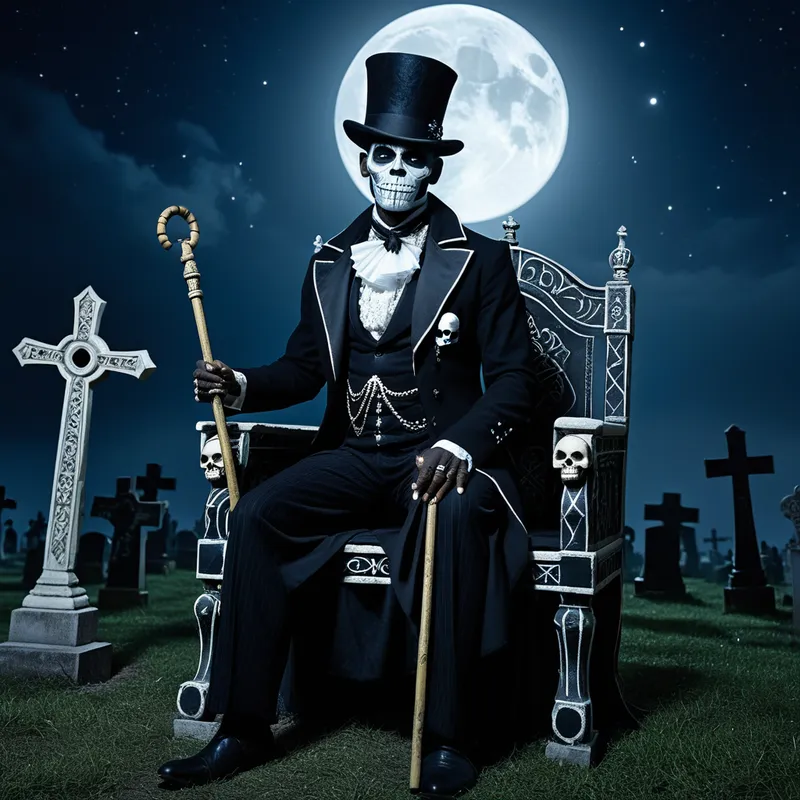
Zombi Myth Meaning & Symbolism
The myth of a soul captured, its will stolen, and its long, arduous journey back to the source of its own life and freedom.
The Tale of Zombi
Listen. In the deep hours, when the moon is a sliver of bone and the wind carries the scent of salt and dust, there is a story told in whispers. It is not a story of monsters, but of a theft so profound it echoes in the soul.
There was a person, whole and living. Let us call them Jean. Jean walked the red earth, felt the sun, knew love and anger. But Jean also made an enemy—a person with a heart turned to cold stone, a bokor. To the bokor, Jean’s vibrant life was a currency. In the still of a moonless night, the bokor came. Not with weapons of iron, but with powders ground from secret things: the bone of a toad, the dust of a dried pufferfish, the soil from a fresh grave. A whisper on the wind, a pinch of dust blown through a crack in the door, and Jean’s body fell as if struck. Breath shallow, pulse a faint drumbeat fading into silence. To the village, Jean was dead. They mourned, they buried, they returned to the world of the living.
But the bokor returned to the grave. In the pitch black, he called to Baron Samedi, master of the cemetery. He made his offerings of rum and spicy peanuts. With permission grudgingly given, he dug. He lifted Jean’s body from the earth. Then, holding a mirror to the lifeless lips, he called out a name—Jean’s secret name, the name of the soul’s essence, the gros bon ange. He captured this name-breath in a bottle, corking it tight. With a slap and a command, the body stirred. But the eyes that opened were empty wells. Jean walked, obeyed, labored—a shell animated by will alone, the will of the bokor. This was the zombi: the body without its captain, the ship adrift, commanded by a thief.
The tale does not end in the field under the lash. For a sliver of the soul remains—the ti bon ange, the little good angel. It is a spark of memory, of self. And if that spark can be fed—by a taste of salt, the memory of the sea from which life came—a shudder runs through the hollow frame. Memory floods the empty channels. The zombi stops. It turns its face from the master’s command and begins to walk. Not to rebellion, but to return. It walks back to the village it knew, to the grave that was its prison. It seeks the bottle, the stolen name. And if it finds it, if it can shatter the glass and release the breath back into its own body, or if it can find its way to the crossroad and beg Baron Samedi for the return of what was lost, then the hollow man becomes Jean once more. The journey home is the final, most arduous labor.
Cultural Origins & Context
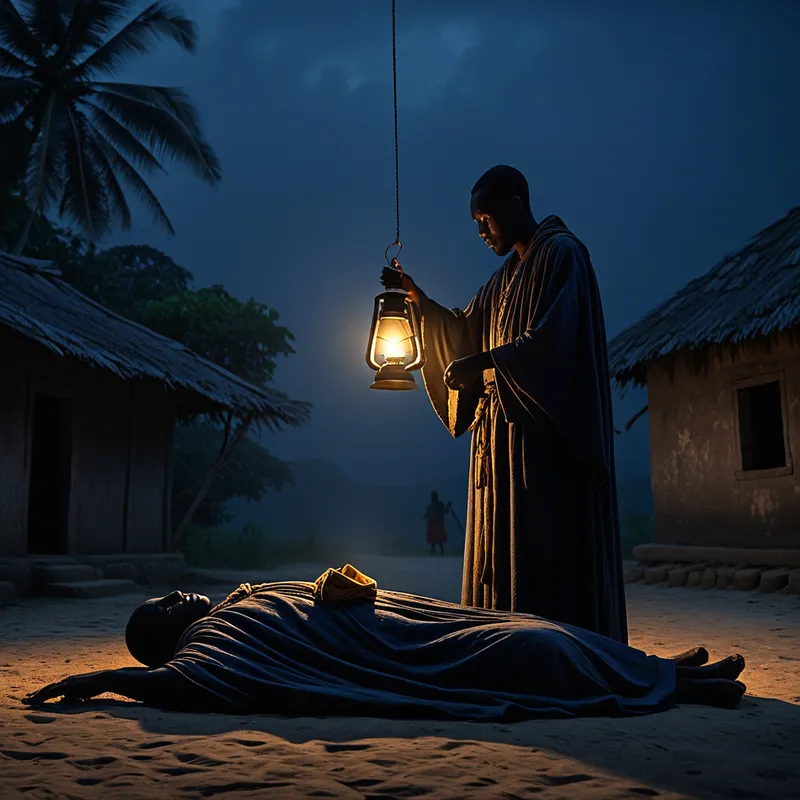
This myth is not ancient folklore from a distant past; it is a story born from the very soil of colonial Saint-Domingue, forged in the crucible of the transatlantic slave system. The Zombi narrative is a profound product of Haitian Vodou, a spiritual system that itself is a resilient synthesis of West and Central African traditions, primarily from the Dahomey and Kongo regions, with Roman Catholicism. It served as a covert language of resistance and a metaphysical explanation for an unimaginable reality.
The story was passed down not in books, but in the hounfò (temple), in the fields after dark, and in the warnings of elders. Its primary societal function was twofold. First, it was a dire cautionary tale about social and spiritual integrity: do not betray your community, do not invite envy, for you could lose your very self. Second, and more critically, it was a direct allegory for the condition of slavery. The enslaved person was seen as one whose body was forced to labor for another’s profit, whose family and culture were stolen, whose very name was replaced—a living person socially and spiritually “dead,” a zombi to the plantation system. The myth thus named the horror, making it comprehensible within a spiritual framework that also held the key to liberation, mirroring the historical Haitian Revolution itself.
Symbolic Architecture
The Zombi is not a monster of hunger, but of absence. It is the ultimate symbol of the stolen will, the psyche under occupation. The bokor represents not just an evil individual, but the corrosive, parasitic aspect of power that seeks to consume the autonomy of others for its own gain.
The most profound slavery is not of the body, but of the soul’s consent. The zombi is the image of the self from which the power of consent has been severed.
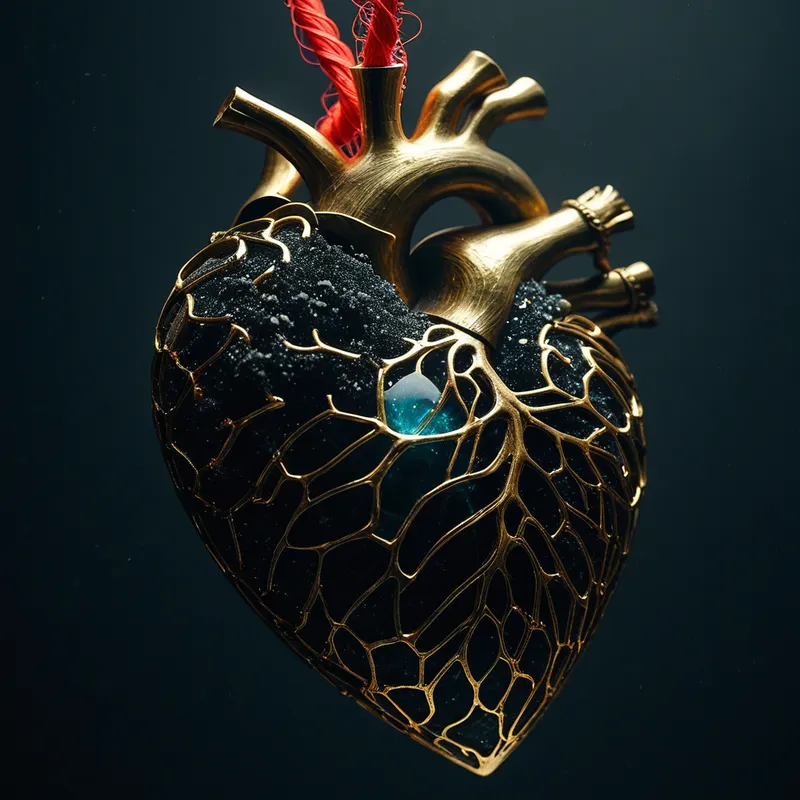
The captured gros bon ange in the bottle is the symbol of essential vitality held captive—one’s true name, one’s passion, one’s driving spirit, locked away by trauma, oppression, or addiction. The salt that triggers the return is the catalyst of memory and pain; it is the taste of one’s own tears and the ocean of the unconscious, the reminder of a wholeness that once was. The entire narrative is a map of disintegration and re-membering. The journey back to the grave is not a morbid obsession, but a necessary return to the site of the trauma to reclaim what was buried there.
The Dreamer’s Resonance
When this myth stirs in the modern dreamscape, it rarely appears as a Hollywood ghoul. Instead, the dreamer may find themselves in an endless, grey office performing meaningless tasks, or moving through their own home as a silent, unseen ghost. They may dream of being unable to speak, their voice box filled with sand, or of searching desperately for a small, vital object—a key, a locket, a word—that has been misplaced.
Somatically, this is the process of profound dissociation. The psyche is signaling that a core part of the self—the will, the voice, the capacity for joy—has gone offline, has been “zombified” by overwhelming stress, systemic oppression, or relational trauma. The body in the dream feels heavy, numb, or automated. The emotional tone is one of deep futility and isolation. This dream pattern is the soul’s cry that a fundamental alienation has occurred; the connection between executive action (the body) and authentic desire (the soul) has been severed.

Alchemical Translation
The individuation process modeled by the Zombi myth is the arduous alchemy of reclaiming sovereignty. It is the work of the ti bon ange, that persistent spark of consciousness, gathering itself against the inertia of emptiness.
The first step is the “taste of salt”—the conscious, often painful, acknowledgment that one is living a half-life, that one’s actions are not one’s own, but are dictated by internalized bokors: old wounds, familial expectations, or societal mandates. This bitter taste is the beginning of awakening. The next phase is the walk back to the grave. Psychologically, this is the descent into the personal unconscious, a willing confrontation with the site of the original “burial”—the childhood trauma, the abusive relationship, the period of burnout where the self was abandoned. It is there, in that dark place, that one must search for the “bottle.”
Liberation is not an escape from the grave, but a courageous return to it to retrieve what was left behind.
This bottle is the encapsulated, frozen complex—the stored anger, the sequestered creativity, the captured vitality. The alchemical work is to break the glass, not with violence, but with the heat of conscious attention and the fluid of felt experience, to reintegrate the gros bon ange back into the psyche. Finally, one must present this reclaimed self at the crossroads—symbolized by Baron Samedi—the point of choice and transformation. Here, the reclaimed soul is ratified. The individual is no longer a hollow vessel reacting to old commands, but a sovereign being, made whole not by forgetting the journey through the underworld, but because of it. The myth teaches that the soul can be stolen, but it can also, with immense courage, be won back.
Associated Symbols
Explore related symbols from the CaleaDream lexicon: