Ziz the Giant Bird Myth Meaning & Symbolism
A primordial, sky-spanning bird of Hebrew myth, Ziz embodies the untamed power of the heavens and the soul's capacity for vast, protective consciousness.
The Tale of Ziz the Giant Bird
In the beginning, before the lines of the world were fully drawn, the Creator fashioned guardians for the three realms. For the seas, Leviathan. For the earth, Behemoth. And for the vault of the heavens, He summoned a being of wind and cloud, of storm and song. He called it Ziz.
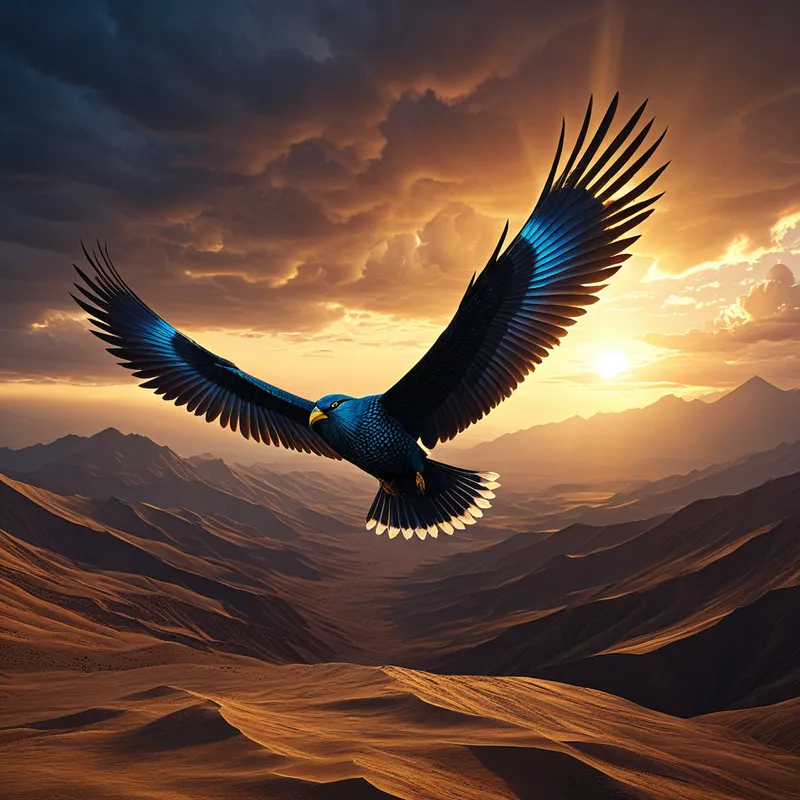
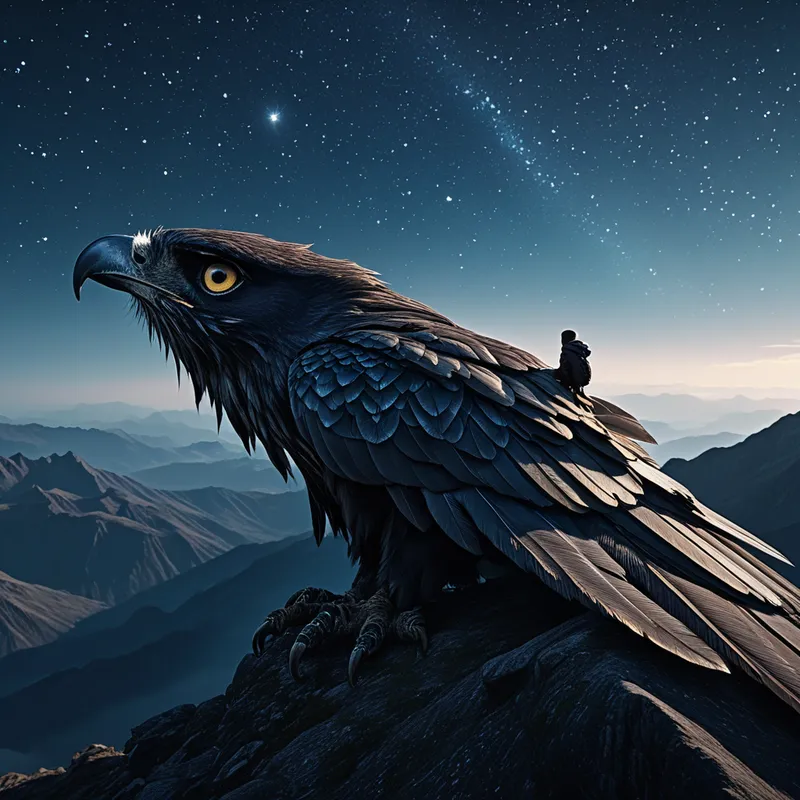
Its birth was a tempest. From the breath of the east wind and the fire of the morning star, its form coalesced. When it stretched its wings for the first time, the sun was blotted out. The shadow it cast was not of darkness, but of a profound, violet twilight that stretched from one horizon to the other. The sound was not a flap, but the deep, resonant groan of the sky itself bending. Its feathers were not mere plumage; each was a vast expanse, the color of thunderheads at sunset, edged with the silver of distant lightning. Its legs were pillars that could straddle mountain ranges, and its eyes held the calm, ancient light of fixed stars.
This creature did not hunt upon the earth. Its domain was the boundary between heaven and the upper waters, the firmament. It soared on currents no other being could feel, a silent sovereign of the air. Yet, its purpose was not dominion, but guardianship. It was said that when the great floodwaters rose, threatening to drown all creation, the beating of Ziz’s wings drove back the surging tides, creating great valleys with the downdraft of its pinions. Its shadow was a refuge for migrating birds, and its call—a sound heard only in the deepest silence of the desert night—calmed the raging winds.
The conflict was not of battle, but of scale and solitude. Ziz was a creature of such immensity that its very existence was a testament to a world too vast for human comprehension. Its rising would darken the sky for days; its landing would shake the foundations of the earth. It lived in a perpetual state of majestic isolation, a solitary king in a palace of endless blue. The resolution of its tale is not one of death or defeat, but of ordained destiny. In the lore of the sages, it is written that Ziz, along with Leviathan and Behemoth, is preserved for a great feast at the end of days, a symbol of chaos transformed into sacred sustenance for the righteous. Until that time, it remains, a living covenant written across the sky, a reminder that the world is held within a grasp far greater than our own.
Cultural Origins & Context
The myth of Ziz finds its roots in the Aggadic literature of the Talmud and Midrash, composed between the 3rd and 6th centuries CE. These were not canonical scriptures, but expansive, imaginative discourses where rabbis and storytellers pondered the mysteries of creation, filling the spaces between the lines of the Torah with profound speculation. Ziz, often called Renanim (the joyful singer) or Sekwi (the seer), emerged from this contemplative tradition.
It was a myth told not to children at bedtime, but debated by scholars in study halls. Its function was cosmological and theological. In a worldview that sought to affirm the absolute sovereignty and orderly power of the One God, the existence of such terrifying, primordial creatures posed a question: why would God create such monstrous beings? The myth of Ziz, Leviathan, and Behemoth provided an answer. They were demonstrations of divine power—proof that even the most chaotic and overwhelming forces were created beings, subject to God’s ultimate authority. They served as “measuring sticks” for creation, embodying the awesome, sometimes frightening, fullness of a world that humanity was meant to steward, but never fully dominate. The myth was a tool for cultivating awe (yirat shamayim) and humility, placing humanity within a cosmos of staggering scale and diversity.
Symbolic Architecture
Ziz is the [archetype](/symbols/archetype “Symbol: A universal, primordial pattern or prototype in the collective unconscious that shapes human experience, behavior, and creative expression.”/) of the Sky [Father](/symbols/father “Symbol: The father figure in dreams often symbolizes authority, protection, guidance, and the quest for approval or validation.”/) in its most elemental form. It does not represent the personal, intervening God of [the covenant](/symbols/the-covenant “Symbol: A sacred, binding agreement between parties, often with divine or societal significance, representing commitment, obligation, and mutual responsibility.”/), but the impersonal, vast, and protective canopy of [heaven](/symbols/heaven “Symbol: A symbolic journey toward ultimate fulfillment, spiritual transcendence, or connection with the divine, often representing life’s highest aspirations.”/) itself. It symbolizes the [aspect](/symbols/aspect “Symbol: A distinct feature, quality, or perspective of something, often representing a partial view of a larger whole.”/) of [consciousness](/symbols/consciousness “Symbol: Consciousness represents the state of awareness and perception, encompassing thoughts, feelings, and experiences.”/) that is boundless, overseeing, and connected to the celestial.
The giant bird does not fight the storm; it is born from it and becomes its master. It represents the psyche’s capacity to contain and navigate immense, chaotic energies by attaining a higher perspective.
Its immense wings, which can block the sun, speak to the [shadow](/symbols/shadow “Symbol: The ‘shadow’ embodies the unconscious, repressed aspects of the self and often represents fears or hidden emotions.”/) of the Self—the totality of the psyche, which is so vast it can [eclipse](/symbols/eclipse “Symbol: An eclipse symbolizes change, transitions, and sometimes unexpected challenges, marking a significant transformation process.”/) the conscious ego (the sun). This is not a negative [shadow](/symbols/shadow “Symbol: The ‘shadow’ embodies the unconscious, repressed aspects of the self and often represents fears or hidden emotions.”/), but the necessary ground of our being. Ziz’s [role](/symbols/role “Symbol: The concept of ‘role’ in dreams often reflects one’s identity or how individuals perceive their place within various social structures.”/) as a protector of other birds translates psychologically to the Self’s function of organizing and safeguarding the multitude of instinctual drives and “[bird](/symbols/bird “Symbol: Birds symbolize freedom, perspective, and the connection between the earthly and spiritual realms, often representing the soul’s aspirations or personal growth.”/)-like” thoughts (the flock of impulses, ideas, and fears) within us. Its ultimate [fate](/symbols/fate “Symbol: Fate represents the belief in predetermined outcomes, suggesting that some aspects of life are beyond human control.”/)—to be transformed into sustenance—points to the alchemical goal: the raw, primal power of the instinctual world ([chaos](/symbols/chaos “Symbol: In Arts & Music, chaos represents raw creative potential, uncontrolled expression, and the breakdown of order to forge new artistic forms.”/)) must be integrated and “consumed” to nourish the development of the whole individual.

The Dreamer’s Resonance
To dream of Ziz is to encounter the numinous power of the Self in its most awe-inspiring, non-human form. It is not a dream of gentle guidance, but of overwhelming scale. The dreamer may find themselves staring up at a sky that has become a living creature, feeling simultaneously terrified and profoundly safe. This is the somatic signal of the psyche confronting something far greater than the ego’s daily concerns.
Such a dream often occurs during periods of existential expansion or crisis—when one is taking on immense responsibility, grappling with a philosophical or spiritual awakening, or feeling the weight of a protective role (as a parent, leader, or caregiver). The giant bird’s shadow falling over the dream landscape mirrors the feeling of one’s own potential or destiny looming large, both promising and intimidating. The dream is an invitation from the deep unconscious to acknowledge the vast, often dormant, capacities within. The fear it may evoke is the ego’s rightful tremor before the majesty of its own totality. The subsequent feeling of awe, if allowed, is the beginning of a conscious relationship with that totality.
Alchemical Translation
The individuation process modeled by Ziz is one of conscious expansion. Where the hero archetype conquers external foes, the Ziz archetype integrates internal vastness. The initial state is one of identification with the small, earth-bound ego. The “prima materia” is the chaotic, stormy energy of unrecognized potential—ambition, intellect, spiritual yearning—that feels overwhelming and alien.
The first stage is Confrontation with the Sky: acknowledging these towering feelings and thoughts, allowing oneself to feel dwarfed by one’s own inner landscape. The second is Acquiring Perspective: learning, like Ziz, to soar above the tempest of personal drama and see one’s life pattern from a higher, more detached vantage point. This is the “view from the firmament.”
The alchemical goal is not to become the giant bird, but to house its spirit—to build a psychic structure (the vas) capable of containing its boundless energy without being shattered by it.
The final translation is Protective Embodiment. The integrated energy of Ziz does not manifest as grandiosity, but as a calm, immense protective capacity. One becomes a steady, overseeing presence in one’s own life and for others—able to “cast a shadow” of calm, to “beat back the floods” of emotional chaos with the steady rhythm of conscious action, and to provide a “sky” under which the smaller, vulnerable parts of oneself and others can find safe passage. The feast at the end of days symbolizes the ultimate nourishment the fully realized Self provides: the chaotic primal forces are transformed into the sacred meal of wisdom, meaning, and enduring peace.
Associated Symbols
Explore related symbols from the CaleaDream lexicon:
- Bird — The fundamental symbol of spirit, transcendence, and the connection between heaven and earth; Ziz is this concept magnified to a cosmic, protective scale.
- Sky — Represents the realm of consciousness, the divine, and limitless potential; Ziz is the animate, living embodiment of the sky itself.
- Shadow — The immense, overarching totality of the psyche that can eclipse the conscious ego, represented by the vast shadow Ziz casts upon the world.
- Giant — Symbolizes primordial power, overwhelming scale, and forces beyond ordinary human comprehension, directly reflecting Ziz’s nature as a being of mythic proportions.
- Protection — The core function of the Ziz archetype, representing the Self’s capacity to oversee, guard, and provide a safe container for the contents of the psyche.
- Chaos — The raw, stormy, primordial energy from which Ziz is formed and which it masters, symbolizing the untamed potential within the unconscious.
- Mountain — The earthly anchor point for the celestial Ziz; its talons rest on peaks, symbolizing the connection between the highest aspirations and the solid ground of reality.
- Storm — The elemental force associated with Ziz’s origin and power, representing the turbulent psychic energy that must be navigated and harnessed.
- Feather — A single, manageable piece of Ziz’s vastness, symbolizing a token of divine protection, a message from the higher Self, or a connection to transcendent insight.
- Wind — The invisible medium and breath of Ziz, representing the spirit, inspiration, and the powerful, unseen currents of fate and the unconscious that carry us.
- Destiny — Ziz’s preserved role for the end of days points to a pre-ordained purpose within the cosmic order, reflecting the soul’s journey toward a destined wholeness.
- Thunderbird — A parallel archetype from other cultures, emphasizing the universal motif of a gigantic, sky-dwelling bird associated with storms, power, and spiritual authority.