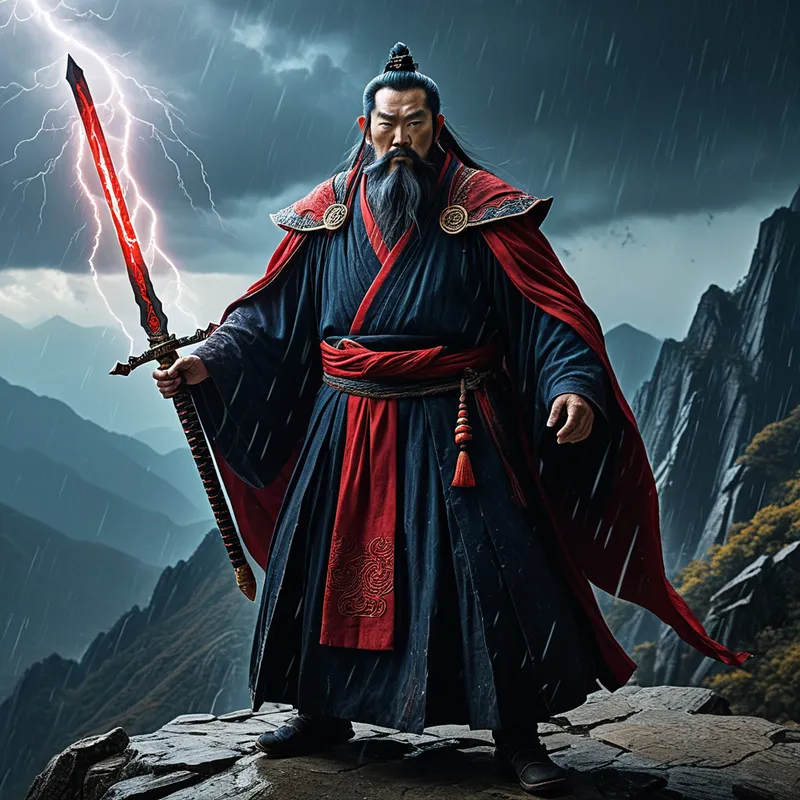
Zhong Kui Myth Meaning & Symbolism
A brilliant scholar, betrayed by his appearance, becomes a ghostly king, wielding divine authority to protect the living from the unseen.
The Tale of Zhong Kui
Let the drums fall silent and the incense smoke curl. Listen now to the tale that walks the line between the scholar’s lamp and the hungry ghost’s wail. It begins not with a birth, but with a death—a death of hope.
In the age of the Tang, when the empire hungered for wise men, there was a scholar named Zhong Kui. His mind was a library of stars, his brush could paint wisdom onto paper. He journeyed to the capital, his heart a vessel of ambition tempered by virtue, to sit for the Imperial Examinations. He wrote. The characters flowed from him like a river of clarity, answering every profound question set by the emperor himself. His paper was declared flawless, the pinnacle of scholarship. He was to be named Zhuangyuan.
Then came the audience. Before the Son of Heaven, Zhong Kui knelt. The emperor looked upon him. And where the court expected a face of jade-like refinement, they saw a visage of startling, fearsome ugliness—a brow like a cliff, eyes like coals, a beard wild and tangled. The court gasped. The emperor, in a moment of shallow horror, recoiled. The title was revoked. Not for lack of merit, but for lack of beauty. The gates of the world, opened by his intellect, were slammed shut by his face.
Despair, cold and absolute, swallowed him. The shame was a poison no antidote could cure. In a final, furious act of defiance against a world that valued shell over substance, Zhong Kui took his own life. He dashed his head against the palace steps, his scholar’s robes staining crimson. But his spirit did not dissipate like morning mist. It coalesced, burning with a righteousness unspent. He descended into the underworld, not as a meek ghost, but as a tempest of unresolved intent.
In the shadow realms, his formidable spirit and unmatched intellect could not be ignored. The King of Hell, Yanluo Wang, saw not a monster, but a minister. He saw the justice in Zhong Kui’s rage. And so, the outcast of the mortal realm was crowned the king of ghosts in the netherworld. He was given a divine mandate: to command the spectral legions, to hunt malevolent demons and wandering, hungry ghosts who plagued the living. He was granted a sword to subdue evil and the authority to pass judgment.
The tale echoes back to the mortal world. The emperor, plagued by a terrible fever and nightmares of a small, vicious demon, found no cure. Then, in a dream, a colossal, dark-robed figure appeared. It was Zhong Kui. With a mighty grasp, he seized the nightmare imp and devoured it. The emperor awoke, healed. In gratitude and profound remorse, he ordered the finest painter to render Zhong Kui’s image—all his terrible power and protective might—so that it might be hung on palace gates and household doors. Thus, the betrayed scholar became the eternal guardian, his fierce visage a talisman against all invisible chaos, a protector born from the world’s gravest injustice.
Cultural Origins & Context
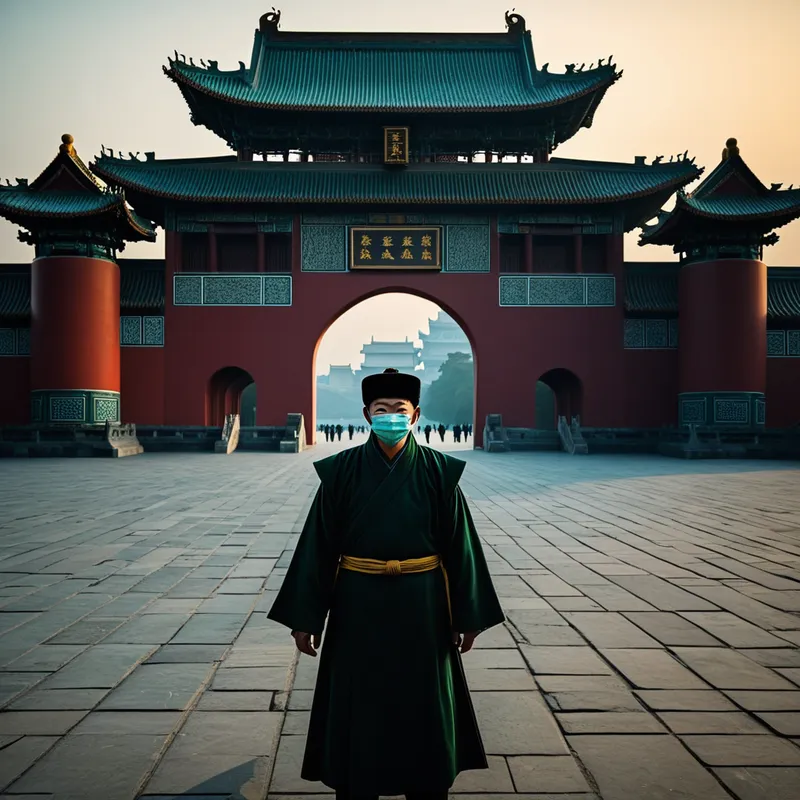
The myth of Zhong Kui is woven deeply into the fabric of Chinese spiritual pragmatism. Its earliest known literary record appears in the Song dynasty, but its folk origins are undoubtedly older, rooted in the Tang dynasty setting of the tale. This was not a story confined to temple scrolls; it was a living narrative enacted during the Duanwu Festival, a time associated with warding off poison and malevolent influences. Troupes would perform exorcistic dances, with one actor embodying the mighty Zhong Kui, cleansing homes and villages.
His image transcended ritual to become a staple of folk art. New Year’s prints (nianhua) featured him prominently, pasted on doors to bar evil spirits from entering in the coming year. He was the people’s deity—a bureaucrat of the supernatural who understood the systems of both worlds. Unlike remote celestial gods, Zhong Kui was born of human suffering and bureaucratic failure. He represented a divine correction to mortal folly, a figure who channeled his personal grievance into a universal protective function. He was told by parents to children, painted by artisans for commoners, and respected by emperors, bridging every layer of society with his story of ultimate requital.
Symbolic Architecture
At its core, the myth is a profound allegory of the rejected Self. Zhong Kui embodies the raw, unassimilated potential that society discards based on superficial judgments. His brilliant mind symbolizes the latent genius, the deep knowing, that is often ignored or shamed because it does not come in an acceptable package. His ugliness is not merely physical; it is a metaphor for any aspect of the psyche deemed too intense, too passionate, too dark, or too unconventional for the conscious, daylight world of order and appearance—the Shadow.
The greatest protector is often forged in the crucible of the world’s rejection. What is cast out returns, not as a curse, but as the only force capable of mastering the chaos that rejection creates.
His suicide is the critical alchemical nigredo, the blackening. It is the total annihilation of the ego’s worldly identity and hopes. Yet, it is not an end, but a descent into the underworld of the unconscious. There, in the realm of disowned parts and primal energies, his essential quality—his fierce intelligence and sense of justice—is not destroyed but re-contextualized. The King of Hell represents the deep, structuring principle of the psyche (the Self) that recognizes the value in the outcast. The crowning of Zhong Kui is the integration of the Shadow into a position of immense internal authority. He is no longer a victim of the system; he becomes the master of the inner wilderness, the ruler of the very ghosts (repressed fears, traumas, instincts) that once threatened to overwhelm him.
The Dreamer’s Resonance
When the archetype of Zhong Kui stirs in the modern dreamscape, it signals a profound somatic and psychological reckoning. One may dream of being shamed in a public forum for an inherent trait, of holding a perfect solution that is violently rejected, or of a fierce, ugly-yet-majestic figure appearing at the threshold of a dream home.
These dreams often accompany a life phase where one’s deep capabilities or true nature have been chronically invalidated by family, workplace, or social norms—where one’s “face” does not fit. The somatic experience can be one of a hot, constricting shame in the chest, or a cold fury in the gut. Psychologically, it is the process of the ego’s constructed identity—the “presentable self”—failing and breaking apart. The dream figure of Zhong Kui is the psyche’s announcement that the time for appeasement is over. The raw, intelligent power that was buried is now rising, not to destroy the dreamer, but to offer a fearsome form of protection. It is the Self mobilizing the Shadow to end an inner tyranny of conformity.
Alchemical Translation
The journey of Zhong Kui is a precise map for psychic transmutation, or individuation. It begins with the conscious ego’s project: to succeed by the world’s standards (the examination). The brutal rejection is the necessary shock that shatters this identification. The ego must “die”—the suicidal despair symbolizes the utter surrender of the old way of being.
The treasure is always guarded by a dragon; the gold is found only in the descent into the dark earth. One must be betrayed by the surface world to be crowned by the depths.
The descent into the underworld is the courageous, often terrifying, dive into the unconscious. This is the stage of shadow-work, of confronting the repressed anger, grief, and instincts (the ghosts and demons). Here, the individual does not fight these forces as enemies, but, like Zhong Kui, begins to organize them. The intellect (Zhong Kui’s scholarship) is not discarded but repurposed as discernment. The rage is not purged but harnessed as the sword of boundaries and righteous action.
The crowning by the King of Hell represents the Self conferring sovereignty upon this integrated complex. The individual no longer flees their inner “demons”; they command them. They become the Queller of Demons in their own life. The final return—the image on the gate—is the external manifestation of this inner alchemy. The once-rejected trait becomes the source of one’s unique authority and protective power. The fierce visage is no longer a source of shame but a talisman of integrity, a declaration that one’s wholeness, in all its unvarnished power, is the ultimate safeguard against the chaos of both outer judgment and inner fragmentation. The outcast becomes the cornerstone.
Associated Symbols
Explore related symbols from the CaleaDream lexicon: