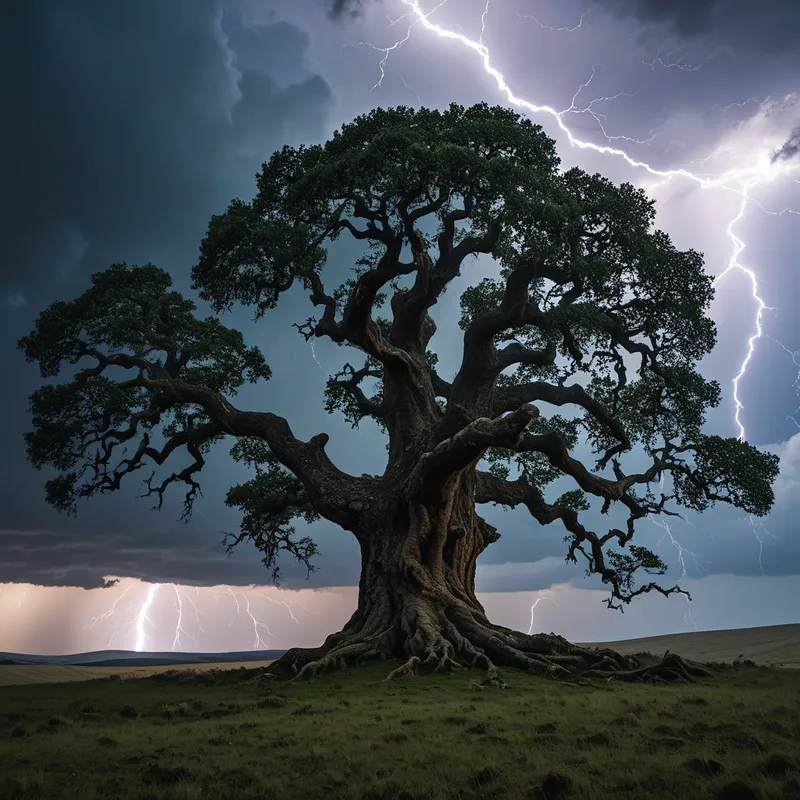
Zeus's Oak Myth Meaning & Symbolism
The sacred oak at Dodona, where Zeus's voice rustled in the leaves, offering divine prophecy and grounding celestial power in the earth.
The Tale of Zeus’s Oak
Hear now the tale of the first oracle, born not from stone or fire, but from the deep, patient heart of the earth. Before the Delphic tripod cast its shadow, before the Python fell, there was a place in the wilds of Epirus, where the mountains sigh and the winds carry secrets from the ends of the world. This was Dodona.
Here, in a grove cradled by hills, stood an oak unlike any other. It was not merely a tree, but a pillar between realms. Its roots plunged into the dark, moist memory of the earth, and its crown brushed the vault of heaven where the thunder gathers. This was the Oak of Zeus.
The story whispers that the god’s presence did not arrive with a cataclysm, but with a subtle, enduring claim. Some say a black dove, speaking with a human voice, flew from Egyptian Thebes and alighted upon its branches, declaring this spot sacred. Others tell of two priestesses, carried from distant lands by fate, who first heard the god in the mountain zephyrs. But the oldest song, the one that rings truest in the bones, says the oak itself was sacred from the world’s dawn, and Zeus, in his sovereignty, chose it as his mouthpiece.
The air in Dodona was different. It tasted of ozone and damp soil. Pilgrims would journey for weeks, their hearts heavy with questions for the King of the Gods. They did not come to a grand temple, but to this humble, mighty grove. They would bring gifts of bronze—tripods and cauldrons—hanging them from the oak’s limbs until the branches groaned a soft, metallic song alongside the wind.
Then, they would wait in the profound silence that comes before a voice. The Selloi, the barefoot priests who slept on the ground, would listen. The priestesses, the Peleiades, would stand with eyes closed, their very souls attuned. And the answer would come.
It was not a voice of a man, but the voice of the world itself. A sudden gust would rush through the valley, and the countless leaves of the sacred oak would erupt into a chorus of sibilant rustling. In that sound—a thousand whispers at once—the will of Zeus was heard. The priests interpreted the language of the leaves; the murmuring of a nearby spring gave it nuance. To the seeker, it was the sound of destiny rustling, of the divine mind thinking aloud through the very substance of nature. The oak did not speak for Zeus; in that holy place, it was Zeus, his authority made tangible, his counsel rooted deep in the living earth.

Cultural Origins & Context
The oracle of Dodona is considered the oldest in Hellenic world, with origins stretching back into the pre-Olympian, chthonic mists. Its antiquity is underscored by Homer, who has Achilles pray to “Zeus, Dodonaean, Pelasgian,” referencing the indigenous Pelasgian inhabitants. This was a rustic, elemental oracle, far from the political sophistication of later Delphi.
Its function was deeply woven into the fabric of early Greek society. Communities and individuals sought guidance on matters ranging from agriculture and health to founding new colonies and waging war. The oracle’s responses, framed in the ambiguous poetry of nature, required interpretation by its dedicated priesthood, creating a living, breathing institution of divination. Unlike the single Pythian priestess at Delphi, Dodona featured a college of priestesses and the unique order of the Selloi, whose ascetic, earth-connected lifestyle (they famously did not wash their feet) symbolized a direct, unmediated channel to the divine through the natural world. The myth was passed down not as a single authored epic, but as a living tradition anchored to a physical, awe-inspiring location—the tree itself was the constant, the eternal witness.
Symbolic Architecture
The myth of Zeus’s Oak is a masterful symbolic construct about the nature of authority, communication, and the foundational structures of reality.
At its core, the oak tree is an archetypal axis mundi. It is the world pillar, the central axis upon which the cosmos turns. By making this oak his oracle, Zeus does not merely inhabit nature; he consecrates the fundamental connection between the celestial and the terrestrial. His authority (sky, lightning, law) is literally grounded in the strength, stability, and deep-rooted endurance of the earth (the oak).
True power is not imposed from above, but arises from a sacred marriage between the heights of consciousness and the depths of instinct.
The prophecy itself, emerging from the rustling leaves, symbolizes a profound truth: divine or psychic communication is often not literal, linear, or clear. It is polyphonic, ambiguous, and requires interpretation. The leaves are a multitude of potential meanings, and the wind—the spirit, pneuma—is what animates them into a message. This represents the intuitive, non-rational way deep wisdom from the unconscious reaches the conscious mind: not as a shouted command, but as a whisper in the periphery of awareness, a synchronicity, or a feeling in the body that must be deciphered.
Finally, the bronze cauldrons hanging from the branches add a crucial layer. Bronze, an alloy of copper and tin, was the metal of the heroic age. These vessels, resonating in the wind, symbolize the human capacity to contain and amplify the divine message. They represent culture, craft, and human ritual—the necessary vessels we must create to catch, hold, and understand the raw, flowing wisdom of nature and the unconscious.

The Dreamer’s Resonance
When the pattern of Zeus’s Oak manifests in modern dreams, it signals a profound somatic and psychological process: the search for inner authority and authentic voice. The dreamer may encounter a massive, central tree in a landscape; feel a powerful wind that seems to carry meaning; or hear indistinct, whispering voices that feel immensely significant.
Psychologically, this is the Self (the Zeus archetype) seeking to establish its rule not through egoic domination, but through connection to the innate, instinctual wisdom of the body and the unconscious (the earth-rooted oak). The “rustling leaves” phase is often experienced as a period of inner confusion—multiple thoughts, possibilities, and intuitions swirling without a clear directive. The dreamer is in the grove at Dodona, hearing the sound but lacking the interpreter.
This dream pattern calls for the development of the inner Peleiades—the attentive, receptive function of the psyche that can sit in the silence and decode the natural language of the soul. It is a call to ground one’s sense of purpose and truth in something deeper and more enduring than social opinion or personal whim, to find the central, rooted tree within one’s own psychic landscape.
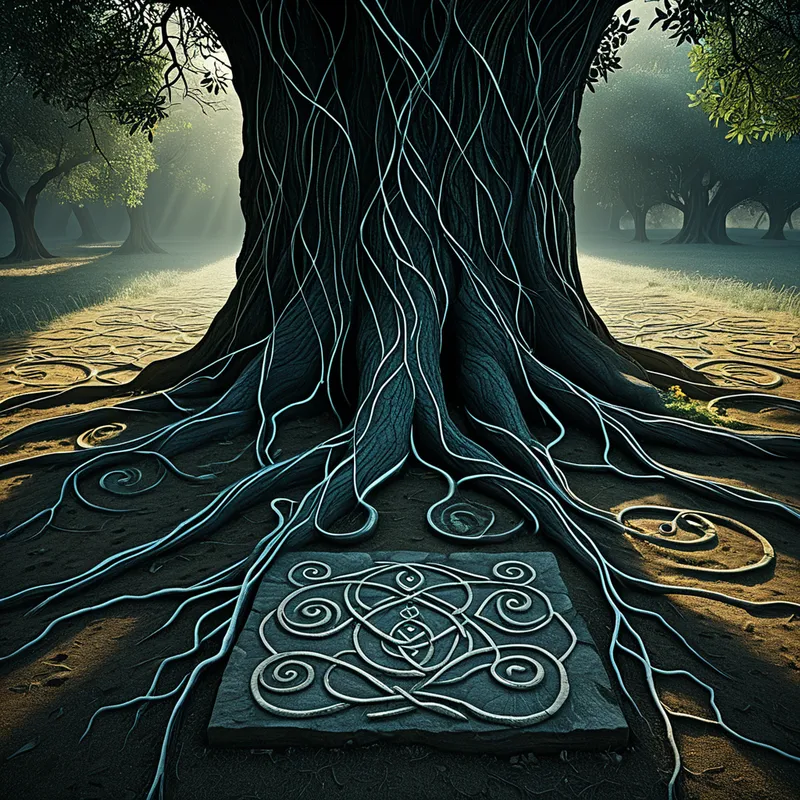
Alchemical Translation
The alchemical process modeled by this myth is the coniunctio oppositorum—the sacred marriage—between the soaring, volatile element of Spirit (Zeus, sky, lightning) and the fixed, solid element of Earth (the oak, the grove). For the modern individual undergoing individuation, this is the struggle to integrate the highest aspirations of the spirit with the grounded reality of one’s embodied existence and personal history.
The initial state is one of dissociation: the lightning bolt strikes randomly, destructively, or the tree stands silent, disconnected from the animating sky. The alchemical work is to bring them into conscious relationship. This involves “journeying to Dodona”—withdrawing to a place of inner quiet (the grove) and attending to the natural, often subtle, manifestations of the Self.
Individuation is the process of becoming the sacred grove where your highest purpose can take root and speak through the medium of your lived experience.
The “prophecy” received is not a fortune-telling of external events, but the revelation of one’s own inherent law, the dike (justice/order) of one’s unique being. The hanging bronze vessels are the conscious efforts we make—through journaling, art, therapy, ritual—to capture these whispers and give them form. The triumph is not becoming a tyrannical “ruler” of one’s psyche, but becoming a Dodona: a stable, sacred space within, where the sovereign voice of the Self can be heard in dialogue with the deep earth of the unconscious, guiding one’s life with an authority that is both transcendent and deeply rooted.
Associated Symbols
Explore related symbols from the CaleaDream lexicon: