Zeus's Eagle Myth Meaning & Symbolism
The myth of the eagle that serves Zeus, embodying celestial authority, the delivery of fate, and the painful, transformative journey of the soul.
The Tale of Zeus’s Eagle
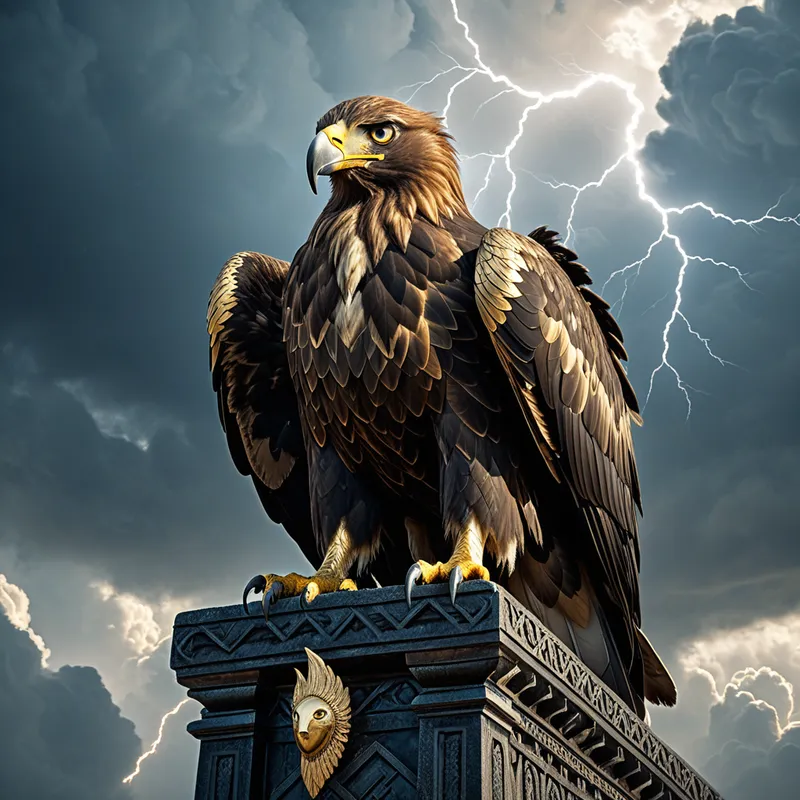
Hear now the tale of the sky’s sovereign and his winged fury. In the beginning, after the great war that shook the cosmos, Zeus claimed his dominion. The heavens were his throne, the thunder his scepter, and the air his royal court. But a king requires a messenger, a hunter, an extension of his will that can pierce the veil between the divine and the mortal. From the aether itself, or perhaps from the first crack of his thunderbolt, was born the Eagle.
Its wingspan blotted out the sun. Its feathers were not mere plumage but seemed forged from the light that rings the edge of storms—a dull, potent gold shot through with the grey of gathering clouds. Its eyes held the cold, unblinking fire of distant stars, seeing not just the shape of things, but the truth within them. This was no simple beast of prey. This was the will of Olympus given form, a creature of absolute purpose.
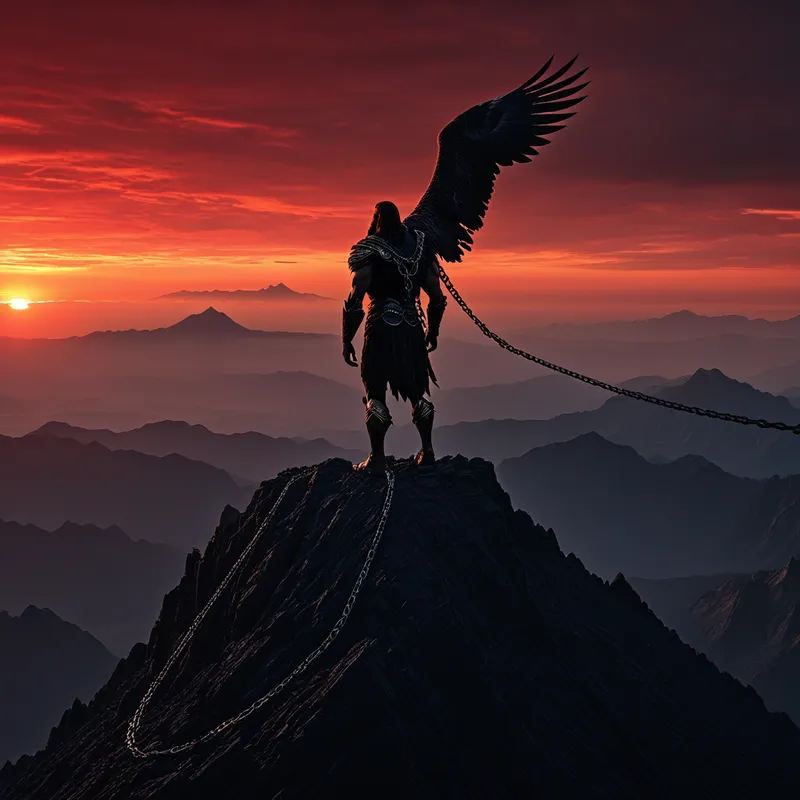
And purpose it found in the grim, rocky crags of the Caucasus Mountains. For there was bound Prometheus, the cunning Titan, shackled in unbreakable adamant. His crime was compassion; his gift, the spark of divine fire to wretched, shivering humanity. For this defiance of the new order, Zeus pronounced an eternal sentence. Every day, under the pitiless sun or the icy stars, the agony would renew.
The air would grow heavy, charged with the scent of ozone and a profound, predatory silence. Then, a shadow would fall—a moving darkness that chilled the blood. The Eagle descended not with a screech, but with the sound of shearing wind. It would land upon the tormented Titan, its talons like hooks of chilled iron. With a terrible, deliberate precision, it would tear into his side, seeking the liver, the seat of passion and vitality. Prometheus would cry out, a sound swallowed by the vast, uncaring mountains. The Eagle would feast, its golden beak stained, fulfilling its sacred, dreadful duty.
And every night, as the Eagle returned to its perch beside the throne of Zeus, the immortal flesh of Prometheus would heal, the liver regrowing, preparing him for the dawn’s fresh torment. This was the cycle: the descent of justice, the consumption of defiance, the silent, painful rebirth. The Eagle was the instrument, the relentless hour-hand of divine punishment, circling the mountain peak in an orbit of suffering. For ages untold, this was its sole, grim labor—until the day the hero Heracles, passing on his own impossible journey, saw the shadow fall. With a cry that echoed his father’s thunder, he drew his bow. The arrow, guided by fate or compassion, found its mark. The Eagle fell, its reign of rending flesh ended. Prometheus was unbound, and the Eagle, its terrible task complete, was lifted to the heavens, immortalized among the stars, forever circling as the constellation Aquila. The hunter became the hunted, and the instrument of torture became a fixture of eternal glory.
Cultural Origins & Context
This myth, in its most famous form, comes to us from the epic poetry of Hesiod and later the tragic playwright Aeschylus. It was not a simple fireside tale, but a foundational narrative deeply embedded in the Greek understanding of cosmic order, moira, and the price of progress. The story of Prometheus and the Eagle was part of a larger mythological complex explaining humanity’s ambiguous relationship with the gods—blessed with technology and consciousness, yet subject to divine wrath and natural suffering.
The myth served multiple societal functions. For the ruling class, it was a potent symbol of the consequences of rebellion against established authority (Zeus’s rule). For the common person, it likely resonated as a story of immense sacrifice for human betterment, with the Eagle representing the inevitable, recurring sufferings of mortal life—plague, famine, war—that feel like a predatory force from above. It was a myth told to explain the presence of unearned, cyclical pain in the world, and the fragile hope for a hero (a Heracles) who might one day break the cycle.
Symbolic Architecture
The Eagle of Zeus is a symbol of breathtaking complexity. It is not merely a bird, but an archetypal embodiment of celestial authority in its most visceral form.
The eagle does not question; it executes. It is the perfect union of will and action, the thought of the king made manifest in the world.
Primarily, it represents Absolute, Impersonal Law. Zeus’s decree is the law of the cosmos. The Eagle is that law enacted, devoid of malice or mercy. It is the system itself, the inescapable consequence. Its daily return mirrors the inevitability of natural cycles—the rising sun, the changing seasons, death itself—which are both glorious and terrifying in their indifference.
Psychologically, the Eagle symbolizes the Superego in its most tyrannical aspect. It is the internalized voice of authority, of “should” and “must,” that perpetually punishes the rebellious, creative, and compassionate spirit (Prometheus) within us. It is the part of the psyche that enforces conformity, that tears at our vital energies (the liver) when we dare to step outside sanctioned boundaries or claim a power (fire/consciousness) not explicitly granted.
Yet, its elevation to the stars upon its death reveals a final layer: Transmuted Instrument. The Eagle, through the completion of its duty and its sacrifice at the hands of the reconciling hero, is itself transformed. It moves from being an agent of torture to a celestial guide. It becomes a symbol of the soul’s own potential ascent, but only after the painful, necessary work of the psyche has been accomplished.

The Dreamer’s Resonance
When the Eagle of Zeus circles in the modern dreamscape, it signals a profound encounter with the archetype of the Ruler—both internal and external. The dreamer is likely experiencing a period where they feel subject to an overwhelming, impersonal force. This could be a rigid institutional structure, a demanding career, a suffocating family dynamic, or their own crippling perfectionism.
Somatically, this dream may be preceded by or result in feelings of constriction in the chest or solar plexus, a literal feeling of being “preyed upon.” The dream Eagle is rarely friendly; its gaze is assessing, its intent ambiguous or threatening. To dream of being Prometheus, feeling the talons or the beak, indicates a direct experience of this psychic punishment—perhaps for a creative risk, a personal truth spoken, or a act of independence that has invoked inner or outer censure.
The psychological process here is one of Confrontation with the Senex—the old, ordering, often oppressive principle. The dream asks: What unbending law am I serving? What part of my own vitality am I allowing to be consumed daily by duty, fear, or a harsh inner critic? The Eagle’s appearance marks the moment this automated cycle of punishment becomes conscious, and therefore, capable of being addressed.
Alchemical Translation
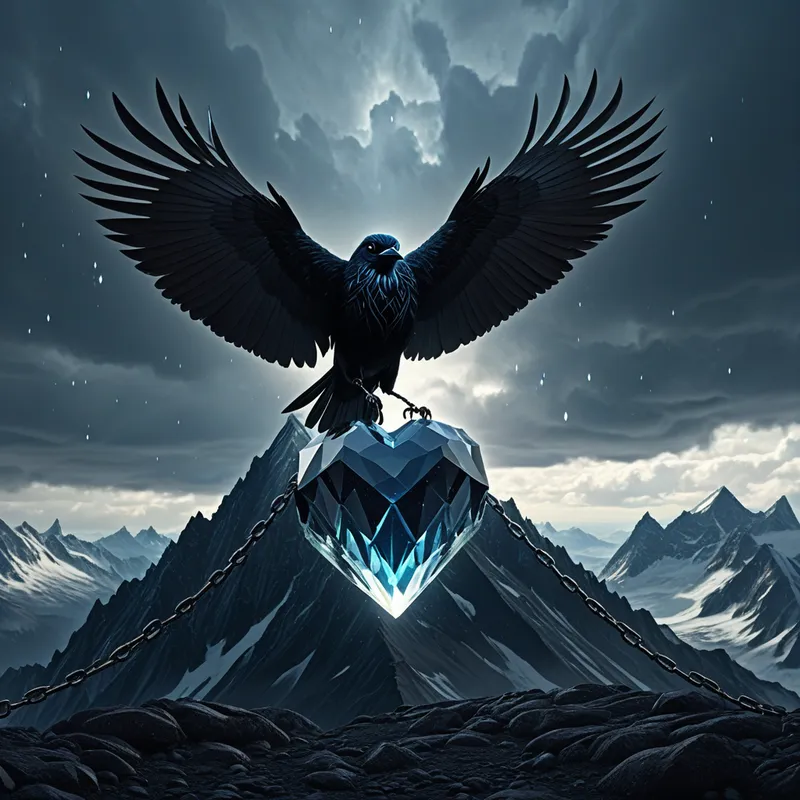
The alchemical journey modeled by this myth is not for the faint of heart. It is the opus of nigredo—the blackening, the putrefaction. Prometheus, the creative, rebellious spirit (the anima or the conscious ego that seeks growth), is chained to the mountain of material reality and habitual suffering. The Eagle is the agent of this necessary dissolution.
The eagle’s feast is horrifying, yet it is the precise mechanism of the old identity’s undoing. One cannot steal divine fire and remain unchanged; the cost is the deconstruction of the former self.
The modern individual undergoing this “Promethean” process feels bound by their own past actions, commitments, or the structures they helped build. The recurring “eagle” is the recurring crisis, the anxiety attack, the depressive episode, the failed project—that seems to tear out the same piece of them, over and over. The alchemical secret is that this is not meaningless torture, but a brutal, initiatory refinement. The liver, the organ of filtering and metabolism, is attacked. Psychically, this is the forced metabolization of experience, the filtering of raw life into wisdom.
The transmutation occurs in the heroic intervention—the arrival of Heracles, the empowered ego or the integrating Self. This is the moment one finally says “enough,” and takes aim at the cyclical pattern itself. Shooting the Eagle is not destroying one’s sense of order or responsibility, but killing its tyrannical, repetitive mode. It is the act of conscious choice breaking an unconscious complex.
The final stage is astrification—the eagle becoming the constellation. The impersonal force that was once an agent of pain is integrated and lifted to a higher plane. It becomes a navigational principle. The individual internalizes a sense of law and order not as a punitive jailer, but as a guiding structure, a personal cosmology that allows for freedom within its bounds. The liberated Prometheus (the creative spirit) and the stellified Eagle (the wise ruler) coexist. The psyche achieves a sovereign state where authority serves growth, and the fire once stolen becomes the innate, lawful light of a conscious life.
Associated Symbols
Explore related symbols from the CaleaDream lexicon: