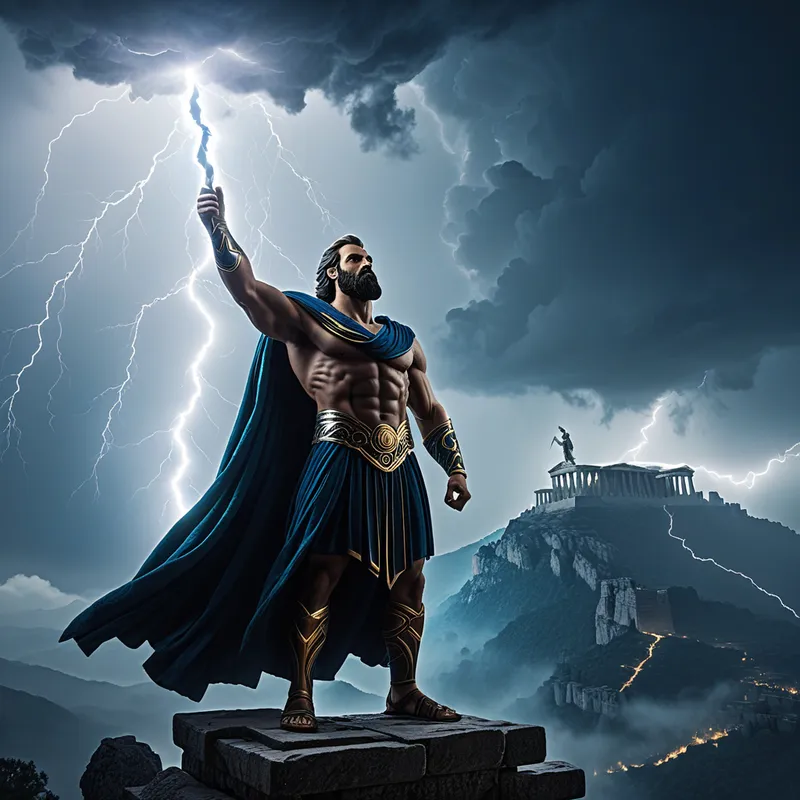
Zeus / Jupiter Pluvius Myth Meaning & Symbolism
The myth of Zeus Pluvius, the rain-bringing aspect of the sky god, embodies the profound psychological tension between divine wrath, mercy, and the life-giving storm.
The Tale of Zeus / Jupiter Pluvius
Hear now the tale of the parched earth and the withheld sky. The sun, a merciless bronze disc, had hung for seasons beyond count. The rivers of Gaia shrank to silver threads, then to dust. The soil cracked like an old pot, and the green life of the world grew brittle, whispered prayers on the dry wind. The people looked up, their eyes stinging, and saw only a vault of relentless, cloudless blue—the domain of the Sky-Father, who had turned his face away.
This was not mere weather. This was the silence of the throne. Zeus, who gathers the clouds, who speaks in thunder and gifts the earth with fructifying rain, held his bounty in check. His reasons were his own—perhaps the pride of men had grown too great, their sacrifices too meager, their forgetfulness a thorn. The connection between heaven and earth, the sacred marriage of sky and soil, was severed. The world was dying of politeness, of a divine neglect that felt like wrath.
In the high places, on mountain peaks that once brushed the belly of the storm, the priests raised their voices. Not in demand, but in a raw-throated invocation. They called not to the distant, juridical Zeus of laws and oaths, but to Zeus Pluvius—the Shower, the Sender of Soft Rains. They offered not grand hecatombs, but libations of the last precious wine poured onto dust, a promise of what could be. They sought to remind the god of his own nature, of his role as the husband of the earth.
And on Olympus, the tension gathered. It was a pressure in the ether, a weight in the air before the breaking. The god felt the pull of his own function, the ache of the land that was his bride. His anger, a cold, high thing, began to warm, to churn, to become something else—a generative turmoil. He reached for his terrible weapon, the Keraunos, but not to punish. To court. To consummate.
Then came the first scent, carried on a sudden, cool wind that sighed through the olive groves—the smell of wet stone, of ozone, of promise. The flawless blue dome was marred by a stain, a bruise of deepest grey blooming from the horizon. A low rumble, not yet a crash, traveled through the very bones of the hills. It was the sound of the god remembering.
The sky darkened, a majestic, terrifying canopy. Then, the first drop. It struck the dust with a sound like a tiny drum, raising a puff of earth-scent. Then another. And another. Not a deluge of fury, but the steady, insistent patter of Pluvius at work. The rain was a veil, a blessing, a returned embrace. It soaked into the cracks, kissed the withered stems, filled the streambeds with a newborn chatter. The people did not cheer; they wept, faces upturned, drinking the sky’s mercy. The storm was not an end to the god’s silence, but his profound, thundering speech. The drought was broken. Life was renewed not in spite of the god’s power, but through its essential, nurturing expression.

Cultural Origins & Context
The figure of Zeus Pluvius, or his Roman counterpart Jupiter Pluvius, is not a separate deity but a vital aspect of the supreme sky god, rooted in the most fundamental realities of Mediterranean life. This mythic pattern emerged from an agrarian world utterly dependent on seasonal rains. The narrative was not a single story penned by an author, but a collective, lived experience given voice through ritual, prayer, and the oral tradition of bards and priests. It was told during times of anxiety at shrines on high places like Mount Lycaeus in Arcadia, where Zeus was worshipped as “the rainmaker.”
Its societal function was multifaceted. On a practical level, it provided a framework for understanding and potentially influencing the uncontrollable climate. More profoundly, it reinforced the cosmic and social order. The king of the gods mirrored the ideal of the earthly ruler: one who holds the power of life and death (the lightning bolt that destroys, the rain that nourishes) and must be petitioned correctly to exercise his benevolent aspect. The myth codified the relationship between humanity and the divine as a reciprocal covenant of respect, sacrifice, and remembrance. The failure of rain was not a meteorological accident; it was a theological and social crisis, a sign of broken xenia with the heavens.
Symbolic Architecture
At its core, the myth of Zeus Pluvius is an archetypal drama of withheld and released potential. The drought symbolizes a state of psychic or spiritual sterility—a period where the animating, nourishing energies of the Self (the inner sovereign) are disconnected from the conscious personality (the people, the land). The unyielding blue sky represents a consciousness that is all order, all law, all distant intellect, devoid of the fertilizing moisture of emotion, intuition, and soulful connection.
The storm is the necessary chaos that precedes creation; the lightning, the brilliant, terrifying insight that cleaves old structures, and the rain, the compassionate dissolution that allows for new growth.
Zeus himself embodies the tension of the ruling principle. He contains both the scorching sun of judgment and the life-giving cloud. His transformation from withholding sky-god to nourishing rain-god illustrates a critical psychological movement: the integration of power with nurturance, of authority with generosity. The Keraunos, typically an instrument of annihilation, becomes here an instrument of catalysis, sparking the atmospheric alchemy that produces rain. This symbolizes how our most potent and sometimes destructive energies, when directed inwardly with purpose, can generate profound emotional and spiritual release.

The Dreamer’s Resonance
When this mythic pattern stirs in the modern dreamer, it often manifests as dreams of profound thirst in a barren landscape, of staring at a locked or empty sky, or of waiting for a storm that never comes. Somatically, this may correlate with feelings of creative block, emotional dryness, or a sense of being ruled by a cold, critical inner authority that offers no sustenance.
The dream of the arriving storm—the dark clouds, the thunder, the eventual rain—signals a pivotal shift in the unconscious. It represents the psyche’s innate movement toward self-regulation and wholeness. The initial fear of the storm’s approach is the ego’s resistance to the overwhelming power of the unconscious emotions now demanding recognition. The soaking rain in the dream is not just relief, but a profound somatic experience of being permeated, filled, and emotionally rehydrated by one’s own deepest Self. The dreamer is undergoing the process of moving from a state of psychic drought—where feelings are armored and life feels sterile—to one where the waters of the unconscious are allowed to flow again, nourishing the parched fields of conscious life.

Alchemical Translation
The alchemical journey mirrored in this myth is the Solutio, or dissolution. The conscious personality (the dry, hardened earth) must be dissolved by the aqua divina of the unconscious (the rain) to be reborn in a more fertile, integrated form. The modern individual’s “drought” is a state of rigid identification with persona, duty, or intellectual control.
Individuation requires the sovereign Self to send the storm, to disrupt the stagnant peace of the ego with the terrifying and fructifying waters of the soul.
The “petition” to Zeus Pluvius translates as the active engagement with the inner ruler—the act of acknowledging one’s own dryness and sincerely calling upon the deeper, often feared, sources of one’s being. This is shadow work. The lightning bolt is the shocking, disruptive insight—perhaps a sudden realization, a forgotten trauma surfacing, or a passionate conviction—that shatters the old, arid way of being. The ensuing “rain” is the flood of associated feelings, memories, and creative impulses that follows. The goal is not to avoid the storm, but to learn to stand in the rain, to allow the dissolving and nourishing powers of the unconscious to perform their alchemy. One emerges not simply watered, but transformed, with the hard ground of the ego softened to receive the seeds of a new and more authentic life. The individual becomes, in a sense, their own Zeus Pluvius—the sovereign who commands the inner climate and, in a act of supreme self-compassion, sends the life-giving storm.
Associated Symbols
Explore related symbols from the CaleaDream lexicon: