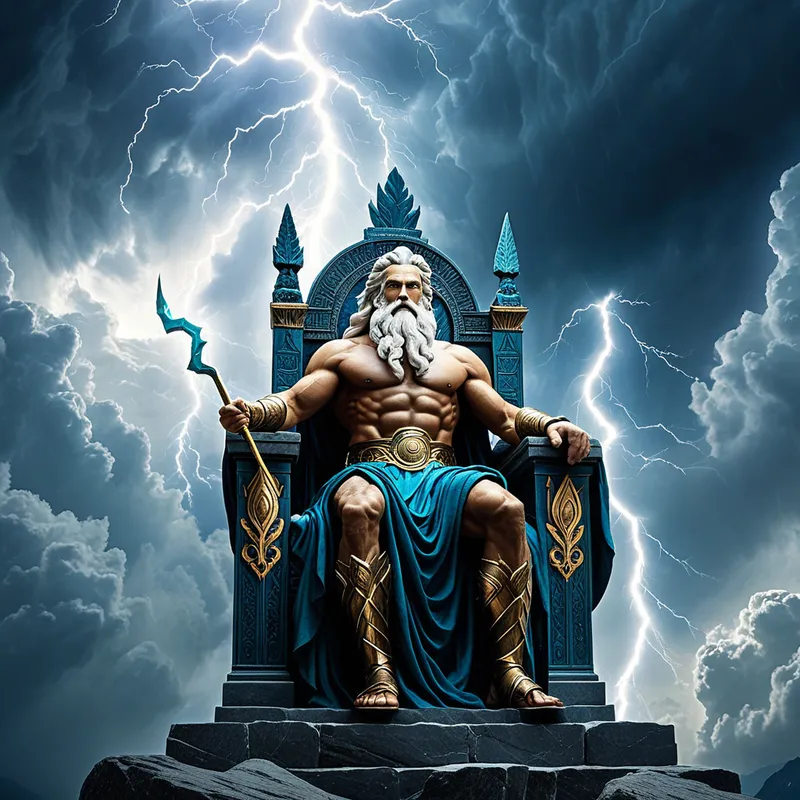
Zeus as the king of gods in Gr Myth Meaning & Symbolism
The myth of the sky-father who establishes cosmic order from primordial chaos, embodying the eternal tension between authority, justice, and raw, untamed power.
The Tale of Zeus as the king of gods in Gr
Before the world knew its name, there was only the yawning, formless dark—Chaos. From its depths arose the Earth, Gaia, and with her, the first gods, the Titans. Their king was Kronos, who, fearing a prophecy that his own child would overthrow him, swallowed his children whole as they were born. The air grew thick with the silence of swallowed destinies.
But his wife, Rhea, her heart a cavern of grief and cunning, could bear it no more. When her sixth child was born, she wrapped a stone in swaddling clothes and gave it to Kronos. The Titan, his mind clouded by fear, devoured the deception without a glance. The true child, a son, was spirited away to a hidden cave on the isle of Crete. There, the infant’s cries were drowned by the clashing of shields raised by the Kouretes, and he was nursed by the divine goat, Amaltheia. He was named Zeus.
He grew in secret, his strength the strength of the hidden sky, his will the gathering storm. When he came of age, he confronted his father. With a potion of cunning and might, he forced Kronos to disgorge his swallowed siblings: Hestia, Demeter, Hades, Hera, and Poseidon, whole and raging. Thus began the great war, the Titanomachy. For ten years, the cosmos shook. Zeus freed the Cyclopes and the hundred-handed Hekatoncheires from the pit of Tartarus. In gratitude, the Cyclopes forged for him his ultimate weapon: the thunderbolt.
With this crackling spear of celestial fire, Zeus led the final assault. The Hekatoncheires hurled mountains; the Titans roared defiance. Lightning split the firmament, and the earth boiled. Finally, Zeus cast the defeated Titans down into Tartarus, appointing the Hekatoncheires as their eternal guards. The old order, ruled by fear and consumption, was shattered.
From the ashes of chaos, a new cosmos was born. The three brothers drew lots: Hades won the shadowy underworld, Poseidon the restless seas, and Zeus the luminous sky and the right to preside over all. He established his throne on the cloud-wreathed peak of Mount Olympus. Here, he became the king of gods in Gr, the guarantor of Dike and Themis. His eagle soared as his messenger, his thunderbolt was the enforcer of oaths, and his gaze, though often tempered by passions of its own, fell upon gods and mortals alike, a reminder of a power that had wrested order from the belly of chaos itself.
Cultural Origins & Context
This myth is the foundational narrative of the Hellenic world, a story that did not belong to a single author but to the collective soul of a culture. It was passed down through generations of oral poets, the aoidoi, long before being crystallized in the epic verses of Hesiod’s Theogony and echoed in the hymns of Homer. Its function was profoundly societal and cosmological. It was not mere entertainment; it was a sacred map explaining the origin of the world (cosmogony), the structure of power (theocracy), and the nature of justice itself.
The myth served to legitimize a patriarchal, Olympian social order, displacing the older, chthonic powers associated with the Titans and Gaia. It answered fundamental questions: Why is the sky supreme? Why do storms come? Why must oaths be kept? By rooting authority in a victory over monstrous, chaotic forces, it provided a divine blueprint for kingship, law, and the precarious balance of civilization against the ever-present threat of a relapse into disorder. The king of gods in Gr was the ultimate archetype of the ruler, and his story was the template against which human leaders were measured and understood.
Symbolic Architecture
Psychologically, Zeus represents the emergence of the conscious ego from the unconscious, primal matrix. Kronos, the devouring father, symbolizes the tyranny of the past, of outdated complexes and patterns that consume new potential. Zeus’s hidden childhood signifies the necessary incubation period of the nascent Self, which must develop in secret, protected from the crushing weight of the established psychic order.
The thunderbolt is not merely a weapon; it is the sudden, illuminating flash of consciousness that differentiates, decides, and imposes order upon the inner chaos.
His victory is the triumph of differentiated consciousness (light, sky, law) over undifferentiated, instinctual power (earth, darkness, raw consumption). Establishing his rule on Olympus represents the construction of a coherent psychic structure—a “ruling principle” or central complex of consciousness that attempts to govern the myriad other forces (gods, desires, impulses) within the psyche. Yet, Zeus is no sterile tyrant; his many liaisons symbolize the ego’s constant, often disruptive, engagement with other archetypal energies (beauty, wisdom, transformation), reminding us that the ruling principle is never absolute and must continually negotiate with the full pantheon of the soul.
The Dreamer’s Resonance
When this mythic pattern stirs in modern dreams, it often signals a critical phase of psychological restructuring. Dreaming of a powerful, authoritarian figure—a king, a CEO, a stern father—can reflect the dreamer’s confrontation with their own internal “ruling complex.” This might be an outdated self-image, a rigid moral code, or a domineering inner critic that has, like Kronos, been consuming one’s potential.
A dream of a gathering storm or being struck by lightning can somaticize the shocking, yet necessary, insight that breaks an old pattern. The somatic feeling might be one of awe, terror, or sudden, electrifying clarity. To dream of finding or wielding a sacred, powerful object (a scepter, a key, a brilliant crystal) parallels Zeus seizing the thunderbolt; it is the psyche granting the ego a new tool of authority and discrimination. Such dreams ask: What old, fear-based order in your life needs to be overthrown? What nascent strength have you been hiding away, waiting for its moment to reign?
Alchemical Translation
The alchemical journey mirrored in Zeus’s myth is the opus of achieving psychic sovereignty—the stage of Individuation where one moves from being ruled by unconscious complexes to establishing a conscious, responsible center of gravity. The initial state is the nigredo: the dark, chaotic rule of Kronos, where potential is swallowed by shadow.
The hidden growth in Crete is the albedo, the purification and nurturing of the true Self in isolation. The confrontation and the Titanomachy represent the fiery rubedo, the violent but necessary conflict that separates and differentiates the elements of the psyche. Casting the Titans into Tartarus is not about annihilation, but about containment—placing primal, chaotic drives under the guard of awareness (the Hekatoncheires).
To become sovereign is not to eliminate the Titans within, but to know their prison so well you hold the key.
Finally, drawing lots with his brothers signifies the integration and acceptance of all realms of being: the depths of the unconscious (Hades), the fluid realm of emotion and the unconscious (Poseidon), and the clarified realm of consciousness and spirit (Zeus). The mature individual does not deny any part but establishes a “ruling” consciousness that can, however imperfectly, mediate between them. The ongoing myth of Zeus—with his judgments, his passions, and his enforcement of order—models the lifelong task of maintaining this hard-won sovereignty, forever negotiating between the law of the sky and the chaos of the deep.
Associated Symbols
Explore related symbols from the CaleaDream lexicon: