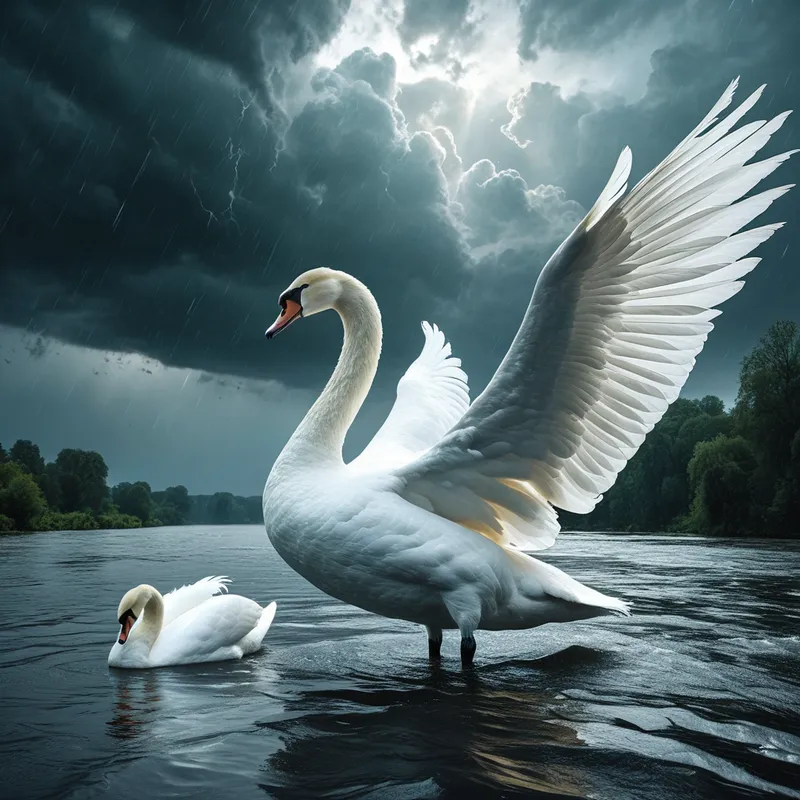
Zeus as Swan Myth Meaning & Symbolism
Zeus transforms into a swan to seduce Queen Leda, a union that births the twins of fate and ignites the Trojan War.
The Tale of Zeus as Swan
The air above Sparta was heavy, not with summer heat, but with a watching presence. It was the gaze of the King of Olympus, a force that bent the light and stilled the birdsong. His eye had fallen upon Leda, a queen whose beauty was not of delicate things, but of the deep earth and the steady flame. She walked by the Eurotas, [the river](/myths/the-river “Myth from Buddhist culture.”/)’s murmur a familiar comfort against the strange, charged silence of the evening.
Zeus, from his cloudy throne, knew the direct approach of a god in glory would shatter the moment, would turn awe to terror. The divine must sometimes cloak itself to achieve its ends. A plan, both cunning and profound, unfolded in his thunderous mind. He would not come as a lord, but as a creature of sublime and vulnerable beauty. The clouds above Sparta began to churn, not into a storm, but into a vortex of downy white and celestial light. From this luminous tumult, he descended—no longer the bearded wielder of the keraunos, but a swan.
But this was no bird of the marsh. This swan was magnificent beyond measure, its plumage holding the sheen of moonlight on snow, its wingspan vast enough to cast the riverbank into shadow. It moved with an eerie, graceful purpose, a being of pure myth made flesh and feather. It let out a cry that was not a honk, but a haunting, melodic note that seemed to still the very flow of the [water](/myths/water “Myth from Chinese culture.”/).
Leda froze. Terror and wonder warred within her. The creature was beautiful, yet its beauty was immense, alien. It did not flee her mortal presence but approached, its dark eyes holding depths of ancient sky. It moved closer, and in its gaze, she saw not animal instinct, but a terrifying, knowing intelligence. The swan, this divine disguise, bowed its long neck, a gesture of supplication and courtship that was utterly unnatural for a beast. The air hummed with a power both seductive and overwhelming.
The myth tells us she did not run. Perhaps she could not. The boundary between the mortal and the divine had been breached not with a quake, but with a feather’s touch. The swan enfolded her with its great wings, a shelter that was also a capture, a embrace that was also a consummation. In that moment by the whispering river, under a sky that watched with a thousand hidden eyes, queen and god, woman and swan, were joined. It was a union of impossible opposites, a collision of realms that would ripple through time itself. When the dawn finally broke, the magnificent swan was gone, leaving only a shaken queen and the indelible mark of destiny upon her soul.
Cultural Origins & Context
This haunting tale is primarily preserved for us in later sources, such as the poetic fragments of the Sappho and the more systematic, though no less mythic, catalogues of Pseudo-Apollodorus. It was not a central cult myth with grand temples, but a narrative that thrived in the realms of poetry, art, and private reflection. Vase painters depicted the enigmatic scene; poets alluded to its devastating consequences.
Its function was explanatory and foundational. For the Greeks, the myth served as a divine etiology for the most catastrophic human event in their legendary past: the Trojan War. From the union of Zeus and Leda came two eggs (or one double-yolked egg, in some versions). From these eggs hatched Helen, whose face would launch a thousand ships; Clytemnestra, who would become a queen of murder; and the twin brothers Castor and Polydeuces (Pollux), the Dioscuri. Thus, a single act of divine desire, mediated through a feathered form, sets in motion the entire engine of epic fate, heroism, and tragedy. It roots human history in a moment of transcendent, ambiguous intimacy.
Symbolic Architecture
The [symbolism](/symbols/symbolism “Symbol: The use of symbols to represent ideas or qualities, often conveying deeper meanings beyond literal interpretation. In dreams, it’s the language of the unconscious.”/) here is a dense and potent layering of opposites. Zeus, [the principle](/symbols/the-principle “Symbol: A fundamental truth, law, or doctrine that serves as a foundation for a system of belief, behavior, or reasoning, often representing moral or ethical standards.”/) of sky, law, and sovereign [consciousness](/symbols/consciousness “Symbol: Consciousness represents the state of awareness and perception, encompassing thoughts, feelings, and experiences.”/), chooses the form of the swan—a [creature](/symbols/creature “Symbol: Creatures in dreams often symbolize instincts, primal urges, and the unknown aspects of the psyche.”/) of [water](/symbols/water “Symbol: Water symbolizes the subconscious mind, emotions, and the flow of life, representing both cleansing and creation.”/), grace, and poetic [beauty](/symbols/beauty “Symbol: This symbol embodies aesthetics, harmony, and the appreciation of life’s finer qualities.”/). This is the ultimate hieros gamos, or sacred [marriage](/symbols/marriage “Symbol: Marriage symbolizes commitment, partnership, and the merging of two identities, often reflecting one’s feelings about relationships and social obligations.”/), between the celestial and the earthly, the structured and the fluid, the [king](/symbols/king “Symbol: A symbol of ultimate authority, leadership, and societal order, often representing the dreamer’s inner power or external control figures.”/) and the [lover](/symbols/lover “Symbol: A lover in dreams often represents intimacy, connection, and the emotional aspects of relationships.”/).
The swan is the disguise that reveals the true nature of divine power: its ability to become its opposite to achieve union.
The swan itself is a profound [symbol](/symbols/symbol “Symbol: A symbol can represent an idea, concept, or belief, serving as a powerful tool for communication and understanding.”/). In many cultures, it represents transformation, purity, and the [journey](/symbols/journey “Symbol: A journey in dreams typically signifies adventure, growth, or a significant life transition.”/) between worlds (land, water, air). Its song was fabled to be most beautiful at the [moment](/symbols/moment “Symbol: The symbol of a ‘moment’ embodies the significance of transient experiences that encapsulate emotional depth or pivotal transformations in life.”/) of [death](/symbols/death “Symbol: Symbolizes transformation, endings, and new beginnings; often associated with fear of the unknown.”/), linking it to transitions and thresholds. For Zeus to become the swan is for the ultimate ruling principle to temporarily abdicate its [throne](/symbols/throne “Symbol: A seat of authority, power, and sovereignty, representing leadership, divine right, or social hierarchy.”/) and enter the [realm](/symbols/realm “Symbol: The symbol of ‘Realm’ often signifies the boundaries of one’s consciousness, experiences, or emotional states, suggesting aspects of reality that are either explored or ignored.”/) of [soul](/symbols/soul “Symbol: The soul represents the essence of a person, encompassing their spirit, identity, and connection to the universe.”/), beauty, and [fate](/symbols/fate “Symbol: Fate represents the belief in predetermined outcomes, suggesting that some aspects of life are beyond human control.”/). He does not conquer; he seduces. He does not command; he enchants. The power is no [less](/symbols/less “Symbol: The concept of ‘less’ often signifies a need for simplicity, reduction, or minimalism in one’s life or thoughts.”/) absolute, but its [expression](/symbols/expression “Symbol: Expression represents the act of conveying thoughts, emotions, and individuality, emphasizing personal communication and creativity.”/) is inverted, becoming intimate and immanent rather than distant and transcendent.
Leda represents the [human](/symbols/human “Symbol: The symbol of a human represents individuality, complexity of emotions, and social relationships.”/) soul or the receptive consciousness that encounters the numinous—the overwhelming, wholly other [presence](/symbols/presence “Symbol: Presence in dreams often signifies awareness or acknowledgment of something significant in one’s life.”/) of the divine. Her experience is not of clear [revelation](/symbols/revelation “Symbol: A sudden, profound disclosure of truth or insight, often through artistic or musical means, that transforms understanding.”/), but of awe-struck [ambiguity](/symbols/ambiguity “Symbol: A state of uncertainty or multiple possible meanings, often found in abstract art and atonal music where clear interpretation is intentionally elusive.”/). Was it rape or seduction? A violation or a blessing? The myth refuses a simple answer, holding the [tension](/symbols/tension “Symbol: A state of mental or emotional strain, often manifesting physically as tightness, pressure, or unease, signaling unresolved conflict or anticipation.”/) of an encounter that is both traumatic and fatefully creative. She is the [vessel](/symbols/vessel “Symbol: A container or structure that holds, transports, or protects something essential, representing the self, emotions, or life journey.”/) for a [destiny](/symbols/destiny “Symbol: A predetermined course of events or ultimate purpose, often linked to spiritual forces or cosmic order, representing life’s inherent direction.”/) she did not choose, embodying the [human](/symbols/human “Symbol: The symbol of a human represents individuality, complexity of emotions, and social relationships.”/) [condition](/symbols/condition “Symbol: Condition reflects the state of being, often focusing on physical, emotional, or situational aspects of life.”/) of being acted upon by forces far greater than the individual will.
The Dreamer’s Resonance
When this myth pattern stirs in the modern unconscious, it often manifests in dreams of profound, unsettling beauty. One might dream of a magnificent bird that is both terrifying and compelling, entering one’s personal space. There may be dreams of unexpected, transformative unions or visitations that feel sacred yet violating. The somatic experience can be one of paralysis within the dream—the Leda complex—a feeling of being chosen, overwhelmed, and irrevocably altered by a force from the deep [psyche](/myths/psyche “Myth from Greek culture.”/).
This dream signals a confrontation with the animus in its most transcendent, non-personal form. It is not about a human partner, but about an encounter with the archetypal masculine principle of consciousness itself, descending in a disguised, “softer” form. The dreamer may be undergoing a process where a dominant, perhaps rigid, conscious attitude (their inner “Zeus”) is being compelled to transform, to adopt a new guise of sensitivity, artistry, or connection (the “swan”) to integrate a neglected part of the soul (the “Leda”). The resulting psychic “children” are new potentials, fates, or creative drives born from this uneasy marriage.
Alchemical Translation
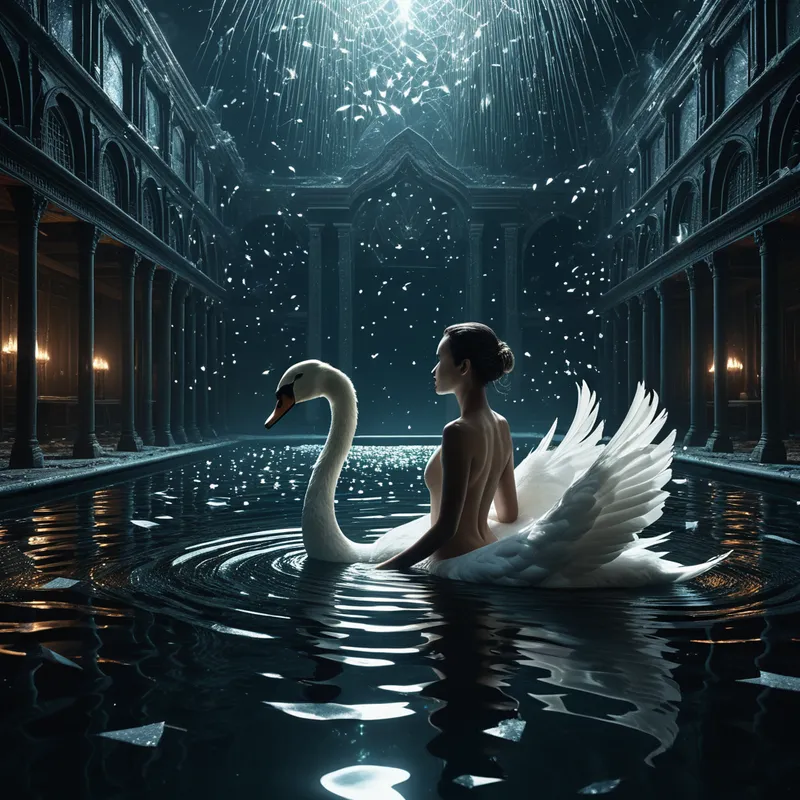
Psychologically, the myth models the alchemical stage of coniunctio oppositorum—[the conjunction](/myths/the-conjunction “Myth from Alchemical culture.”/) of opposites necessary for individuation. The modern individual often experiences their psyche as a set of warring opposites: spirit versus instinct, order versus chaos, will versus surrender. The conscious ego often identifies with one pole (the ruling, sky-god mentality) and represses the other.
The alchemical work is for the king to become the swan: for the ruling consciousness to willingly humble itself, to take on the form of its opposite, to court the soul.
This is not an act of defeat, but of supreme strategy and love. The “Zeus” in us—our willful, structuring, goal-oriented mind—must learn to approach the “Leda”—our embodied, instinctual, and fate-sensitive soul—not with force, but with enchantment. It must become beautiful, vulnerable, and poetic to win her consent for a union that will shatter the old, sterile order.
The “children” of this union are the new, synthetic realities of the personality. Helen is the dazzling, problematic beauty that leads to conflict and destiny—the compelling new value or life direction that upends everything. Clytemnestra is [the shadow](/myths/the-shadow “Myth from Jungian culture.”/), the ruthless consequence and buried rage that also emerges. Castor and Pollux represent the reconciled duality, the mortal and immortal twins who share their existence, symbolizing the integrated self that can navigate both the human and the transcendent. To integrate this myth is to accept that our deepest transformations, our most fateful choices, are often born not from clear decisions, but from moments of awe-filled, terrifying, and beautiful communion with the unknown within.
Associated Symbols
Explore related symbols from the CaleaDream lexicon: