Zellij Myth Meaning & Symbolism
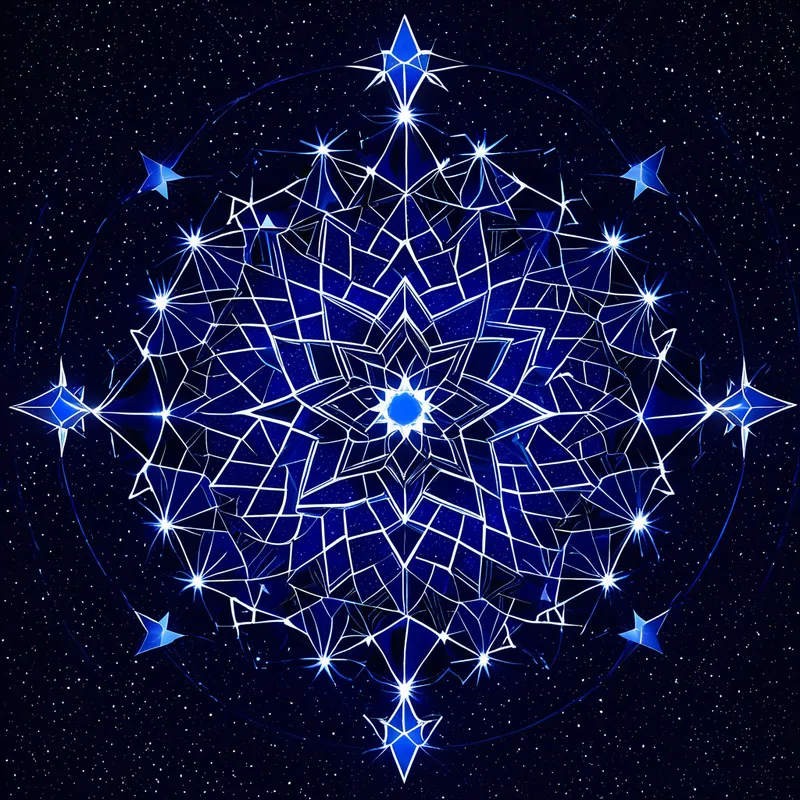
A myth of a shattered divine light, whose fragments became the infinite, interlocking patterns of Zellij, guiding the soul back to unity through sacred geometry.
The Tale of Zellij
In the time before time, when [the world](/myths/the-world “Myth from Tarot culture.”/) was a single, silent note held in the mind of the Divine, there existed a perfect, singular light. This was not a light that shone upon things, but the Light from which all things are shaped—the Nur. It was a perfect, seamless whole, a consciousness containing all potential forms, all mathematics, all beauty in a state of sublime unity.
But within that unity stirred a desire: to be known. To see its own infinite beauty reflected. And so, with a breath that was both a sigh and a command, the Light allowed itself to shatter. It was not a violent breaking, but a deliberate, sacred dispersion, like a dewdrop falling onto a parched mosaic floor. A million, billion fragments scattered across [the void](/myths/the-void “Myth from Buddhist culture.”/), each one a spark of the original radiance, each one holding a memory of the whole, yet now alone and adrift in the darkness.
The silence that followed was profound. The fragments, these sparks of Nur, floated in the emptiness, yearning. They longed for their lost neighbors, for the contact that would remind them of what they were. And as they yearned, they began to hum. Each fragment emitted a unique, geometric vibration—a triangle’s sharp song, a star’s complex harmony, a square’s steady drone.
Drifting through [the abyss](/myths/the-abyss “Myth from Kabbalistic culture.”/), a star-shaped fragment brushed against a hexagon. Their edges did not clash, but fit. A spark, not of light, but of recognition, passed between them. Where they touched, a line of golden mortar—the breath of that original sigh—solidified, binding them. Emboldened, they sought others. Triangles found their families, forming larger stars; squares gathered in grids, creating stable fields. A great, silent symphony of seeking and joining began to weave itself across the void.
They were building. Not a wall, not a prison, but a vast, infinite proof. A testament to their origin. Every connection was a prayer, every fitted edge a remembrance. From their yearning, the first Zellij was born—a cosmic mosaic, a map of longing that charted the path back from multiplicity to unity. The darkness was no longer empty; it was a canvas of divine grammar, written in tile and grout. The fragments were no longer lost. In finding each other, they were remembering themselves. And in the center of the greatest pattern, where the most complex star met the most perfect field, a new, composite light began to glow—not the original, singular Nur, but a light born of relationship, of journey, of sacred reunion.
Cultural Origins & Context
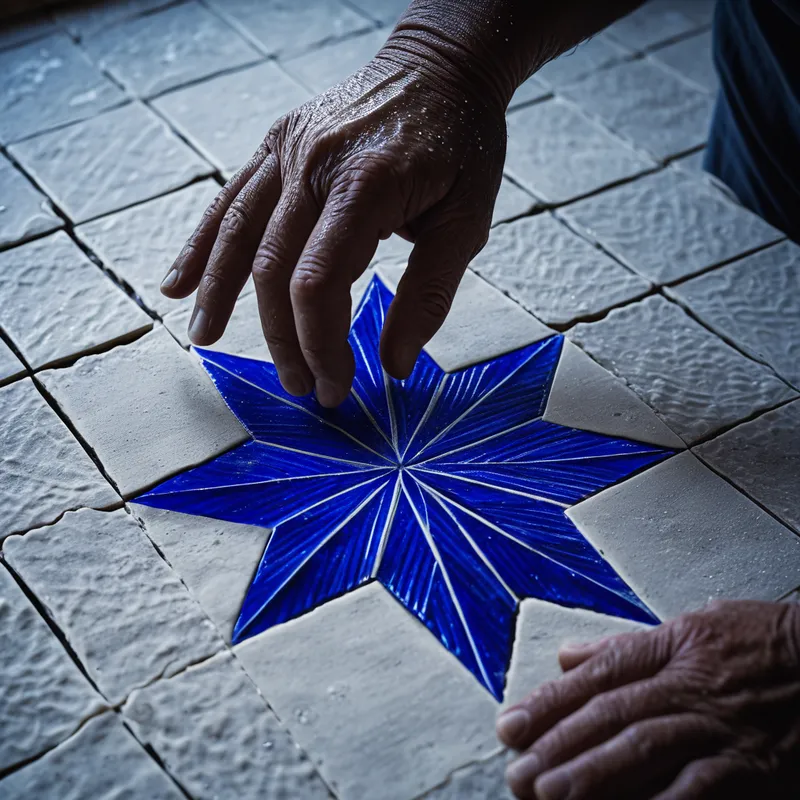
The myth of Zellij is not found in a single holy book but is woven into the very fabric of Islamic artistic and philosophical tradition. It is an oral and visual myth, passed down from master artisan to apprentice in the workshops (kuttab) of Fez, Granada, and Istanbul. The story was told not with words alone, but with the click of tile against tile, the scrape of the menqash, and the patient application of plaster.
Its societal function was multifaceted. For the craftsman, it was a creation myth that sanctified his labor; he was not merely decorating a wall, but participating in the cosmic act of reuniting divine fragments. For the theologian and mystic, particularly within the Sufi tradition, it was an allegory for the soul’s journey. The shattered light represented the descent of the human spirit into the material world, and the intricate, endless path of the pattern symbolized the Tariqa, the path back to God through discipline, love, and remembrance (dhikr).
The myth served as a bridge between the explicit aniconism of Islamic doctrine—the avoidance of figurative imagery—and the deep human need to visualize the divine. Zellij became the permissible face of the infinite, a geometry that points beyond itself without depicting, a form that contains the story of all form.
Symbolic Architecture
At its [heart](/symbols/heart “Symbol: The heart symbolizes love, emotion, and the core of one’s existence, representing deep connections with others and self.”/), the myth of Zellij is a profound map of the [psyche](/myths/psyche “Myth from Greek culture.”/). The primal, unified Light represents the original, undifferentiated state of [the Self](/myths/the-self “Myth from Jungian culture.”/)—a wholeness we intuit but cannot consciously grasp. The shattering is the necessary [trauma](/symbols/trauma “Symbol: A deeply distressing or disturbing experience that overwhelms the psyche, often manifesting in dreams as unresolved emotional wounds or psychological injury.”/) of [consciousness](/symbols/consciousness “Symbol: Consciousness represents the state of awareness and perception, encompassing thoughts, feelings, and experiences.”/) itself: [the fall](/myths/the-fall “Myth from Biblical culture.”/) into individuality, into the multiplicity of thoughts, feelings, personas, and complexes that constitute our experienced [life](/symbols/life “Symbol: The symbol of ‘Life’ represents a journey of growth, interconnectedness, and existential meaning, encompassing both the joys and challenges that define human experience.”/).
The broken piece does not curse its fracture, but seeks the edge that completes its meaning.
Each unique tile fragment symbolizes an archetypal component of the psyche: a talent, a wound, a [memory](/symbols/memory “Symbol: Memory symbolizes the past, lessons learned, and the narratives we construct about our identities.”/), a potential. [The star](/myths/the-star “Myth from Tarot culture.”/) might be our aspiration, [the square](/myths/the-square “Myth from Platonic culture.”/) our [stability](/symbols/stability “Symbol: A state of firmness, balance, and resistance to change, often represented by solid objects, foundations, or steady tools.”/), the complex [polygon](/symbols/polygon “Symbol: A geometric shape with multiple straight sides, representing structure, complexity, and boundaries in games and leisure.”/) our hidden complexity. The void they drift in is the unconscious itself—dark, unknown, but pregnant with potential [connection](/symbols/connection “Symbol: Connection symbolizes relationships, communication, and bonds among individuals.”/).
The golden mortar is the transcendent function, the psychic [energy](/symbols/energy “Symbol: Energy symbolizes vitality, motivation, and the drive that fuels actions and ambitions.”/) that arises from the [tension](/symbols/tension “Symbol: A state of mental or emotional strain, often manifesting physically as tightness, pressure, or unease, signaling unresolved conflict or anticipation.”/) of opposites and allows for new [synthesis](/symbols/synthesis “Symbol: The process of combining separate elements into a unified whole, representing integration, resolution, and the completion of a personal journey.”/). It is the love that binds, the [insight](/symbols/insight “Symbol: A sudden, deep understanding of a complex situation or truth, often arriving unexpectedly and illuminating hidden connections.”/) that connects, the disciplined practice that integrates. The resulting [pattern](/symbols/pattern “Symbol: A ‘Pattern’ in dreams often signifies the underlying structure of experiences and thoughts, representing both order and the repetitiveness of life’s situations.”/), the Zellij, is the individuated psyche: not a return to the blank slate of the primordial Light, but the [achievement](/symbols/achievement “Symbol: Symbolizes success, mastery, or reaching a goal, often reflecting personal validation, social recognition, or overcoming challenges.”/) of a complex unity. It is a wholeness that honors and incorporates every fragment, where the self is realized as a dynamic, beautiful, and endless network of interrelated parts.
The Dreamer’s Resonance
When the myth of Zellij stirs in the modern unconscious, it often manifests in dreams of intricate patterns, puzzles, or fragmented spaces. To dream of a perfect, glowing geometric mosaic may speak to a moment of profound inner coherence, where disparate parts of one’s life suddenly reveal their hidden connections.
More commonly, one dreams of incomplete Zellij. A wall where a single tile is missing, its absence a throbbing void. A pattern that starts to unravel at the edges. Or the self, looking into a mirror, seeing a reflection composed of disjointed ceramic pieces. These are dreams of the psyche in its work of integration.
The somatic experience is one of seeking-fit. The dreamer may feel a physical yearning to find a missing piece, or a deep satisfaction when two dream-elements click together. This is the unconscious mirroring the mythic process: the psychic fragments are in motion, seeking their relationships. The dream is the workshop of the soul, where the menqash of attention shapes the raw tiles of experience, and the mortar of meaning is being mixed, ready to set the pattern into the waking self.
Alchemical Translation
The alchemical journey mirrored in the Zellij myth is the transmutation of fragmentation into ordered beauty—the opus of individuation. It begins with the [Nigredo](/myths/nigredo “Myth from Alchemical culture.”/), the blackening: the painful awareness of our shattered state. We feel ourselves as isolated tiles, cut off from meaning and whole-ness. This is the necessary first stage, the acknowledgment of the problem.
The Albedo, the whitening, is the process of cleaning and identifying the fragments. In psychological terms, this is the work of introspection, therapy, and shadow-work—chipping away the plaster of old identities to see the true shape of our component parts. What are our innate patterns? What shape is our grief? Our joy? Our ambition?
The masterpiece is not found in the single perfect tile, but in the willingness of every piece to be bounded, and thus, liberated into relationship.
The Citrinitas, the yellowing, is the application of the golden mortar. This is the stage of active integration, where insights are linked, where compassion binds wound to strength, where discipline connects aspiration to action. It is the slow, patient work of building the pattern in one’s life.
Finally, the [Rubedo](/myths/rubedo “Myth from Alchemical culture.”/), the reddening, is the emergence of the new, composite light at the heart of the completed pattern. This is the Self realized. It is not a static end but a dynamic, living system—a psyche that understands itself as both many and one. The modern individual engaged in this alchemy learns that wholeness is not the absence of pieces, but the artful, endless, and sacred fitting of them together. We are not repairing a break to return to a naive unity. We are artisans of the soul, building a Zellij of such intricate and personal beauty that it becomes our own unique signature of the divine.
Associated Symbols
Explore related symbols from the CaleaDream lexicon: