Zal and the Simorgh Myth Meaning & Symbolism
An albino prince, abandoned on a mountain, is raised by the Simorgh, a cosmic bird, forging a hero whose wisdom bridges the human and divine.
The Tale of Zal and the Simorgh
Hear now the tale of a king’s shame and a child’s destiny, woven in the loom of the Persian night. In the court of the mighty warrior-king Sam, a son was born. But when the midwives beheld the babe, a cry of horror stifled their joy. For the child’s hair and skin were as white as the winter moon, his eyes like rubies in the snow. They named him Zal, meaning “the aged one,” and whispers of a demon’s curse slithered through the halls.
King Sam, his heart a fortress of pride and fear, saw not a son, but an omen. The child’s unnatural pallor was a stain upon his honor, a challenge to the natural order. Tormented by the scornful eyes of his court and the dread of divine disfavor, he made a terrible decree. In the dead of night, he carried the swaddled infant to the foot of the towering, forbidding Alborz mountains, a place where only eagles and jinn dared to dwell. He laid his son upon the cold, unfeeling stone, a sacrifice to the wild, and turned away, his soul a cavern of grief.
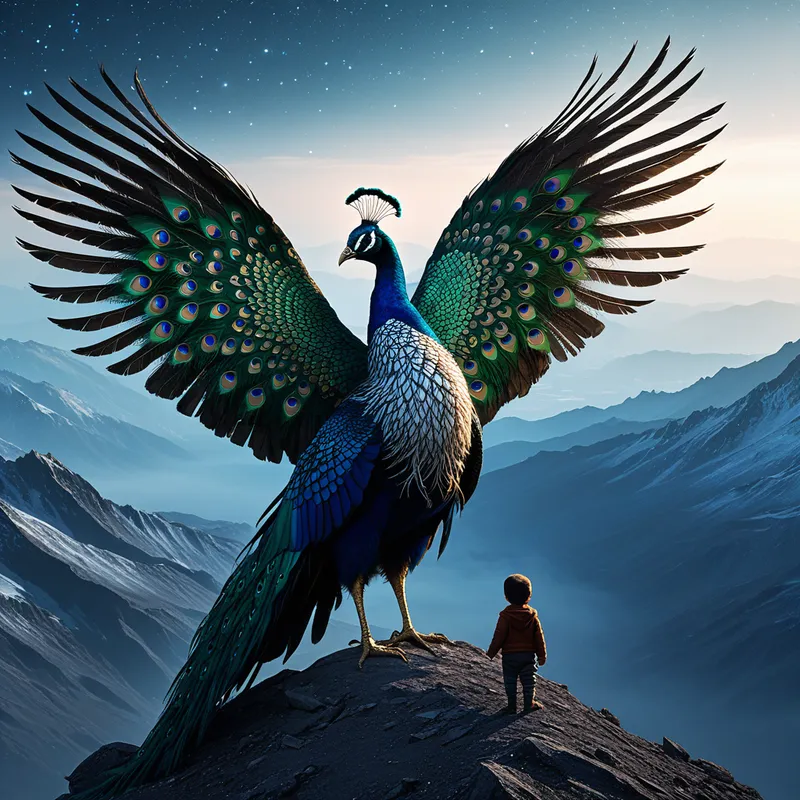
But the mountains are not barren of mercy. The cries of the forsaken child pierced the thin, high air, reaching the ears of a being both of earth and sky. The Simorgh, the Phoenix of Persia, a creature so vast its wings blotted out the sun, whose feathers held the hues of copper and lapis lazuli, whose nest was a fortress in the highest crag, heard the plaintive sound. Moved by a compassion older than kings, she descended. With infinite gentleness, she gathered the white-haired babe in her talons and bore him to her aerie, a kingdom of wind and cloud.
There, in that nest of fragrant branches and lost treasures, Zal was nurtured. The Simorgh fed him not with milk, but with the marrow of mountain beasts and the essence of rare herbs. She taught him the language of the winds, the secrets of the stars, and the wisdom of all creatures. He grew strong and wise, a prince of the heights, his hair a banner of snow against the sky, his mind a library of celestial and earthly lore. He was no outcast, but the beloved ward of a goddess-bird.
Years flowed like mountain streams. King Sam, haunted by his deed, was visited by a dream—a vision of his son, alive and radiant, under the protection of a divine being. Consumed by remorse, he journeyed back to the Alborz, climbing with a penitent’s heart. When he reached the fabled peak and beheld Zal, now a man of majestic bearing and preternatural wisdom, he wept and begged forgiveness. The Simorgh, seeing the true repentance in the king’s heart, prepared to return her foster child to the world of men. As a parting gift, she plucked a feather from her breast and gave it to Zal. “Burn this feather,” she said, her voice the rustle of a thousand leaves, “whenever you have dire need of me, and I will come.”
Thus did Zal descend from the mountain, not as a cursed anomaly, but as a sage and a hero, a bridge between the wild, divine wisdom of the heights and the complex, flawed world of humanity. The feather was not just a token, but a covenant—a promise that the wisdom of the outcast and the nurture of the Other would forever be his guide.

Cultural Origins & Context
This profound myth is preserved in the Shahnameh, the monumental epic composed by the poet Ferdowsi in the 10th century CE. While Ferdowsi’s work solidified the tale in the Persian literary canon, the archetype of the divine bird and the abandoned hero reaches back into the Zoroastrian and pre-Zoroastrian substrata of Iranian mythology. The Simorgh itself is a composite of earlier mythical birds, like the Saena Meregha.
Functionally, the story served multiple layers of Persian society. For the royal court, it was a myth of legitimacy, explaining how the lineage of heroes (leading to Zal’s son, the greatest champion Rostam) was infused with supernatural wisdom and favor. For the common listener, it was a moral and psychological drama about the perils of pride, the nature of true nobility, and the redemptive power of mercy that exists outside human law. It was told by storytellers and naqqals in coffeehouses and courts, binding the community to a shared symbolic history where even the most profound rejection could be the precursor to a sacred destiny.
Symbolic Architecture
At its core, the myth maps the [journey](/symbols/journey “Symbol: A journey in dreams typically signifies adventure, growth, or a significant life transition.”/) of the [orphan](/symbols/orphan “Symbol: Represents spiritual abandonment, primal vulnerability, and the quest for belonging beyond biological ties. Often signifies a soul’s journey toward self-reliance.”/) [archetype](/symbols/archetype “Symbol: A universal, primordial pattern or prototype in the collective unconscious that shapes human experience, behavior, and creative expression.”/). Zal’s albinism symbolizes radical otherness—that essential part of the self or the potential that the conscious ego, represented by [King](/symbols/king “Symbol: A symbol of ultimate authority, leadership, and societal order, often representing the dreamer’s inner power or external control figures.”/) Sam and his court (the collective), deems unacceptable, shameful, and must be cast out.
The mountain of abandonment is always the birthplace of transformation. What the conscious world rejects is often the very seed the soul requires for its wholeness.
The Simorgh is the embodiment of the transpersonal Great [Mother](/symbols/mother “Symbol: The symbol of ‘Mother’ represents nurturing, protection, and the foundational aspect of one’s emotional being, often associated with comfort and unconditional love.”/), but in a specifically numinous, non-[human](/symbols/human “Symbol: The symbol of a human represents individuality, complexity of emotions, and social relationships.”/) form. She is not the personal [mother](/symbols/mother “Symbol: The symbol of ‘Mother’ represents nurturing, protection, and the foundational aspect of one’s emotional being, often associated with comfort and unconditional love.”/); she is the [spirit](/symbols/spirit “Symbol: Spirit symbolizes the essence of life, vitality, and the spiritual journey of the individual.”/) of [nature](/symbols/nature “Symbol: Nature symbolizes growth, connectivity, and the primal forces of existence.”/) itself, the instinctive wisdom of the unconscious that accepts and nurtures what [consciousness](/symbols/consciousness “Symbol: Consciousness represents the state of awareness and perception, encompassing thoughts, feelings, and experiences.”/) has discarded. Her aerie represents a liminal [space](/symbols/space “Symbol: Dreaming of ‘Space’ often symbolizes the vastness of potential, personal freedom, or feelings of isolation and exploration in one’s life.”/)—not [heaven](/symbols/heaven “Symbol: A symbolic journey toward ultimate fulfillment, spiritual transcendence, or connection with the divine, often representing life’s highest aspirations.”/), not [earth](/symbols/earth “Symbol: The symbol of Earth often represents grounding, stability, and the physical realm, embodying a connection to nature and the innate support it provides.”/)—where the rejected ego-complex is incubated and rewired with archetypal [knowledge](/symbols/knowledge “Symbol: Knowledge symbolizes learning, understanding, and wisdom, embodying the acquisition of information and enlightenment.”/).
Zal’s return is not a simple reintegration. He returns transformed. He carries the [feather](/symbols/feather “Symbol: A feather represents spiritual elevation, lightness, and the freedom of the spirit. It often symbolizes messages from the divine and connection to ancient wisdom.”/), a [symbol](/symbols/symbol “Symbol: A symbol can represent an idea, concept, or belief, serving as a powerful tool for communication and understanding.”/) of his enduring [connection](/symbols/connection “Symbol: Connection symbolizes relationships, communication, and bonds among individuals.”/) to the deep, guiding Self. He becomes a [mediator](/symbols/mediator “Symbol: A figure who resolves conflicts between opposing parties, representing balance, communication, and the integration of differences.”/), his white [hair](/symbols/hair “Symbol: Hair often symbolizes identity, power, and self-expression, reflecting how we perceive ourselves and how we wish to be perceived by others.”/) a permanent [emblem](/symbols/emblem “Symbol: A symbolic design representing identity, authority, or ideals, often used in heraldry, logos, or artistic expression.”/) of his unique [destiny](/symbols/destiny “Symbol: A predetermined course of events or ultimate purpose, often linked to spiritual forces or cosmic order, representing life’s inherent direction.”/), turning his initial “flaw” into his signature [strength](/symbols/strength “Symbol: ‘Strength’ symbolizes resilience, courage, and the ability to overcome challenges.”/) and wisdom.

The Dreamer’s Resonance
When this myth stirs in the modern psyche, it often manifests in dreams of profound isolation or unique nurturing. To dream of being abandoned on a stark mountain reflects the somatic feeling of being cast out for some inherent quality—a sensitivity, a talent, a trauma, an identity that feels too “white,” too visible and unacceptable to one’s inner “king” or social milieu.
Conversely, dreams of being sheltered by a great, benevolent bird, or finding a single, magnificent feather, signal that the nurturing, compensatory function of the unconscious is active. The psyche is providing the solace and wisdom the conscious ego cannot. The process underway is one of deep validation. The dream-ego is being taught, like Zal, that its point of difference is not a curse, but the key to a unique form of knowledge and strength. The emotional tone shifts from the cold terror of abandonment to the awe-filled warmth of sacred guardianship.
Alchemical Translation
The alchemical process modeled here is the nigredo leading to a divine albedo. The nigredo is the blackening, the despair and “death” of Zal’s social identity as a prince, his literal exposure on the dark mountain. This is the necessary first step of dissolution, where the old, prideful structure of the ego (King Sam’s world) is shattered.
The mountain aerie is the albedo—the whitening. But note: Zal was already physically white. The true albedo is not a change in color, but a change in meaning. His whiteness is transmuted from a symbol of shame to a symbol of wisdom, a connection to the lunar, reflective knowledge of the Simorgh. This is psychic transmutation: the base material (the rejected child) is not destroyed, but is cooked in the nest of the unconscious until its essential nature is revealed as gold.
Individuation does not mean becoming normal according to collective standards; it means becoming sacredly strange, becoming uniquely oneself, forged in the nest of one’s deepest wounds.
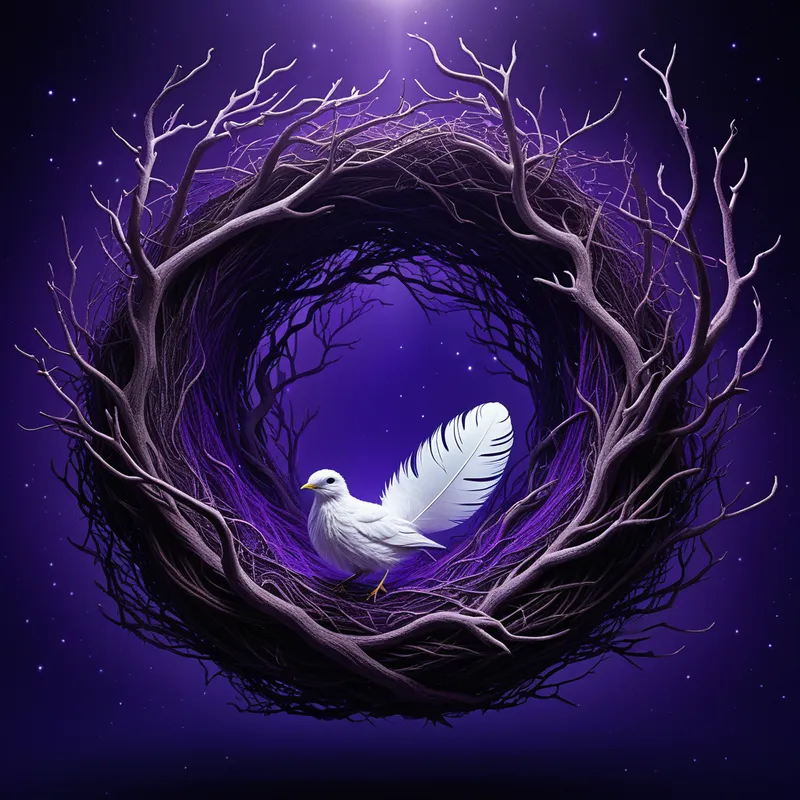
The feather is the ultimate symbol of this alchemy. It is a concrete token of the bond with the Self. To “burn the feather in time of need” is the operative principle of integrated wholeness. It means the individual has internalized the connection. They do not need to physically return to the mountain (regress); they have the wisdom within to call upon that transpersonal resource, to set the covenant alight through conscious remembrance and ritual, transforming crisis into guidance.
Associated Symbols
Explore related symbols from the CaleaDream lexicon:
- Mountain — The place of exile and ultimate transformation, representing the daunting, isolating challenge that separates the rejected self from the comforts of the known world.
- Bird — The Simorgh embodies the ultimate bird symbol: a divine messenger, a creature of the sky (spirit) that intervenes in the earthly realm, offering protection, wisdom, and transcendence.
- Child — The vulnerable, innocent, and unformed potential that is cast out, representing the nascent Self that must be nurtured outside conventional structures to reach its full destiny.
- Father — King Sam represents the flawed paternal principle, one governed by pride, shame, and the laws of the collective, whose rejection initiates the necessary exile.
- Feather — The gift and covenant from the divine to the human, a tangible link to transcendent wisdom and a tool for summoning aid in times of profound need.
- Hero — Zal becomes the hero not through conventional strength first, but through the wisdom gained in exile, returning to mediate between the divine and human worlds.
- Shadow — Zal’s white hair is his visible shadow, the trait deemed monstrous by the collective, which ultimately holds his greatest power and unique identity.
- Wisdom — The core treasure gained in the Simorgh’s nest, a knowledge not of books but of nature, spirit, and the self, which becomes the hero’s guiding force.
- Abandonment — The primal wound and the necessary catalyst, the brutal severance from the source that forces the journey into the realm of transformative grace.
- Nurture — The divine, unconventional care provided by the Simorgh, representing the sustenance the soul finds when it is accepted by the deep unconscious.
- Destiny — The hidden pattern that guides the abandoned child to the mythical nest and back, turning a curse into a sacred, fated path.
- Bridge — Zal himself becomes a living bridge, connecting the high, solitary wisdom of the mountain with the complex, social world of humanity.