Yuhwa and the Golden Light Myth Meaning & Symbolism
A river goddess is touched by a golden light, giving birth to a hero and embodying the sacred union of heaven and earth, fate and will.
The Tale of Yuhwa and the Golden Light
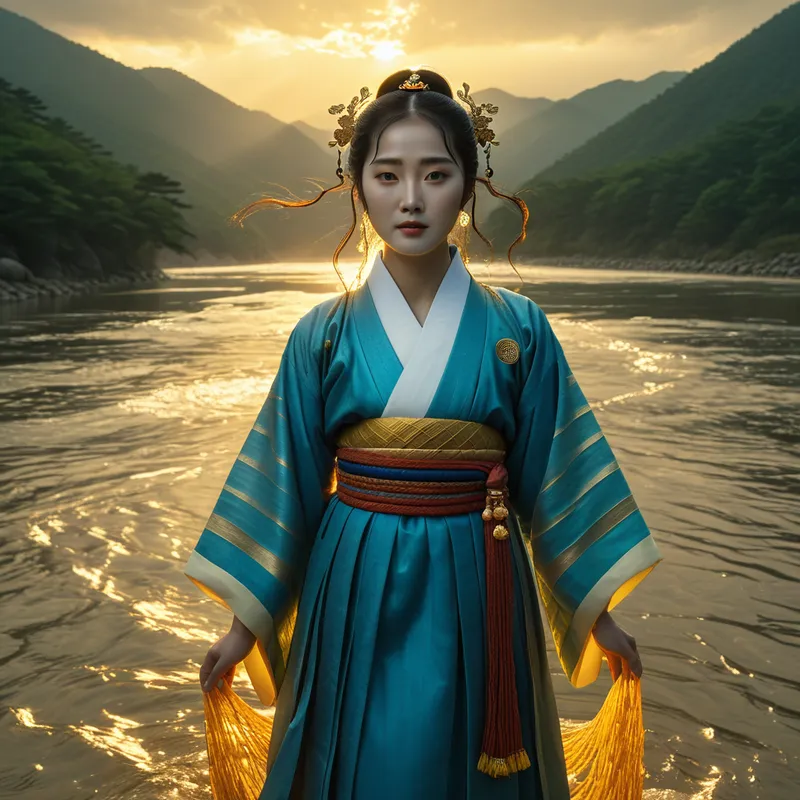
Listen, and hear the tale whispered by the reeds along the Yalu. In the time when gods walked closer to the earth, there lived a king, Habaek, who ruled the flowing veins of the world. He had three daughters, and the youngest was Yuhwa, whose beauty was not of mere flesh, but of spirit—she moved with the grace of willow branches in the wind, and her eyes held the deep, knowing stillness of a river pool.
One day, under a sky heavy with the promise of storm, Yuhwa and her sisters ventured from their watery palace to play upon the sun-dappled shore. The air grew thick, charged with a power that made the stones hum. Then, from the bruised heavens, a figure descended. It was Hae Mosu, the son of the Lord of Heaven. He arrived not with quiet steps, but in a chariot of thunder, a prince of the upper world drawn by five mighty dragons. His presence was the crackle before lightning.
He saw Yuhwa, and in that seeing, the worlds of Sky and Water trembled on the brink of union. He declared his love, his voice the rumble of distant storms. But Yuhwa, bound by filial duty and perhaps an instinctive fear of this overwhelming celestial force, refused. She fled back to the dominion of her father, the river god. Hae Mosu, the spurned sky prince, did not pursue with force, but with a profound and terrible magic. He did not lay a hand upon her. Instead, he vanished back into the clouds, and the sky opened.
It was not rain that fell. It was a single, concentrated shaft of light—not white, but a molten, living Gold. It pierced the canopy, ignored stone and water, and found Yuhwa where she hid. It did not burn; it penetrated. It struck her low on her body, a radiant, fateful touch. In that instant, she was imprinted with a celestial destiny. The light faded, leaving not a wound, but a resonance, a seed of heaven planted within the vessel of earth and water.
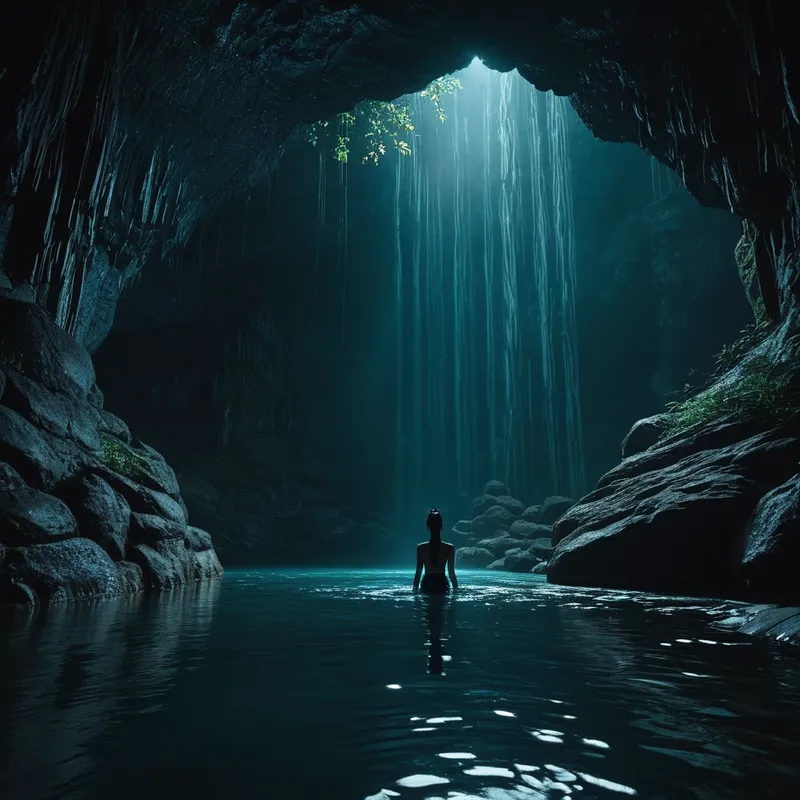
Her father, Habaek, was enraged not at the violation, but at the shame. The purity of his watery lineage had been breached by the sky. In his wrath, he trapped Yuhwa. He stretched her lips with a hot hook, sealing her voice of protest, and imprisoned her within a dark Cave by the river’s edge. There, in that damp, silent womb of stone, the seed of the golden light grew. And from it, from Yuhwa, was born an egg. A great, luminous egg. From this egg emerged a boy, a child of both realms: Jumong, the master archer, the future king, the divine hero. The golden light had found its form. Through sacrifice, through containment, the impossible union gave birth to a new world.
Cultural Origins & Context
This myth is the foundation narrative of Goguryeo, one of the Three Kingdoms of Korea, and is recorded in the 13th-century historical text Samguk Sagi. Unlike myths that exist purely in the religious sphere, the tale of Yuhwa and Hae Mosu served a direct sociopolitical function: to legitimize the ruling dynasty by tracing its lineage back to a divine union between Heaven (Cheon) and Earth or Water (Jigu). This cheonjagyeolhap (heaven-earth marriage) motif is a powerful archetype in East Asian state-foundation myths.
The story was likely preserved and told by court historians and Mudang, for whom the elements of the tale—the river god, the celestial visitor, the transformative light—resonated with indigenous shamanic cosmology. It bridges the animistic worship of nature spirits (like Habaek) with the later, more structured heavenly mandates of kingship. The myth provided a sacred origin point, explaining not just the birth of a hero, but the very legitimacy of a kingdom as a child of cosmic forces.
Symbolic Architecture
At its core, this is a myth of impregnation by [consciousness](/symbols/consciousness “Symbol: Consciousness represents the state of awareness and perception, encompassing thoughts, feelings, and experiences.”/). The Golden Light is not a physical [beam](/symbols/beam “Symbol: A structural support element in architecture, symbolizing stability, connection, and the framework that holds things together.”/) but a [symbol](/symbols/symbol “Symbol: A symbol can represent an idea, concept, or belief, serving as a powerful tool for communication and understanding.”/) of sudden, fateful [insight](/symbols/insight “Symbol: A sudden, deep understanding of a complex situation or truth, often arriving unexpectedly and illuminating hidden connections.”/), a divine [idea](/symbols/idea “Symbol: An ‘Idea’ represents a spark of creativity, innovation, or realization, often emerging as a solution to a problem or a new outlook on life.”/), or an annunciation of [destiny](/symbols/destiny “Symbol: A predetermined course of events or ultimate purpose, often linked to spiritual forces or cosmic order, representing life’s inherent direction.”/) that comes from a [realm](/symbols/realm “Symbol: The symbol of ‘Realm’ often signifies the boundaries of one’s consciousness, experiences, or emotional states, suggesting aspects of reality that are either explored or ignored.”/) beyond the personal. Yuhwa, the [River](/symbols/river “Symbol: A river often symbolizes the flow of emotions, the passage of time, and life’s journey, reflecting transitions and movement in one’s life.”/) and Willow [goddess](/symbols/goddess “Symbol: The goddess symbolizes feminine power, divinity, and the nurturing aspects of life, embodying creation and wisdom.”/), represents the deep, fluid, and receptive unconscious—the feminine principle that is fertile, nurturing, and connected to the emotional and instinctual currents of [life](/symbols/life “Symbol: The symbol of ‘Life’ represents a journey of growth, interconnectedness, and existential meaning, encompassing both the joys and challenges that define human experience.”/).
The divine does not ask permission; it announces itself. The golden light is the irrevocable moment of calling, which first feels like a violation of the established order of the self.
Her initial refusal and subsequent imprisonment by her [father](/symbols/father “Symbol: The father figure in dreams often symbolizes authority, protection, guidance, and the quest for approval or validation.”/), the River God, symbolize the old order’s [resistance](/symbols/resistance “Symbol: An object or tool representing opposition, struggle, or the act of pushing back against external forces or internal changes.”/) to this new, disruptive consciousness. The sealed lips represent the suppression of this new potential, forced into a [period](/symbols/period “Symbol: Periods in dreams can symbolize cyclical patterns, renewal, and the associated emotions of loss or change throughout life.”/) of [incubation](/symbols/incubation “Symbol: A period of internal development, rest, or hidden growth before emergence, often associated with healing, creativity, or transformation.”/) (the Cave). The [birth](/symbols/birth “Symbol: Birth symbolizes new beginnings, transformation, and the potential for growth and development.”/) of the egg—and from it, Jumong—is the ultimate symbol of the new consciousness achieving form. It is a psychic [birth](/symbols/birth “Symbol: Birth symbolizes new beginnings, transformation, and the potential for growth and development.”/), where the luminous insight, after a [period](/symbols/period “Symbol: Periods in dreams can symbolize cyclical patterns, renewal, and the associated emotions of loss or change throughout life.”/) of [gestation](/symbols/gestation “Symbol: A period of development and preparation before a significant birth or emergence, symbolizing potential, transformation, and the journey toward manifestation.”/) in darkness, emerges as a viable entity capable of [action](/symbols/action “Symbol: Action in dreams represents the drive for agency, motivation, and the ability to take control of situations in waking life.”/) in the world—the heroic ego, or a new ruling principle of the psyche.
The Dreamer’s Resonance
When this myth pattern stirs in the modern Dream, it often manifests as dreams of being struck or illuminated by a light from above—a Lightning bolt, a spotlight, a laser beam. The dreamer may feel chosen, targeted, or even attacked by a sudden knowing or a life-altering idea. Somaticly, this can feel like a jolt of energy, a warmth in the abdomen (the site of Yuhwa’s impregnation), or a sense of profound, unsettling resonance.
Psychologically, this signals the eruption of a numinous content from the Self into the conscious mind. The dreamer is in the role of Yuhwa: their existing identity and loyalties (to family, to old ways of being) are being challenged by a call to a larger destiny. The subsequent feelings of being trapped, silenced, or imprisoned in a dull, routine life (the Cave) reflect the necessary, often painful, period of incubation where this new potential must be protected and nurtured in secret, away from the critical, shaming voice of the internalized “father” or superego. The dream is mapping the early, vulnerable stages of individuation.

Alchemical Translation
The alchemical process mirrored here is solutio (dissolution in the waters of the unconscious) followed by coagulatio (solidification into new form). Yuhwa’s journey is the model for psychic transmutation. First, the prima materia of the psyche (the stable, fluid identity) is struck by the Lapis, the golden light of the Self. This is the initial, often traumatic, inspiration.
The cave of imprisonment is the alchemical vessel. It is not a dungeon, but a womb where the lead of shame and isolation is secretly transmuted into the gold of authentic purpose.
The refusal and captivity are not failures, but essential parts of the Individuation process. They represent the ego’s necessary struggle with and containment of this overwhelming new content. The weaving Yuhwa does in the cave (implied in many versions) is the silent, patient work of relating to this new energy, spinning the threads of meaning. The birth of the egg-hero is the Magnum Opus coming to fruition—the emergence of the conscious personality (Jumong) that can wield the power of both heaven (spirit, vision) and earth/water (instinct, reality), capable of founding a new “kingdom” of the integrated psyche. The modern individual undergoes this when a vocation, a creative vision, or a call to authentic selfhood irrupts, is resisted, is nurtured in secret, and finally demands to be born into the world.
Associated Symbols
Explore related symbols from the CaleaDream lexicon:
- Gold — The divine, transformative substance from heaven, representing the highest value, spiritual illumination, and the irrevocable seed of destiny implanted within the psyche.
- Lightning — The sudden, penetrating, and electrifying moment of divine contact or fateful insight that bypasses all rational defense and alters the course of a life.
- River — The domain of Yuhwa, symbolizing the deep, flowing unconscious, emotional life, fertility, and the connective, nurturing feminine principle.
- Cave — The place of forced incubation and imprisonment, representing the necessary womb-like darkness where new potential is protected and gestates before it can be safely born.
- Egg — The perfect, self-contained vessel of potential, symbolizing the nascent wholeness of the new consciousness before it differentiates and enters the world.
- Sacrifice — Yuhwa’s loss of freedom and social standing, representing the necessary price paid to contain and bring forth a transformative new reality from a disruptive inspiration.
- Heaven — The realm of Hae Mosu, representing the world of spirit, order, destiny, and transcendent forces that seek manifestation in the earthly realm.
- Earth — The complementary realm to heaven, representing the physical, instinctual, and material world that receives and gives form to celestial impulses.
- Mother — Yuhwa in her aspect as the life-giver who endures isolation and shame to bring forth a divine child, embodying the creative, sustaining, and sacrificial principle.
- Destiny — The inescapable course set in motion by the golden light, representing the call of the Self that overrides personal will and societal expectation to fulfill a larger pattern.
- Rebirth — The core process of the myth: the death of Yuhwa’s old life and identity, leading to the birth of Jumong and, symbolically, the rebirth of the psyche into a new order.
- Journey — The entire arc from celestial encounter to heroic birth, mapping the internal voyage from unconsciousness to the emergence of a conscious, purposeful self capable of founding new inner and outer kingdoms.