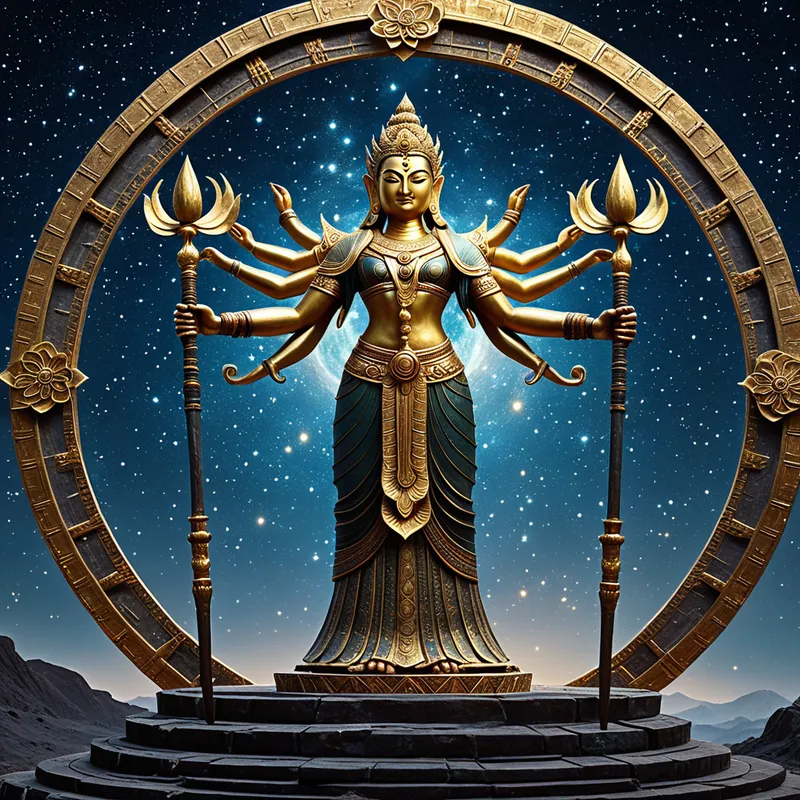
Yugas Myth Meaning & Symbolism
A vast cosmic cycle of four ages, from a golden dawn to a dark twilight, describing the soul's descent into matter and its potential for re-ascent.
The Tale of Yugas
Listen. Before time was counted, before the first breath was drawn, the cosmos itself breathes. It inhales, and a universe is born from the dream of Brahman. It exhales, and all dissolves back into that boundless sleep. Within this great breath, the wheel of the [Kalpa](/myths/kalpa “Myth from Buddhist culture.”/) turns, and upon its rim are etched the four great ages, the Yugas.
First comes the Satya Yuga. Imagine a dawn that lasts for millennia. [The earth](/myths/the-earth “Myth from Hindu culture.”/) is soft as butter, yielding wish-fulfilling trees. The air is thick with Dharma, which stands firm on all four legs, like a sturdy bull. Humans are born not from wombs, but from the mind, luminous and tall, their lifespans stretching for hundreds of thousands of years. They converse directly with the Devas, and the one goal of life—[Moksha](/myths/moksha “Myth from Hindu culture.”/)—is as easily attained as plucking a ripe fruit. There is no mine or thine, no sorrow, no effort. Truth is the only reality.
Then, the wheel grinds forward. One leg of Dharma falters. This is the Treta Yuga. The golden light mellows to a silvery sheen. The first rains fall, the first seeds must be sown. A subtle division enters [the world](/myths/the-world “Myth from Tarot culture.”/); the great sacrifice is introduced. Kings and heroes arise, and with them, the first flicker of desire for name and fame. The great Rama walks the earth in this age, a pillar of virtue in a world where righteousness has begun to erode. Ritual becomes necessary to uphold what was once natural.
The descent continues. Dharma stands now on but two legs. We enter the Dvapara Yuga, an age of duality and conflict. The world is split into opposing halves—good and evil, love and hate, mine and yours. Diseases and natural calamities appear. Lifespans shorten, minds become clouded. It is an age of great epics and terrible wars, where the divine descends in human form to restore a fragile balance. The air thrums with the tension of the Kurukshetra war, and the song of the Bhagavad Gita is sung to guide a soul through the moral fog.
Finally, the wheel turns to its darkest quadrant. We are now in the [Kali Yuga](/myths/kali-yuga “Myth from Hindu culture.”/). Dharma stands precariously on a single leg. The world is heavy, coarse. Truth is replaced by falsehood, strength by cunning, wealth by greed. The air is polluted, the mind agitated. Lifespans are brief, and suffering is widespread. The sacred becomes profane, the wise are ignored, and the loudest voice is that of [the ego](/myths/the-ego “Myth from Jungian culture.”/). It is an age of shadows, where the divine is most hidden, and the path is most obscure. Yet, it is said that in this very darkness, a single step taken toward truth bears the fruit of a thousand steps taken in [the golden age](/myths/the-golden-age “Myth from Greek culture.”/). The wheel, having touched the nadir, must begin its slow, inevitable ascent once more.

Cultural Origins & Context
The doctrine of the Yugas is most systematically elaborated in texts like the Puranas, particularly the [Vishnu](/myths/vishnu “Myth from Hindu culture.”/) Purana and the [Matsya](/myths/matsya “Myth from Hindu culture.”/) Purana. These were not dry philosophical tracts but living narratives recited by Sutas and learned Brahmins at gatherings and festivals. Their function was cosmological, moral, and psychological. They provided a map of time so vast it dwarfed human history, placing individual strife within a grand, cyclical narrative of cosmic decay and renewal.
This myth was a societal compass. It explained the perceived moral and physical decline from an idealized past, not as a unique catastrophe, but as a predictable phase of a divine order. It offered both a warning and a profound consolation: the darkest age, too, shall pass. The concept anchored the Ashrama system and the pursuit of Purusharthas within an understanding that the strategies for living must adapt to the prevailing “climate” of the age. In Kali Yuga, the texts emphasize, the recommended path is Bhakti and the simple chanting of the divine name, a democratization of spirituality suited to an age of shortened attention and pervasive distraction.
Symbolic Architecture
The Yugas are not a [linear](/symbols/linear “Symbol: Represents order, predictability, and a direct, step-by-step progression. It symbolizes a clear path from cause to effect.”/) [history](/symbols/history “Symbol: History in dreams often represents the dreamer’s past experiences, lessons learned, or unresolved issues that continue to influence their present.”/) but a profound symbolic map of [consciousness](/symbols/consciousness “Symbol: Consciousness represents the state of awareness and perception, encompassing thoughts, feelings, and experiences.”/) itself. They represent the [soul](/symbols/soul “Symbol: The soul represents the essence of a person, encompassing their spirit, identity, and connection to the universe.”/)‘s [journey](/symbols/journey “Symbol: A journey in dreams typically signifies adventure, growth, or a significant life transition.”/) from undifferentiated unity into the [fragmentation](/symbols/fragmentation “Symbol: The experience of breaking apart, losing cohesion, or being separated into pieces. Often represents disintegration of self, relationships, or reality.”/) of [material](/symbols/material “Symbol: Material signifies the tangible aspects of life, often representing physical resources, desires, and the physical world’s influence on our existence.”/) existence, and the potential for return.
The four Yugas are the four seasons of the soul’s great year, from the eternal spring of Satya to the spiritual winter of Kali.
The declining [legs](/symbols/legs “Symbol: Legs in dreams often symbolize movement, freedom, and the ability to progress in life, representing both physical and emotional support.”/) of the Dharma [bull](/symbols/bull “Symbol: The bull often symbolizes strength, power, and determination in many cultures.”/) symbolize the gradual obscuration of innate wisdom and ethical [clarity](/symbols/clarity “Symbol: A state of mental transparency and sharp focus, often representing resolution of confusion or attainment of insight.”/). In Satya Yuga, law (dharma) and being (satya) are identical. By Kali Yuga, law is a external, fragile construct constantly at odds with a base [reality](/symbols/reality “Symbol: Reality signifies the state of existence and perception, often reflecting one’s understanding of truth and life experiences.”/) (adharma). The decreasing [human](/symbols/human “Symbol: The symbol of a human represents individuality, complexity of emotions, and social relationships.”/) lifespans mirror the [contraction](/symbols/contraction “Symbol: A symbolic process of compression, reduction, or inward movement, often representing preparation, transition, or the tension between opposing forces.”/) of [awareness](/symbols/awareness “Symbol: Conscious perception of self, surroundings, or internal states. Often signifies awakening, insight, or heightened sensitivity.”/) from the cosmic to the personal, from the eternal to the ephemeral.
Each Yuga also embodies a primary mode of spiritual practice: [meditation](/symbols/meditation “Symbol: Meditation represents introspection, mental clarity, and the pursuit of inner peace, often providing a pathway for deeper self-awareness and spiritual growth.”/) (dhyana) in Satya, elaborate sacrifice (yajna) in Treta, [temple](/symbols/temple “Symbol: A temple often symbolizes spirituality, sanctuary, and a deep connection to the sacred aspects of life.”/) worship (puja) in Dvapara, and devotional repetition (sankirtana) in Kali. This suggests that the [path](/symbols/path “Symbol: The ‘path’ symbolizes a journey, choices, and the direction one’s life is taking, often representing individual growth and exploration.”/) to wholeness must be congruent with the prevailing consciousness of the age—and of the individual. The myth asserts that enlightenment is possible in any age, but the [doorway](/symbols/doorway “Symbol: A doorway signifies transition, opportunities for new beginnings, and the choice to walk through into the unknown.”/) changes shape.
The Dreamer’s Resonance
When this myth stirs in the modern unconscious, it rarely appears as a literal story. Instead, one dreams of profound temporal disorientation. Dreams of living in a decaying, corrupt city (Kali Yuga) while yearning for a lost, pristine wilderness or a radiant, forgotten home (Satya Yuga). Dreams where technology fails and ancient, simple tools work perfectly. Dreams of meeting a serene, luminous being (a Rishi) who offers cryptic advice before fading.
Somatically, this can feel like a deep, cellular nostalgia—a longing for a state of being we have never consciously known. Psychologically, it marks a process of confronting the “descent” in one’s own life: the loss of childhood innocence, the compromises of adulthood, the feeling of being trapped in a cynical, fragmented world. The dream is the [psyche](/myths/psyche “Myth from Greek culture.”/)‘s way of contextualizing personal suffering within a grand, archetypal narrative of fall and potential redemption. It asks: In what “age” does your soul currently reside? Are you identifying only with the fragmentation of Kali, or can you sense the enduring gold of Satya within it?
Alchemical Translation
The alchemical work modeled by the Yugas is the opus contra naturam—the work against the current of entropy. The natural arc of the cycle is descent from unity into multiplicity, from spirit into matter. The spiritual task is to enact the reverse journey within the descent, to perform the ascent while still immersed in the iron of Kali Yuga.
Individuation is the conscious enactment of the entire Yuga cycle within a single lifetime, mining the iron ore of our darkest experiences to reveal the hidden gold of the Self.
The process begins with acknowledging our personal “Kali Yuga”: our inner chaos, selfishness, and alienation. This is the [nigredo](/myths/nigredo “Myth from Alchemical culture.”/), the blackening. We must not flee this darkness but fully inhabit it, as the sage inhabits the corrupted age. From there, we consciously cultivate the “Dvapara” quality of seeking balance amidst duality (the albedo), then the “Treta” quality of disciplined sacrifice of the ego for a higher principle, and ultimately, we touch the “Satya” reality of non-dual awareness ([rubedo](/myths/rubedo “Myth from Alchemical culture.”/)), where the seeker, the path, and the goal are one.
The myth teaches that the endpoint is also the starting point. The [golden age](/myths/golden-age “Myth from Universal culture.”/) is not a lost historical paradise but the ever-present ground of our being, obscured by the accretions of the lesser ages. The alchemical translation is thus a purification of time itself within the soul, a realization that all four ages coexist as layers of our consciousness. To become whole is to integrate the iron’s strength, the bronze’s resonance, the silver’s reflectivity, and the gold’s purity, thus becoming the axis around which the entire wheel turns, unmoved and complete.
Associated Symbols
Explore related symbols from the CaleaDream lexicon: