Yuanyang Myth Meaning & Symbolism
A myth of celestial mandarin ducks, separated by fate, whose eternal bond embodies the soul's longing for sacred union and wholeness.
The Tale of Yuanyang
Hear now a tale not of gods on high, but of a love woven into the very fabric of the waters and the reeds. In the time when the world was a fresher green and rivers sang clearer songs, there lived two beings of sublime beauty: the Yuán and the Yāng.
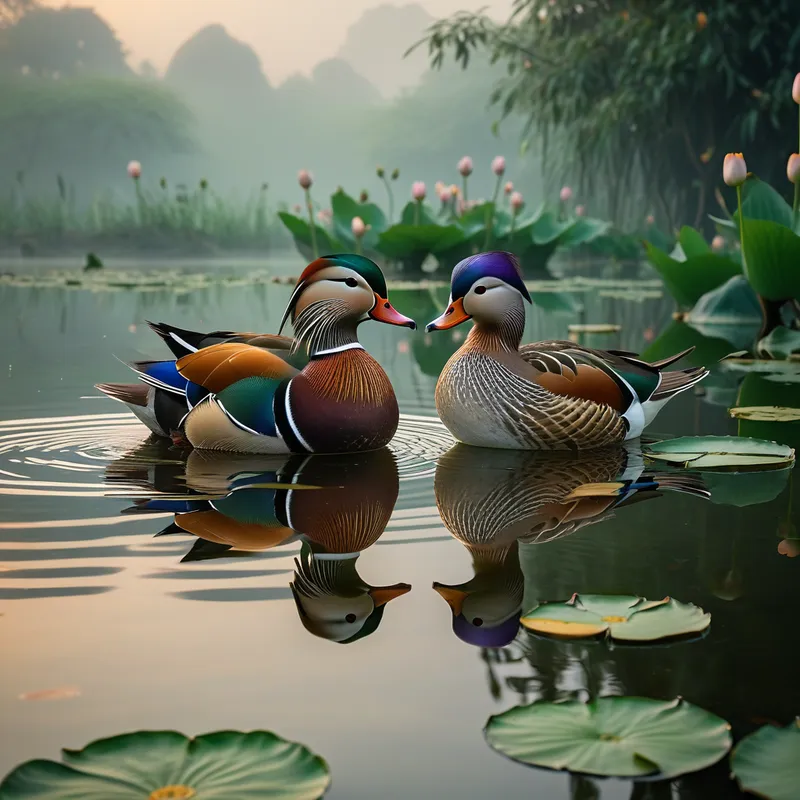
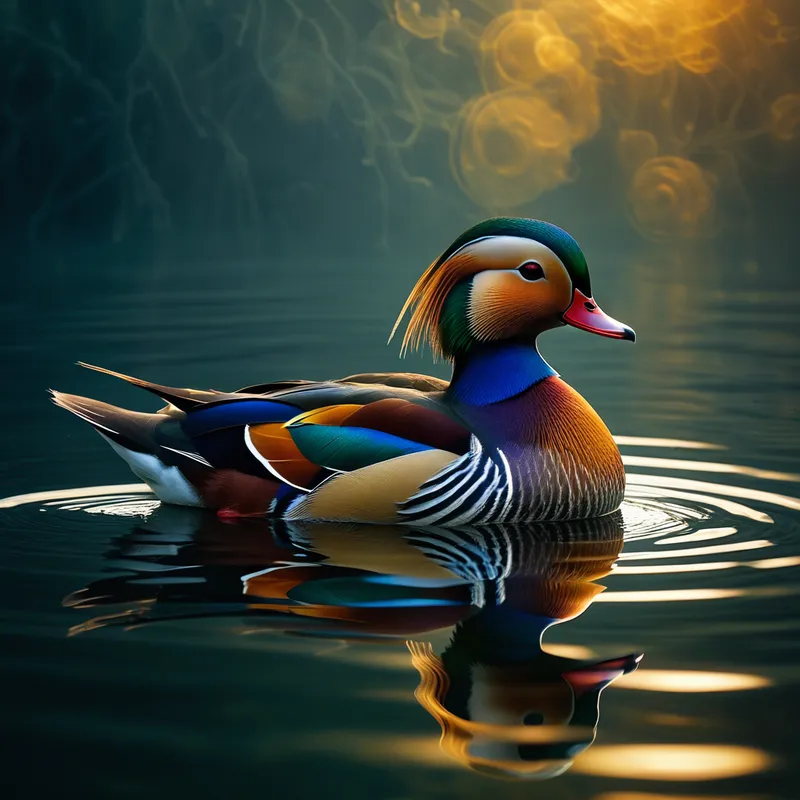
They were not mere birds, but souls clad in feathers. The Yuán was a living jewel, his plumage a cascade of sunset: fiery sails of orange, a crown of emerald, a cloak of deep purple and white, his beak a slash of crimson. The Yāng was the moon to his sun, adorned in soft, speckled grays and browns, with a ring of white like a pearl around her eye, her grace a quiet poem.
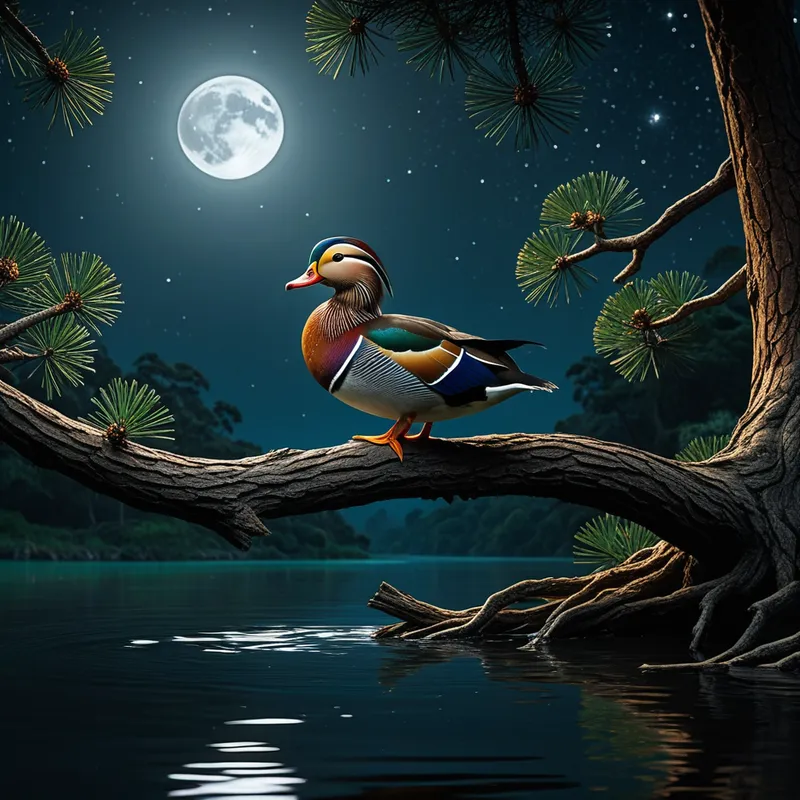
Together, they were perfection. They danced upon the lily pads of secluded ponds, their synchronized movements a silent language older than words. By day, they foraged in the shallows, heads bent close. By night, they nestled in the hollow of a riverside willow, their necks entwined, a single silhouette against the silvered water. Their bond was so absolute it stilled the wind and brought a hush to the forest. They were the Yuanyang, one heart in two bodies.
But the cosmos, in its vast and often cruel balance, cannot abide a perfection that forgets the world. A great storm, sent by a heaven jealous of such earthly bliss, descended upon their sanctuary. Thunder cracked the sky, and the river, once a gentle friend, swelled into a raging dragon. In the chaos of lashing rain and howling wind, a violent surge of water tore them apart. The Yuán was thrown against the rocks, dazed, his brilliant feathers plastered with mud. The Yāng was swept away into the torrent, her cries lost in the roar.
When dawn broke, bruised and quiet, the Yuán found himself alone on a strange shore. The world was colorless. He called, a desperate, rasping sound that echoed over the now-placid water. No answer came but the drip of rain from leaves. He searched. Season bled into season. He flew over endless reed beds, scanned every quiet cove, haunted the places that reminded him of her. He would not take another mate. He would not rest. His once-vibrant plumage grew dull with sorrow, his eyes held a permanent, searching light. He became a ghost of his former self, a king without a kingdom, a song without its harmony, forever gazing across the water, waiting, hoping, for the shape that would make him whole again.
Cultural Origins & Context
The myth of the Yuanyang is not housed in a single, canonical text like the Shījīng or the Shānhǎijīng. Instead, it is a folkloric archetype that seeped into the Chinese consciousness through observation, poetry, and artisan craft. The real mandarin duck (Aix galericulata), with its astonishing sexual dimorphism, provided the perfect natural template for a story of complementary opposites.
The tale was passed down through generations by storytellers, embroidered onto wedding garments, carved into bridal chamber furniture, and painted on porcelain given as marriage gifts. Its primary societal function was didactic and aspirational. It served as the ultimate metaphor for harmonious marriage, representing not just romantic love, but the Confucian ideal of spousal roles working in unison for familial stability. The male Yuán’s dazzling beauty symbolized the husband’s external vigor and social presence, while the female Yāng’s subtle elegance represented the wife’s internal virtue, grace, and nurturing strength. Their legendary fidelity—the belief that a mandarin duck would die of grief if its partner died—made them a powerful emblem for the sacred, unbreakable bonds of matrimony in a culture where family was the cornerstone of society.
Symbolic Architecture
At its heart, the Yuanyang myth is a profound symbol of the coniunctio oppositorum—the conjunction of opposites. It is a psychological map of wholeness achieved through partnership.
The Yuanyang does not represent two halves seeking completion, but two complete essences whose union creates a third, transcendent state of being.
The Yang (embodied by the Yuán) and the Yin (embodied by the Yāng) are not in conflict but in courtship. Their togetherness on the water symbolizes the harmonious flow of these fundamental forces within a balanced psyche or a harmonious relationship. The storm that separates them is the inevitable incursion of chaos, fate, or trauma—the puer and puella (eternal youth and maiden) interrupted by the harsh realities of life.
The separated Yuán, forever searching, becomes a symbol of the soul in a state of longing. This is not mere loneliness, but an anima-driven quest. His vibrant colors fading speaks to a life force diminished when cut off from its receptive, grounding counterpart. He represents the conscious mind adrift, brilliant but directionless, without the guiding, intuitive wisdom of the unconscious (the Yāng).
The Dreamer’s Resonance
When the motif of the Yuanyang surfaces in modern dreams, it rarely appears as a literal pair of ducks. Instead, the dreamer may experience its essence: a profound sense of seeking or recognizing a “missing piece.”
One might dream of finding a stunning, intricate object—only one of a pair—and feeling a compulsive need to find its match. Another might dream of a beloved person or a familiar animal who is always just out of reach, separated by a body of water, a pane of glass, or a crowd. The somatic feeling is crucial: a deep, resonant ache in the chest, a feeling of warmth and recognition when the sought-after image appears, or a cold emptiness upon realizing the separation.
Psychologically, this dream pattern signals a process of anima or animus integration. The dreamer is confronting the otherness within themselves—the contra-sexual archetype that feels foreign yet intimately familiar. The separation in the dream mirrors an internal split, perhaps between logic and feeling, action and reflection, or persona and shadow. The dream is the psyche’s way of highlighting this division and, in the act of seeking, beginning the arduous work of reconciliation.
Alchemical Translation
The myth of the Yuanyang is a perfect allegory for the alchemical process of individuation, where the base materials of the personality are transmuted into the gold of the Self. The initial state of perfect union represents a primal, unconscious wholeness—a paradise of childhood or naive identification where opposites are not yet differentiated.
The necessary catastrophe of separation is the nigredo, the blackening. It is the descent into confusion, grief, and longing that forces consciousness to awaken and begin the search.
The Yuán’s endless, sorrowful quest is the long phase of albedo (whitening) and citrinitas (yellowing)—the painful work of analysis, exploration, and conscious recognition of what has been lost. He must wander the “world,” experiencing his own incompleteness. This is the ego’s journey to understand its dependence on the greater, often hidden, totality of the psyche.
The myth, in its traditional folk rendering, often implies a reunion—a hope that the Yāng is also searching, that fidelity will be rewarded. In the psychological translation, this longed-for reunion is not about finding an external soulmate, but achieving an internal hieros gamos (sacred marriage).
The final, alchemical rubedo (reddening) is the creation of a new, conscious wholeness. It is the moment the seeker realizes that the beloved counterpart was always a part of their own inner landscape. The reunited Yuanyang then symbolizes the integrated Self: no longer two birds on a pond, but a single, sovereign entity capable of containing both dazzling display and quiet depth, action and receptivity, sun and moon, within one being. They become a living mandala, a circling, complete totality gliding forward on the waters of life.
Associated Symbols
Explore related symbols from the CaleaDream lexicon: