Yu the Great Myth Meaning & Symbolism
A hero sacrifices his body and family to channel the chaotic floodwaters, forging the rivers of China and the first dynasty from the primal mud.
The Tale of Yu the Great
Listen. The world was water.
It was not the water of life, but the water of unmaking. A great flood, Hongshui, had risen from the nine springs of the earth and fallen from the broken bowl of the sky. It swallowed the fields, drowned the sacred mountains, and left humanity clinging to the few high places like frightened birds. The world was returning to the formless, churning state before time, a watery chaos where no seed could take root and no fire could burn.
The Emperor Yao looked upon the suffering and commanded a hero, Gun, to quell the waters. Gun stole the magical, self-expanding Xirang from heaven to build dams and dikes. For nine years, he fought the flood by blocking it, by force of will and divine theft. He failed. The waters broke his walls, and heaven’s punishment was severe.
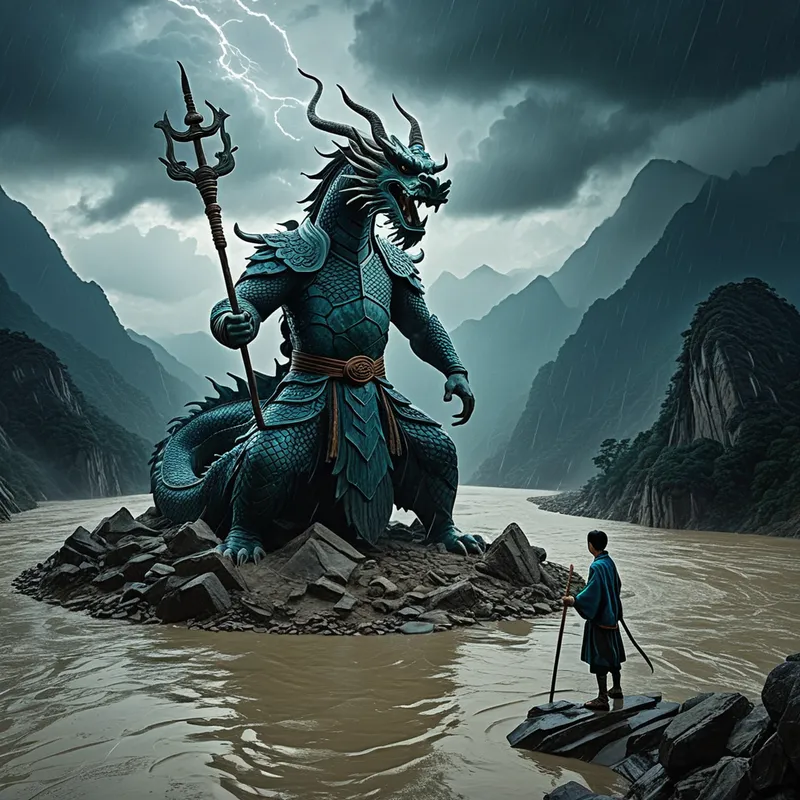
Then came his son, Yu. He received the same impossible mandate from the new emperor, Shun. But Yu had learned from his father’s fate. He did not look to heaven for stolen magic. He looked to the earth itself. He understood that the water must be heard, not imprisoned. For thirteen years, he walked. He traversed the nine provinces, his feet cracking on dried mud, his body caked in the grime of a world half-drowned. He summoned the spirits of the land and the dragons of the deep. With a humble bronze digging tool, he did not build walls. He carved channels.
He opened a path through Mount Longmen, splitting the rock so the Yellow River could roar through. He labored until his hands were claws, his skin blackened by sun and silt, his body hair worn away. He moved like a limping beast, one leg dragging from a permanent injury. He passed the door of his own home three times. On the first pass, he heard his wife sighing within. On the second, he heard the cries of his newborn son, Qi. On the third, his son was old enough to call his name. He did not enter. The work was not done. The waters demanded his whole life.
And then, one day, the roar changed. The chaotic, vertical pouring of the flood became a horizontal flow. The waters found his channels, his riverbeds, his careful, painstaking grooves in the flesh of the earth. They flowed eastward, to the great sea. The mud dried into fertile plains. The people came down from the hills. Where there was chaos, Yu had inscribed order. In gratitude and awe, Emperor Shun passed the throne to him. Yu the Great became the founder of the Xia Dynasty, and the tamed rivers became the arteries of a civilization.

Cultural Origins & Context
The myth of Yu is not merely a story; it is a foundational charter for Chinese civilization. Its earliest fragments appear on oracle bones and bronze vessels from the Shang Dynasty, and it is fully articulated in classic texts like the <abbr title="'Book of Documents', a collection of historical records and speeches">Shangshu</abbr> and <abbr title="'The Classic of Mountains and Seas', a mythological geography">Shanhaijing</abbr>. It was a central narrative for the ruling class, legitimizing the Xia and subsequent dynasties by linking kingship directly to a divine, heroic act of world-ordering.
The myth was performed and transmitted by court historians and ritual specialists. Its function was multifaceted: it explained the origin of China’s unique geography, it established the model of the virtuous, self-sacrificing ruler, and it encoded a fundamental philosophy of governance and interaction with nature. Unlike Western myths where gods command nature, Yu’s story emphasizes a heroic, human-led collaboration with the natural world. He succeeds not by defiance, but by understanding and guiding the inherent tendencies of water and land, setting a precedent for the Chinese ideal of harmony between heaven, earth, and humanity.
Symbolic Architecture
At its core, the myth of Yu is a profound drama of transformation, where the hero’s psyche and the world’s body are altered in a single, grueling process.
The flood is the uncontained psyche, the unconscious in its raw, overwhelming, and destructive aspect. It is emotion, trauma, and potential that has no channel, drowning conscious life.
Yu’s father, Gun, represents the ego’s first, instinctual response to psychic chaos: repression and blockage. He tries to wall it off with stolen divine power (the Xirang), a strategy that inevitably leads to catastrophic failure and punishment. Yu embodies the next, more conscious stage of psychological development. His long journey is the process of mapping the unconscious. He does not fight the water; he studies the lay of the land—the inherent structure of the self. His digging tool is the tool of conscious differentiation, carving channels of understanding, expression, and sublimation so that powerful energies can flow toward a purposeful end (the sea, a symbol of the vast, integrated unconscious).
His physical deformities—the darkened skin, the missing body hair, the lame leg—are not punishments but marks of transformation. He is no longer fully human; he has become something else, a hybrid creature of will and earth, a living embodiment of the labor of consciousness. His refusal to enter his home is the ultimate symbol of the hero’s sacrifice: he forgoes the personal, private life (the anima, the family) in service to the collective, world-building function. His body becomes a public artifact, a testament to the cost of creating order.
The Dreamer’s Resonance
When this myth stirs in the modern dreamer, it often manifests as dreams of overwhelming floods, of being tasked with an impossible, endless project, or of being physically misshapen by one’s labors. The somatic feeling is one of immense, grinding pressure and profound isolation.
Psychologically, this signals a pivotal moment where the dreamer is confronting a “flood” in their waking life—a surge of grief, rage, creative potential, or life-change that feels unmanageable. The Gun-phase of building internal dams (denial, distraction, addiction) has failed. The psyche is now demanding the Yu-process. The dreamer is being called to begin their own “thirteen-year journey”: the long, patient, and often lonely work of self-survey. This involves acknowledging the topography of their pain and passion, and beginning to carve conscious channels through therapy, art, ritual, or disciplined practice. The dream of passing one’s own home symbolizes the painful but necessary neglect of immediate personal comforts and identities in service of this deeper, transformative work.

Alchemical Translation
The alchemy of Yu is the transmutation of chaotic prima materia—the floodwaters of undifferentiated experience and emotion—into the structured gold of a coherent self and a functional life.
Individuation is not about stopping the flood, but learning its language and directing its flow. The Self is not the dam, but the riverbed.
The process begins with the mortificatio of Gun’s failure—the death of the old, obstructive strategy. Yu’s journey is the separatio and circumambulatio, separating oneself from ordinary life to walk the perimeter of one’s entire being, surveying its shadows and heights. The relentless labor is the calcinatio, the burning away of all softness and ego-attachment in the fire of relentless effort. His transformed body is the coagulatio, the new, solid form that emerges from the liquid chaos.
Finally, the establishment of the Xia Dynasty represents the rubedo, the red stage of completion and embodiment. The integrated psyche is no longer a personal secret; it becomes a “dynasty,” a ruling principle that brings order and fertility to one’s external world. The once-destructive floodwaters now nourish the plains of daily life. The myth teaches that true power and kingship over one’s own soul are earned through a sacrifice so total that it alters the very substance of the hero, enabling them to inscribe the patterns of meaning onto the formless clay of existence.
Associated Symbols
Explore related symbols from the CaleaDream lexicon: