Ymir Myth Meaning & Symbolism
From the body of the slain primordial giant Ymir, the gods Odin, Vili, and Vé fashioned the world, a cosmos born of sacrifice and violent creation.
The Tale of Ymir
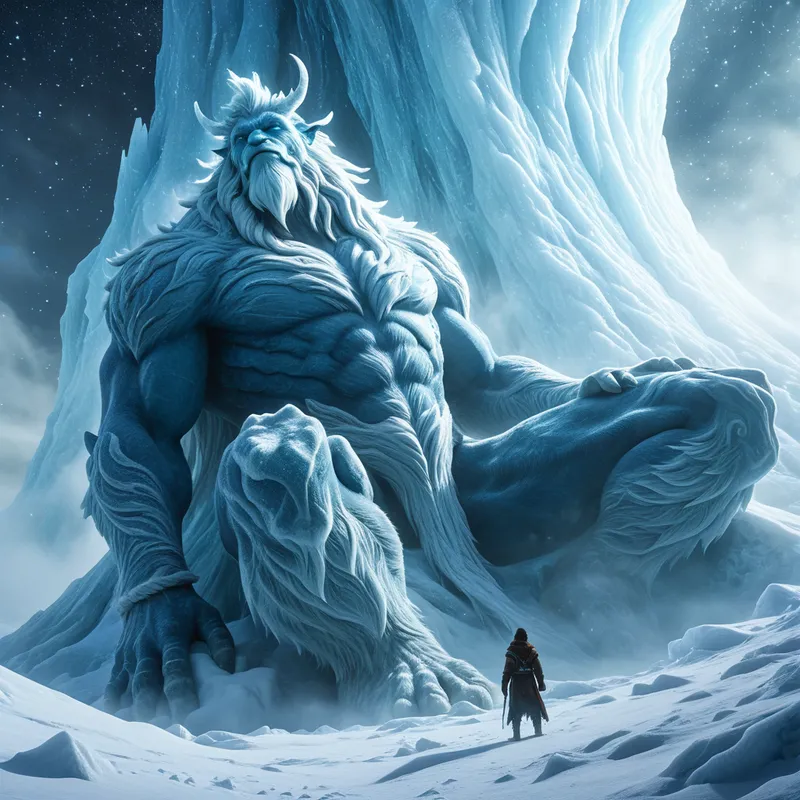
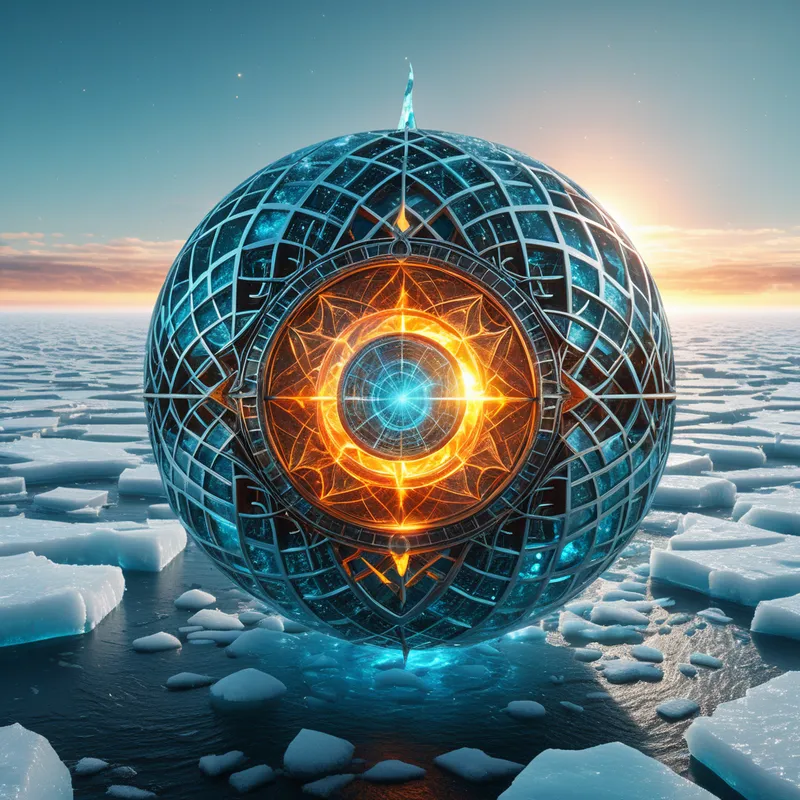
In the beginning, there was a chasm. Not a place, but the absence of all places—Ginnungagap, a yawning gap between the realm of Muspelheim’s searing flame and Niflheim’s biting frost. From this meeting of opposites, where fire kissed ice, a rime was formed. A dripping, living hoarfrost that coalesced, gathered substance, and began to breathe.
And from that breath, from that first condensation of being from non-being, the giant Ymir stirred. He was not born; he came into being, a self-created entity of ice and clay, of potential and chaos. His form was vast, sleeping in the void, a landscape of a body. As he slept, a sweat broke upon him. From the heat of his left armpit, a male and female giant dripped forth. One of his legs begat a son with the other. Thus, the race of the Jötnar sprang from him, a lineage of primordial force.
From the same melting rime that formed Ymir, there emerged a cow, Audhumbla. Her rivers of milk sustained the giant. And as she licked the salty ice-blocks for sustenance, she uncovered, over three days, a being of a different order: Buri, handsome and shining. From Buri came Borr, and from Borr and the giantess Bestla came three sons: Odin, Vili, and Vé.
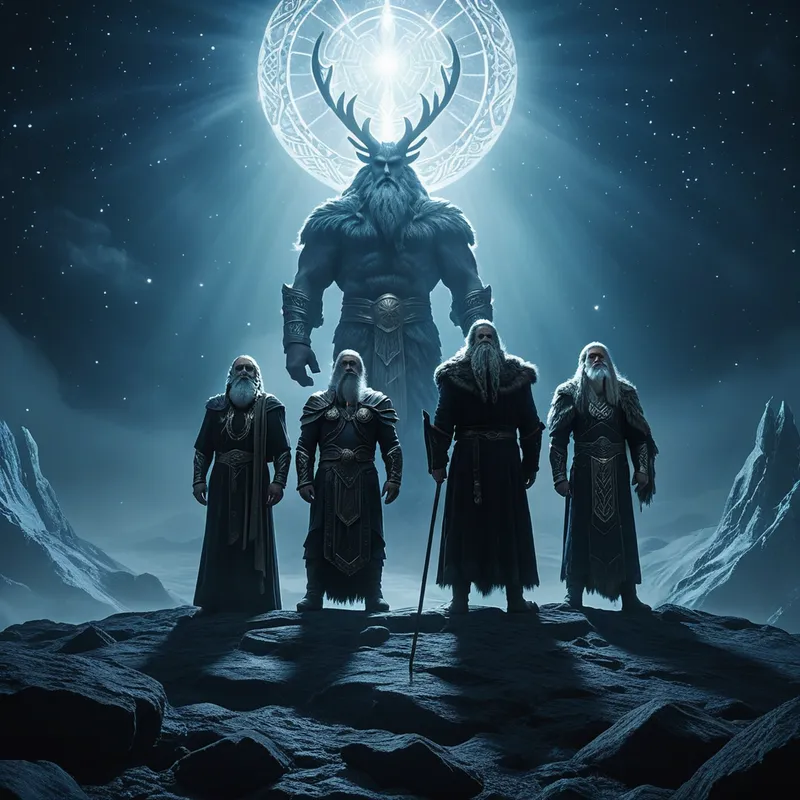
These three brothers looked upon the sleeping form of Ymir and the teeming, chaotic brood of giants that sprang from him. They saw a cosmos of unformed potential, a world trapped within the body of a dreaming, indifferent ancestor. A tension grew in the void—the tension between the raw, untamed substance of Ymir and the will of the brothers to shape, to order, to create.
The conflict erupted not with a shout, but with a decisive, terrible act. Odin, Vili, and Vé rose up against the progenitor. They fell upon the sleeping giant. In that first violence, the silence of Ginnungagap was shattered. Ymir’s blood, a torrent of meltwater and life-force, gushed forth so violently it drowned all but two of the frost giants, beginning the eternal feud between gods and giants. They dragged his colossal corpse into the center of the abyss.
And from his body, they made the world. His flesh became the rich, dark earth. His unspilled blood became the seas and the lakes. His bones were piled into mountains and his teeth became jagged cliffs. From his skull, they fashioned the dome of the sky, set at four corners by dwarfs who became the winds. They took the sparks and embers from Muspelheim and set them in the sky to be the sun, the moon, and the stars. The earth, Midgard, was fashioned from Ymir’s eyebrows as a fortress against the surviving giants. And from two pieces of driftwood, they breathed life into the first humans, Ask and Embla. The cosmos was built from the corpse of the first being, a world born of a necessary, foundational crime.
Cultural Origins & Context
This myth, the very spine of Norse cosmology, was not written in a sacred book but lived in the breath of skalds and the minds of the people. It was preserved primarily in two 13th-century Icelandic texts, the Prose Edda of Snorri Sturluson and the earlier, poem-based Poetic Edda. Snorri, a Christian scholar, compiled these tales, meaning our understanding is filtered through a post-conversion lens, yet the core, brutal poetry of the myth remains unmistakably pre-Christian.
Its societal function was profound. It was not just a “how” story, but a “why” story. It explained the fundamental nature of reality as the Norse people experienced it: a world carved from conflict, sustained by precarious order (örlög) against a backdrop of chaotic, primal forces (the Jötnar). It established the gods not as omnipotent creators ex nihilo, but as shapers who work with—and must violently overcome—preexisting, amoral material. This reflected a worldview where civilization was a hard-won bastion against a wild, unforgiving natural world. The myth justified the gods’ sovereignty through an act of creative violence, mirroring the harsh realities of survival, kingship, and the constant struggle against entropy.
Symbolic Architecture
Ymir is not a villain, but the primordial substance—the unconscious, undifferentiated “prima materia” of existence. He represents the totality of being before consciousness, before distinction, before ego. He is the cosmic womb and the chaotic raw material from which all forms are extracted.
The act of creation is not a gentle birthing, but a necessary dismemberment. Consciousness arises from the sacrifice of undifferentiated wholeness.
The three gods—Odin (spirit, inspiration), Vili (will, conscious intent), and Vé (sanctity, connection)—represent the emerging forces of psychic order. Their slaying of Ymir is the archetypal moment where the ego-consciousness differentiates itself from the unconscious matrix. It is a violent separation, a “cosmic crime” that births individual awareness but also creates a foundational trauma: the conscious mind is now separate from, and often at war with, its own source.
Every element of the created world is a symbolic translation of psychic faculties: the earth (the grounded body and persona), the sky (the lofty realm of thought and spirit), the sea (the emotional, unconscious depths), and the protective wall of Midgard (the fragile boundary of the conscious self). The surviving giants, forever outside the walls, represent the repressed or untamed aspects of the primal self that continually threaten to flood back in.
The Dreamer’s Resonance
When this myth stirs in the modern psyche, it rarely appears as a literal narrative. Instead, one might dream of overwhelming, formless landscapes—vast bodies of earth or ice that one is trapped upon or within. There may be dreams of foundational collapse, where the very ground (the familiar structure of one’s life or identity) is revealed to be made of something disturbingly organic or once-living. Dreams of catastrophic floods (Ymir’s blood) can symbolize an eruption of primal emotion or unconscious content that threatens to drown the conscious mind.
Somatically, this process can feel like a deep, structural disintegration—a “coming apart at the seams” of one’s old self. It is the psyche’s signal that a foundational pattern, often one inherited or formed in a primordial, unexamined state of being (the “sleeping giant” within), must be confronted and deconstructed. The dreamer is not being attacked by an external monster, but is experiencing the inner gods wrestling with the inner giant, initiating a painful but necessary phase of psychic reorganization.
Alchemical Translation
The myth of Ymir is a perfect map for the alchemical process of individuation—the journey toward psychological wholeness. The initial state, the nigredo, is the dark, cold, undifferentiated mass of Ginnungagap and the sleeping Ymir: a state of depression, confusion, or unconscious identification with one’s complexes.
The slaying and dismemberment of Ymir represent the crucial, often brutal stage of separatio and mortificatio. This is the conscious, willful act of breaking down outworn structures of the personality, dissecting one’s own history, traumas, and inherited patterns (the “giant’s body” of one’s unexamined life). It feels like a killing because it is the death of an old, encompassing identity.
To create a true Self, one must first have the courage to destroy the false cosmos built upon unconscious ground.
The reshaping of the world from Ymir’s parts is the stage of coagulatio—giving new, conscious form to the raw material of the psyche. The earth is your grounded, embodied life. The sky is your renewed perspective and spirit. The sea is your relationship with your own depths, now mapped and acknowledged. The defensive wall of Midgard becomes a conscious boundary, not a rigid fortress of denial, but a discerning membrane that allows for relationship with both inner and outer “giants” without being overwhelmed by them.
The completed work is not a return to the blissful sleep of Ymir, nor a pure victory of the gods. It is a living, breathing cosmos—an individuated psyche—built from a reconciled relationship with its own primordial source. It is a world forever born of sacrifice, sustained by the ongoing, conscious engagement between order and chaos, spirit and matter, the gods and the giant within.
Associated Symbols
Explore related symbols from the CaleaDream lexicon: