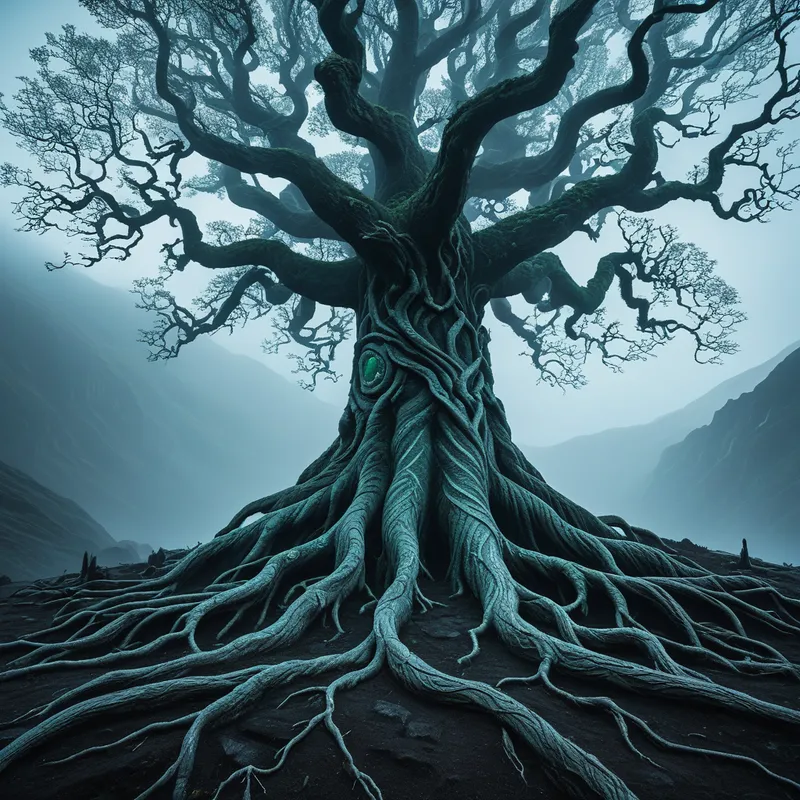
Yggdrasil's roots cracking Myth Meaning & Symbolism
A myth of the World Tree's suffering, where its roots are gnawed by serpents, threatening the stability of all Nine Worlds until a god offers himself as remedy.
The Tale of Yggdrasil’s roots cracking
Hear now of the groaning of the worlds. It begins not with a shout, but with a deep, subterranean sigh, a tremor that runs through the bones of the universe. It is the sound of [Yggdrasil](/myths/yggdrasil “Myth from Global/Universal culture.”/) suffering.
The great Ash, whose branches scrape the stars and whose roots plunge into the wells of fate, does not stand untouched. In the deepest dark, in the icy spring called [Hvergelmir](/myths/hvergelmir “Myth from Norse culture.”/), coils the great serpent [Nidhogg](/myths/nidhogg “Myth from Norse culture.”/). Tireless, venomous, its scales are the color of forgotten grudges. With teeth like shattered mountains, it gnaws. It does not feast, for the tree is not food; it gnaws for the sake of gnawing, for the joy of decay. And with every bite, a crack splinters up through the root, a black fissure in the foundation of all things.
Above, in Asgard, the golden halls shiver. The apples of [Idunn](/myths/idunn “Myth from Norse culture.”/) taste faintly of dust. [The einherjar](/myths/the-einherjar “Myth from Norse culture.”/) in [Valhalla](/myths/valhalla “Myth from Germanic culture.”/) feel a chill that their feasting cannot warm. The tremor is felt in every realm: in the stifling forges of the dvergr, in the light halls of the Alfar, and even in the murky depths of Hel itself. The worlds are slipping. The axis is cracking.
The Æsir gather at the Well of Urd, where the roots are also anchored. They see the damage. They hear the weeping of the [Norns](/myths/norns “Myth from Nordic culture.”/) as they try to plaster the cracks with sacred mud from the well. But it is not enough. The rot is from within and without. The eagle who sits in the high branches shrieks in alarm, and the squirrel [Ratatoskr](/myths/ratatoskr “Myth from Norse culture.”/), that gossip of the worlds, falls silent for once, feeling the great tree list.
It is Odin who understands the cost. The tree does not simply hold up the worlds; it is fed by them. Its suffering is their suffering. Its decay, their fate. To mend a crack in the root is to mend a crack in reality, and such mending requires a sacrifice of equal reality—a consciousness poured into the wound. He does not speak of this to the others. He takes up the horn [Gjallarhorn](/myths/gjallarhorn “Myth from Norse culture.”/), not to blow, but to carry.
He journeys down, past the middle root where [the well of wisdom](/myths/the-well-of-wisdom “Myth from Celtic culture.”/), [Mímisbrunnr](/myths/mmisbrunnr “Myth from Norse culture.”/), lies, and deeper still, into the dripping, resonant dark where Nidhogg dwells. The air is thick with the smell of damp earth and venom. He sees the root—massive as a mountain range, yet fragile as an old bone. The cracks are like black lightning frozen in the wood. He does not fight the serpent. That is not [the way](/myths/the-way “Myth from Taoist culture.”/). Instead, he stands at the site of the wound. He raises the horn, and from it, he pours not [water](/myths/water “Myth from Chinese culture.”/), but something far more precious: his own sovereignty, his own hard-won wisdom, the very essence of his godhood. It is a libation to the tree, a payment for its suffering. The liquid is dark and glimmering, like a night sky. It flows into the cracks, and for a moment, the gnawing ceases. The cracks do not vanish, but they seal over with a silvery, resilient scar-tissue. The groaning lessens to a hum. The worlds breathe again, but they, and Odin, are forever changed. The remedy is not a cure, but a pact. The tree is stabilized, but it bears the marks, and so does the god.

Cultural Origins & Context
This narrative is not a single, isolated tale, but a recurring motif woven throughout the tapestry of Norse cosmology, primarily preserved in the Poetic Edda (e.g., Grímnismál, Völuspá) and later systematized in Snorri Sturluson’s Prose Edda. It was not a bedtime story for comfort, but a cosmological truth told by skalds and wise men to explain the fundamental nature of a universe understood as dynamic, organic, and perpetually under threat.
The myth functioned as a foundational explanation for entropy and suffering within a sacred framework. For a seafaring, agricultural people living in a harsh climate, the idea that the very structure of reality required constant maintenance against inevitable decay was viscerally relatable. The myth provided a cosmic mirror for their own struggles: the ship that needs constant caulking, the field that must be fertilized, the community that requires sacrifice to endure. It was told in halls during the long winters, a reminder that stability is not a given, but an achievement—one that demands a price. The listener was not an outsider to this drama; they lived in the branches of Yggdrasil, feeling its tremors in their daily lives.
Symbolic Architecture
At its core, the cracking roots of Yggdrasil symbolize the inevitable [entropy](/symbols/entropy “Symbol: In arts and music, entropy represents the inevitable decay of order into chaos, often symbolizing creative destruction, impermanence, and the natural progression toward disorder.”/) at the [foundation](/symbols/foundation “Symbol: A foundation symbolizes the underlying support systems, values, and beliefs that shape one’s life, serving as the bedrock for growth and development.”/) of any [system](/symbols/system “Symbol: A system represents structure, organization, and interrelated components functioning together, often reflecting personal or social order.”/)—cosmic, psychological, or societal. The [tree](/symbols/tree “Symbol: In dreams, the tree often symbolizes growth, stability, and the interconnectedness of life.”/) is the [axis](/symbols/axis “Symbol: A central line or principle around which things revolve, representing stability, orientation, and the fundamental structure of reality or consciousness.”/) mundi, the central pillar of the [psyche](/myths/psyche “Myth from Greek culture.”/) and [the world](/myths/the-world “Myth from Tarot culture.”/). Its roots represent the deep, often unconscious foundations: our [primal instincts](/symbols/primal-instincts “Symbol: Primal Instincts represent the basic drives and survival mechanisms inherent in every individual, harkening back to our animalistic nature.”/), our ancestral past, the repressed [material](/symbols/material “Symbol: Material signifies the tangible aspects of life, often representing physical resources, desires, and the physical world’s influence on our existence.”/) (the [shadow](/symbols/shadow “Symbol: The ‘shadow’ embodies the unconscious, repressed aspects of the self and often represents fears or hidden emotions.”/)), and the [source](/symbols/source “Symbol: The origin point of something, often representing beginnings, nourishment, or the fundamental cause behind phenomena.”/) of our vitality.
The crack in the root is where the unconscious, in its raw and often destructive form (Nidhogg), meets the structure of consciousness. It is the fault line where chaos erodes order.
Nidhogg is not merely a [monster](/symbols/monster “Symbol: Monsters in dreams often symbolize fears, anxieties, or challenges that feel overwhelming.”/); it is [the principle](/symbols/the-principle “Symbol: A fundamental truth, law, or doctrine that serves as a foundation for a system of belief, behavior, or reasoning, often representing moral or ethical standards.”/) of [dissolution](/symbols/dissolution “Symbol: The process of breaking down, dispersing, or losing form, often representing transformation, release, or the end of a state of being.”/), the gnawing doubt, the unresolved [trauma](/symbols/trauma “Symbol: A deeply distressing or disturbing experience that overwhelms the psyche, often manifesting in dreams as unresolved emotional wounds or psychological injury.”/), the silent [resentment](/symbols/resentment “Symbol: A deep-seated emotional bitterness from perceived unfairness or injury, often festering silently and poisoning relationships.”/) that, left unattended, undermines our very foundation. The different wells at each root ([Hvergelmir](/symbols/hvergelmir “Symbol: Hvergelmir is the primordial well of Norse mythology, often considered the source of all rivers and living waters. It symbolizes both creation and the cyclical nature of existence.”/), Mímisbrunnr, Urd) suggest that this decay attacks all levels of being: the primal source ([life](/symbols/life “Symbol: The symbol of ‘Life’ represents a journey of growth, interconnectedness, and existential meaning, encompassing both the joys and challenges that define human experience.”/)/[death](/symbols/death “Symbol: Symbolizes transformation, endings, and new beginnings; often associated with fear of the unknown.”/)), the seat of wisdom, and the fabric of [fate](/symbols/fate “Symbol: Fate represents the belief in predetermined outcomes, suggesting that some aspects of life are beyond human control.”/) itself.
Odin’s act is the pivotal [symbol](/symbols/symbol “Symbol: A symbol can represent an idea, concept, or belief, serving as a powerful tool for communication and understanding.”/). He represents the conscious ego, the ruling principle. His sacrifice is not of [blood](/symbols/blood “Symbol: Blood often symbolizes life force, vitality, and deep emotional connections, but it can also evoke themes of sacrifice, trauma, and mortality.”/), but of self-[awareness](/symbols/awareness “Symbol: Conscious perception of self, surroundings, or internal states. Often signifies awakening, insight, or heightened sensitivity.”/). He pours his acquired [consciousness](/symbols/consciousness “Symbol: Consciousness represents the state of awareness and perception, encompassing thoughts, feelings, and experiences.”/)—his “eye” of [insight](/symbols/insight “Symbol: A sudden, deep understanding of a complex situation or truth, often arriving unexpectedly and illuminating hidden connections.”/) won from [Mimir](/myths/mimir “Myth from Norse culture.”/)’s well—into the crack. This symbolizes the critical psychological move: not to repress the disturbing content (the [serpent](/symbols/serpent “Symbol: A powerful symbol of transformation, wisdom, and primal energy, often representing hidden knowledge, healing, or temptation.”/)), nor to be destroyed by it, but to consciously acknowledge it, to “[water](/symbols/water “Symbol: Water symbolizes the subconscious mind, emotions, and the flow of life, representing both cleansing and creation.”/)” the wound with [awareness](/symbols/awareness “Symbol: Conscious perception of self, surroundings, or internal states. Often signifies awakening, insight, or heightened sensitivity.”/). The scar that forms is not a return to [innocence](/symbols/innocence “Symbol: A state of purity, naivety, and freedom from guilt or corruption, often associated with childhood and moral simplicity.”/), but a toughened [integration](/symbols/integration “Symbol: The process of unifying disparate parts of the self or experience into a cohesive whole, often representing psychological wholeness or resolution of internal conflict.”/). The system is saved not by eliminating the destructive force, but by incorporating its [reality](/symbols/reality “Symbol: Reality signifies the state of existence and perception, often reflecting one’s understanding of truth and life experiences.”/) into the [structure](/symbols/structure “Symbol: Structure in dreams often symbolizes stability, organization, and the framework of one’s life, reflecting how one perceives their environment and personal life.”/).
The Dreamer’s Resonance
When this myth surfaces in modern dreams, it rarely appears as a literal [world tree](/myths/world-tree “Myth from Global culture.”/). Instead, the dreamer may encounter: the foundation of their house cracking; their own teeth crumbling; the legs of a vital table splintering; or a great, beloved tree in their yard being hollowed out by insects. The somatic feeling is one of deep, unsettling vulnerability, a dread that something fundamental is giving way.
Psychologically, this dream pattern signals that the dreamer’s foundational psychic structures are under unsustainable strain. The “serpent” gnawing below could be a long-ignored addiction, a festering grief, a core belief that has outlived its usefulness, or the cumulative stress of living inauthentically. The cracking is the symptom—the anxiety, depression, or physical ailation that announces the system’s failure.
The dream is a call from the depths. It says the old ways of propping up [the self](/myths/the-self “Myth from Jungian culture.”/) are failing. It demands a journey to the root of the trouble, a confrontation not with an external monster, but with the internalized source of decay. The healing, as in the myth, lies not in finding a magical external cure, but in the dreamer’s willingness to offer their own conscious attention and resources—their time, their honesty, their tears—to the wounded place.

Alchemical Translation
The myth of the cracking roots is a perfect map for the alchemical process of individuation—the Jungian path to psychological wholeness. The initial state is the [nigredo](/myths/nigredo “Myth from Alchemical culture.”/), the blackening: the recognition of decay, depression, and foundational crisis. Nidhogg’s gnawing is this necessary, if painful, dissolution of outworn attitudes.
The alchemical work is to take the prima materia of one’s own suffering—the cracks, the venom, the dread—and, through the sustained heat of conscious attention, transmute it into the stabilizing elixir.
Odin’s journey to the root is the descent into the unconscious, the deliberate engagement with [the shadow](/myths/the-shadow “Myth from Jungian culture.”/). His horn, Gjallarhorn, is [the vessel](/myths/the-vessel “Myth from Alchemical culture.”/) of the ego, which typically calls the self to order. Here, it is repurposed. He inverts its function: instead of summoning or proclaiming (an act of ego assertion), he uses it to pour out, to irrigate the depths. This is the sacrifice of egoic certainty. He gives up his “godly” stance of detached control to engage directly with the mess.
The silvery scar-tissue that seals the crack is the lapis, the philosopher’s stone, not as a perfect crystal, but as a mended whole. It represents the new, more resilient personality structure born from this process. The individual who undergoes this alchemy does not become “uncrackable.” Instead, they become like [the world tree](/myths/the-world-tree “Myth from Celtic culture.”/) itself: deeply rooted, aware of the serpents below, bearing the scars of integration, and able to hold the tension between growth and decay. Their stability is no longer naive, but earned—a conscious, living structure that has made peace with the very forces that seek to undo it. The world is not saved from suffering, but made capable of containing it.
Associated Symbols
Explore related symbols from the CaleaDream lexicon: