Yūgen Myth Meaning & Symbolism
A poetic exploration of the mythic feeling of Yūgen, the profound, mysterious beauty that whispers of the universe's hidden depths.
The Tale of Yūgen
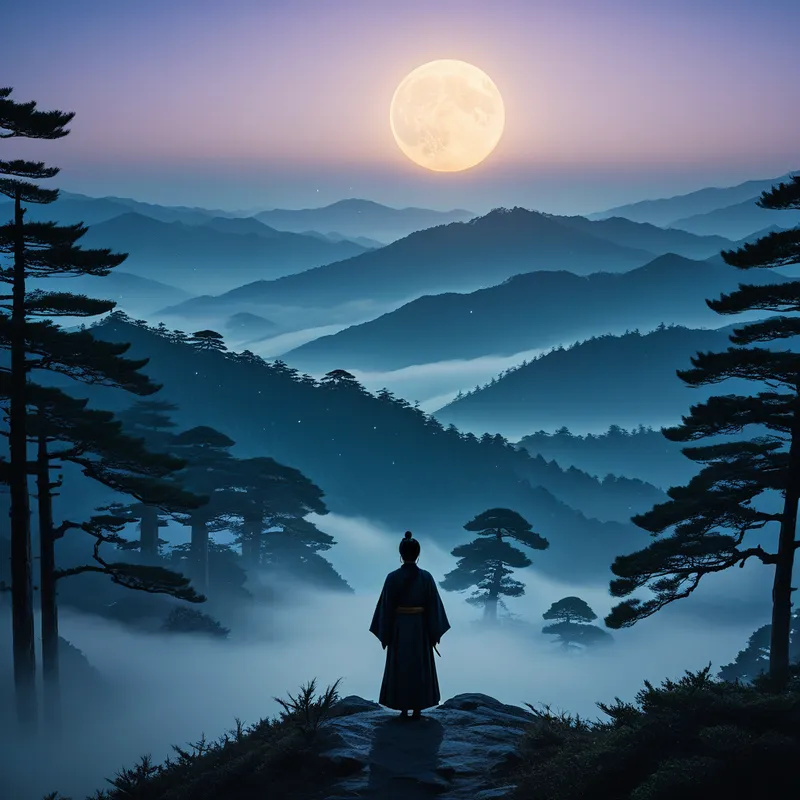
Listen. This is not a story of gods with thunderous names, nor of heroes who cleave mountains. This is the story of a sigh that became the world. A story felt in the hush between the temple bell’s ring and its fading, seen in the space where the mountain disappears into the mist.
In the ancient times, when the world was still writing itself in dew and shadow, there lived a profound silence. It was not an empty silence, but a pregnant one, thick as midnight ink. From this silence, the first poets and monks learned to listen with their souls, not their ears. They would walk the mountain paths at dusk, not to arrive, but to be between. Between the known pine and the unknown valley. Between the last note of the evening bird and the first star’s wink.
They called this listening Yūgen. It was an encounter. A monk, Kūya, once sat by a frozen waterfall. He did not see ice; he saw the memory of the torrent’s roar trapped in a cathedral of stillness. He felt the immense weight of the water’s potential, the ghost of its motion. In that moment, the waterfall was not just water. It was the universe holding its breath.
A noblewoman, gazing from her veranda, watched a lone wild goose vanish into a bank of autumn haze. Her heart did not break at its departure; it swelled. For in that vanishing was the whole truth of autumn—the poignant beauty of things that are beautiful precisely because they do not last. The goose was gone, but the sky now held its absence like a sacred vessel.
This is the myth: the night a traveling poet, lost in a deep forest, saw the faint, ghostly light of Hitodama drifting among the ancient cedars. He did not flee in terror. He stood, his breath a pale cloud in the cold air, and understood. The lights were not monsters, but the forest’s own deep, wordless sorrow made visible—the sadness of centuries of fallen leaves and passing creatures. He felt a awe so deep it tasted like grief, and a grief so pure it became the highest beauty. He did not write a poem that night. He became one.
Cultural Origins & Context
Yūgen is not a myth with a fixed pantheon or plot, but a mythological feeling cultivated and refined over centuries. Its roots are deeply entwined with the arrival of Zen Buddhism from China and its fusion with native Shinto sensibilities. While Shinto felt the divine (kami) in the vivid presence of nature, Zen pointed to the profound truth in absence, in the void.
This concept found its most eloquent expression during the Heian (794-1185) and Kamakura (1185-1333) periods, particularly in the art forms it governed: Waka and later Haiku, Noh theater, and monochrome ink painting (sumi-e). It was the secret language of the aristocracy and the monastic elite, a marker of the deepest cultural and spiritual refinement. To perceive Yūgen was to possess a soul capable of touching the ineffable.
It was passed down not as a story to be told, but as an experience to be hinted at. A master poet would point to the moon, and the student would learn to look at the space around it. A Noh actor, through the slightest tilt of his mask, would convey oceans of unseen emotion. The societal function was one of depth-education: to train perception to move beyond the surface of things, to sense the vast, echoing universe that lives within a single, fleeting moment.
Symbolic Architecture
Psychologically, Yūgen represents the ego’s conscious encounter with the transcendent mystery of the unconscious—the Self, in Jungian terms. It is the moment when the rational, daylight mind glimpses the awesome, unfathomable depth of the psyche and the cosmos, and realizes they are one.
The mist that obscures the mountain is not a barrier, but the very symbol of this encounter. It represents the veil of the personal unconscious, the shadow material that hides the full magnitude of the psyche. The distant, unseen mountain is the archetypal Self—the total, integrated psyche—whose peak we can never fully see or comprehend, but whose presence we can profoundly feel.
Yūgen is the aesthetic of the threshold. It is the soul standing in the doorway between the known world and the infinite, feeling the draft from beyond.
The lone goose vanishing into haze symbolizes the individual ego dissolving its boundaries. Its flight is not a loss, but a homecoming into a larger, more mysterious wholeness. The sorrow-beauty paradox at the heart of Yūgen mirrors the psychological truth of individuation: to become whole, one must consciously acknowledge the transience of all things, including the ego’s own central position. This awareness carries the poignant beauty of authentic existence.

The Dreamer's Resonance
When Yūgen manifests in modern dreams, it is rarely as a clear narrative. It appears as a quality of atmosphere. You dream of walking through a familiar city that is suddenly empty and immense under a twilight sky. You see a loved one from behind, but when they turn, their face is both known and utterly mysterious, filled with a silent, cosmic significance. You hold an object—a stone, a key—that feels heavier than the world, dense with unspoken history.
These are dreams of somatic resonance. The body in the dream is not acting; it is receiving. The psychological process is one of the conscious mind relaxing its grip, allowing the deeper, non-verbal intelligence of the unconscious to communicate through mood, image, and profound feeling. It is the psyche’s way of rehearsing a state of receptive awe. The dreamer undergoing this is at a point where intellectual analysis has reached its limit, and a deeper, more intuitive form of knowing is beginning to stir. There is often a feeling of melancholic awe upon waking—a homesickness for a depth you didn’t know you possessed.
Alchemical Translation
The alchemical work modeled by Yūgen is the transmutation of perception itself. The base metal is our ordinary, utilitarian way of seeing—seeing only the object, the fact, the surface. The gold is the capacity for visionary depth-perception, where every moment and object becomes a portal to the numinous.
The process begins with the nigredo, the blackening: a feeling of melancholy, of something vital being obscured by the “mist” of life’s confusion, depression, or mundane suffering. This is necessary. It darkens the bright, shiny ego so that subtler lights can be seen.
The first step is not to chase the mountain, but to honor the mist. For in the obscurity lies the invitation to see differently.
Then comes the albedo, the whitening: the conscious practice of receptive attention. This is the poet on the path, the monk in meditation. It is the willful turning of attention toward the veiled, the half-seen, the echo. In analysis, this is attending to the faint images of dreams, the hints of synchronicity, the “misty” feelings that have no clear name.
The final transmutation is the rubedo, the reddening or realization: not a dramatic explosion, but a quiet, permanent shift. The mountain does not need to be fully revealed. The beauty and truth are in the relationship between the seen and the unseen. The individual realizes that their deepest self is that mysterious, half-seen mountain. The sorrow of transience (mono no aware) and the awe of depth (Yūgen) fuse into a single, enduring stance toward existence—one of grounded wonder. You cease trying to illuminate every shadow and instead learn to appreciate the profound beauty of the play between light and dark within your own soul.
Associated Symbols
Explore related symbols from the CaleaDream lexicon: