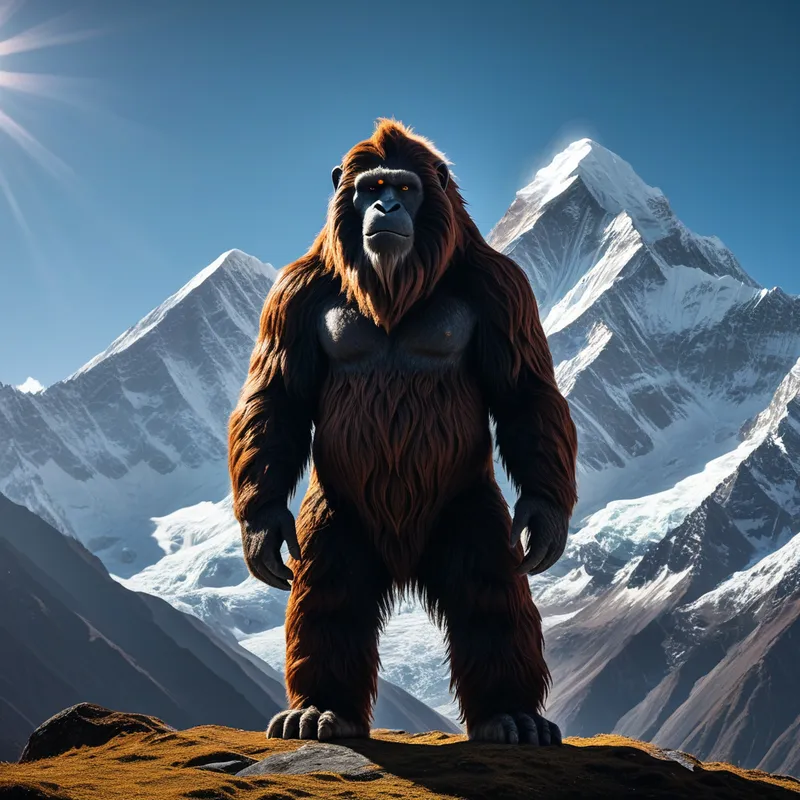
Yeti/Meh-Teh Myth Meaning & Symbolism
A guardian spirit of the high peaks, the Meh-Teh dwells in the liminal mists, a sacred mystery challenging those who seek the world's hidden heart.
The Tale of Yeti/Meh-Teh
Listen. The wind does not howl here; it sings a song older than stone. It carries the scent of ice and ancient cedar down from the Roof of the World, where the air is thin and the gods walk close. In this realm of eternal white and profound silence, where the sky touches the earth with a cold, clear kiss, there is a story written not in ink, but in footprints that vanish with the dawn.
It begins not with a king or a warrior, but with a herder named Norbu. His world was the high pasture, a green jewel cupped in the hands of giants. One evening, as the sun bled gold across the glaciers, a strange sound echoed from the crags—a deep, resonant call that was neither bear nor man. It was a sound that made the marrow in his bones grow cold and wise. The next morning, three of his strongest dzo were gone. Not taken by wolves, for there were no tracks of struggle, only a single, deliberate trail of immense, bipedal prints leading up, ever up, into the realm of perpetual mist.
Norbu knew the old warnings. The Meh-Teh was not a beast to be hunted. It was a yul-lha of the absolute high places, the guardian of the final threshold. Yet, driven by a fire that was part desperation and part a calling he could not name, he followed. For seven days and seven nights, he climbed beyond the pastures, beyond the summer hermitages, into a landscape of raw creation. The air grew sharp enough to cut thought. He slept fitfully, the strange call now a constant companion in the wind.
On the eighth day, the mist parted. There, on a ledge overlooking a chasm that plunged into the heart of the earth, stood the Meh-Teh. It was taller than two men, its form powerful and thick with fur the color of weathered rock and old blood. It did not roar. It simply turned its great, sloping head and regarded Norbu with eyes that held the patience of glaciers. In that gaze, Norbu did not see malice, but a profound, alien loneliness—the solitude of a creature that is the last of its kind, a relic from a time when the world was wilder and the boundaries between animal, man, and spirit were not yet drawn.
The Meh-Teh lifted a hand, not in threat, but in a gesture that seemed to encompass the towering peaks, the yawning void, and Norbu himself. Then, with a grace that belied its size, it turned and vanished into a curtain of cloud that had not been there a moment before. Norbu was left alone with the echo of the wind and a single, overwhelming understanding: he had not found a monster. He had encountered the boundary itself. He descended, forever changed, carrying not a trophy, but a mystery. His story became one of many, a thread in the tapestry of whispers that clings to the high passes—a tale of the sacred wild that watches from the edge of the world.
Cultural Origins & Context
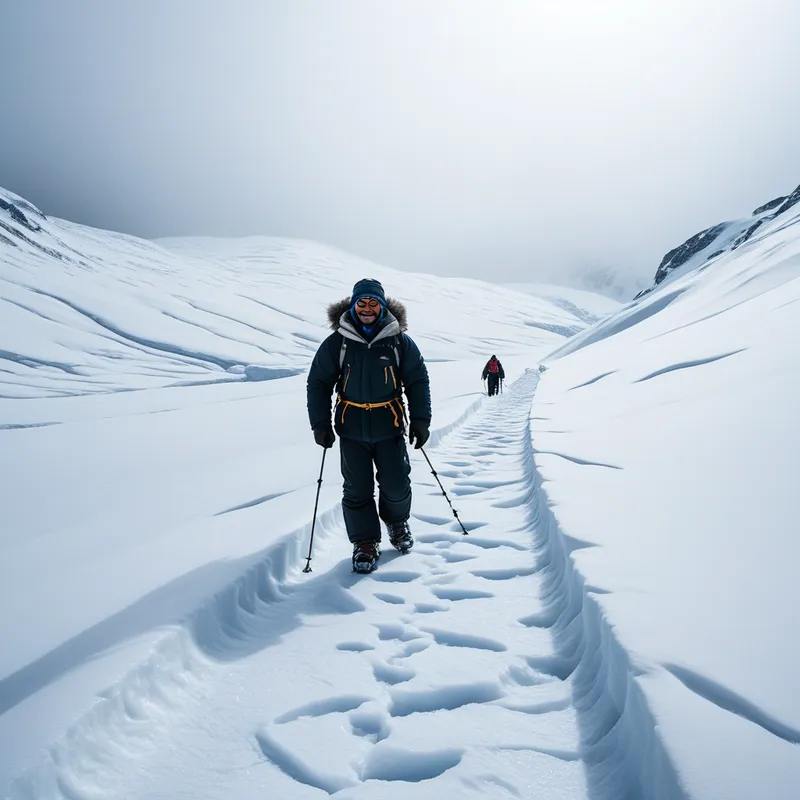
The myth of the Yeti, or more authentically, the Meh-Teh or Migoi, is not a single story but a living folklore woven into the daily fabric of Himalayan life, particularly among the Sherpa, Bhutia, and Tibetan communities. It was never a myth of grand epics recited in courts, but a practical, oral tradition passed between herders, traders, and monks along the perilous caravan routes. The stories functioned as both map and warning. A remote valley said to be the dwelling of a Yeti was a place to be respected, if avoided—a natural conservation marker that protected fragile ecosystems and kept the unprepared from deadly terrain.
The tellers were the people of the mountains themselves. A grandmother might speak of the Yeti’s eerie whistle to keep children from wandering at dusk. A seasoned guide would point to a strange track not as proof of a monster, but as evidence of the mountain’s active, sentient presence. In Vajrayana Buddhism, which deeply infuses the region, the Yeti often occupies a liminal space in the cosmology. It is sometimes considered a yeti (a different, though homophonous, class of spirit), or a manifestation of the raw, untamed power of nature that exists before enlightenment tames the wild mind. The myth served a societal function of enforcing humility, teaching that there are realms beyond human understanding and control, and that the highest places are not empty, but full of a sacred, watchful presence.
Symbolic Architecture
The Meh-Teh is the ultimate symbol of the liminal. It dwells not in the forest or the valley, but in the alp, the literal and metaphorical threshold between the human world and the realm of the gods, the known and the utterly unknown. It is the embodied mystery of the borderland.
The guardian of the threshold is not a barrier to keep us out, but a test of the spirit we bring to the passage.
Psychologically, the Yeti represents the ultimate Shadow—not the personal shadow of our minor flaws, but the collective, primordial shadow. It is the part of our nature that remains utterly wild, untamed by society, language, or even conscious thought. It is the raw instinct for survival, the profound solitude of existence, and the ancient animal wisdom we have sealed away in our climb toward civilization. Its elusive nature—always just out of sight, leaving traces but never yielding to capture—mirrors the psyche’s own defense of its deepest, most instinctual core. We project our fear of the wild, both outside and within, onto this figure, making it a “monster,” when in truth, it may simply be the keeper of a forgotten part of our own souls.

The Dreamer’s Resonance
When the Meh-Teh stalks the landscapes of modern dreams, it signals a profound encounter with this primordial shadow. The dreamer is not facing a simple nightmare, but a summons from the psyche’s highest, most isolated altitudes. The somatic feeling is often one of awe-edged terror: the chilling wind, the crushing silence, the visceral thrill and dread of being watched by something immensely powerful and other.
Psychologically, this dream marks a critical threshold in the dreamer’s life. It appears when one is approaching a personal “high pass”—a career change, a spiritual crisis, the confrontation of a deep-seated fear, or the integration of a powerful but rejected aspect of the self (like raw anger or immense creative power). The Meh-Teh does not attack; it observes. Its gaze forces the dreamer to ask: What untamed part of me have I exiled to the frozen heights? What sacred mystery am I both drawn to and terrified of confronting? The dream is an initiation into bearing the weight of one’s own wholeness, which includes the powerful, solitary, and instinctual creature one has been taught to abandon.

Alchemical Translation
The myth of the Meh-Teh models the alchemical stage of nigredo as it occurs at the summit of the individuation journey. It is not a descent into the personal mud, but an ascent into the collective ice. The process begins with a call—a loss (Norbu’s dzo) or a longing that pulls us out of our comfortable “pastures” and up toward the risky, rarefied air of self-confrontation.
The triumph is not in capturing the wild spirit, but in surviving its gaze and returning, humbled, to the human world with a piece of the eternal cold in your heart.
The arduous climb is the conscious effort to face what we have made monstrous. The final encounter—the silent meeting of gazes—is the moment of coniunctio with the ultimate Shadow. Here, there is no battle, no slaying. There is recognition. The psychic transmutation occurs in that stillness. The wildness is not integrated in the sense of being made domestic; it is acknowledged as a sovereign, eternal part of the inner landscape. The “treasure” the hero returns with is not the pelt of the beast, but the indelible knowledge of its existence. For the modern individual, this translates to the hard-won ability to hold space for the parts of ourselves that will never be civilized, social, or neat. It is to make peace with the eternal guardian at our own personal border, understanding that its presence does not block our path, but sanctifies it. We become, in a sense, the herders of our own mysterious heights, respectful of the wild guardian within that ensures we never fully conquer our own soul’s sacred, untamed territory.
Associated Symbols
Explore related symbols from the CaleaDream lexicon: