Yeti Myth Meaning & Symbolism
A myth of the wild, white-haired guardian of the high peaks, a liminal being embodying the untamed spirit of the mountains and the shadow of the human soul.
The Tale of Yeti
Listen. Above the sigh of the pines and the groan of ancient ice, there is a story written in the snow. It is not a story for [the hearth](/myths/the-hearth “Myth from Norse culture.”/), but for the high, thin air where the lungs burn and the spirit grows quiet.
In the time when the mountains were young gods, and [the sky](/myths/the-sky “Myth from Persian culture.”/) was a bowl of deepest lapis, the people of the valleys lived in the embrace of the Mother. They knew the paths of the yak and the song of [the river](/myths/the-river “Myth from Buddhist culture.”/). But their eyes were always drawn upward, to the white teeth of [the world](/myths/the-world “Myth from Tarot culture.”/) biting [the sky](/myths/the-sky “Myth from Persian culture.”/). Those peaks were not empty. They were the domain of the [Meh-Teh](/myths/meh-teh “Myth from Himalayan culture.”/), the one who walks alone.
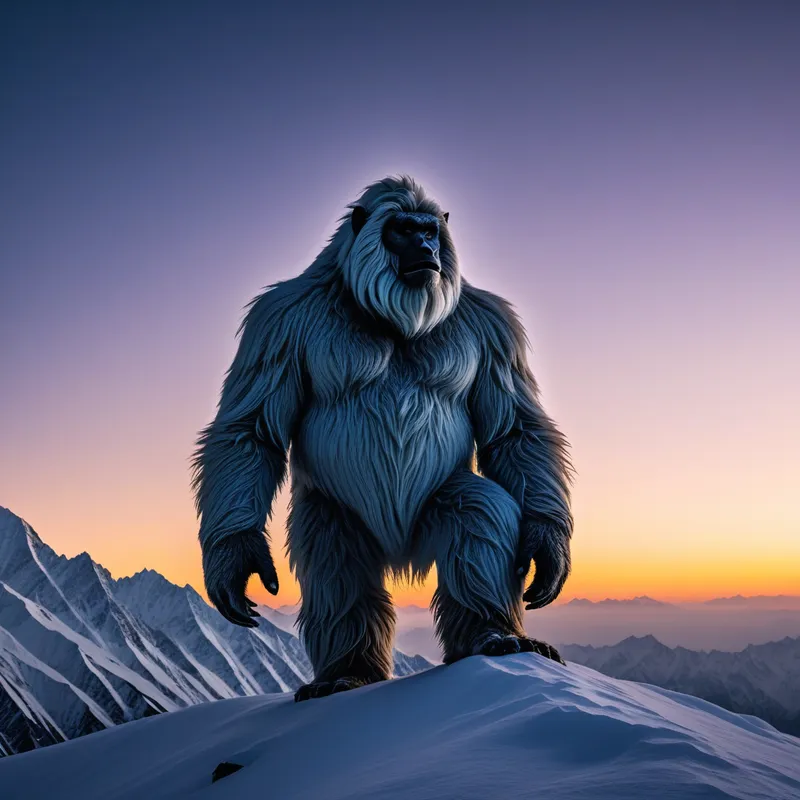
He is born of the mountain’s breath and the glacier’s heart. His pelt is the color of the first winter snow, a cloak woven from moonlight and hoarfrost. His feet are broad as shields, leaving marks in the scree that speak of impossible weight and silent passage. You do not find him. He allows himself to be glimpsed—a shiver in the periphery, a deeper shadow against the rock, the sudden stillness of the [raven](/myths/raven “Myth from Haida culture.”/).
The tale is told of a herder, a man named Pemba, who drove his goats too high in a late autumn, chasing the last sweet grass. A mist, thick as wool, descended. The world shrank to the sound of his own breath and the clatter of stones underfoot. Then, silence. A silence so profound it had weight. From the white void came a sound—not a growl, but a low rumble, like stone grinding against stone. [The mist](/myths/the-mist “Myth from Celtic culture.”/) parted for a heartbeat, and there, standing on a ledge above him, was the shape. It was vast, shouldering the sky. Its eyes were not the eyes of a beast, but pools of ancient, knowing darkness.
Pemba froze, his blood turning to ice [water](/myths/water “Myth from Chinese culture.”/). The figure did not advance. It simply stood, a boundary made flesh. It was the mountain saying, You have come far enough. This is not your place. In that moment, Pemba understood not with his mind, but with his bones. He was not facing a monster, but a guardian. He bowed his head, a gesture of respect to the sovereign of this realm, and began his careful, backward retreat, leaving his stray goats as an offering. The mist closed again. When he stumbled back to the treeline, he was changed. He had seen the keeper of [the threshold](/myths/the-threshold “Myth from Folklore culture.”/) and lived, carrying not a tale of terror, but one of awe. He had met the wildness that defines the edge of the human world.
Cultural Origins & Context
The Yeti is not a single, standardized myth, but a pervasive presence in the folklore of the Himalayan regions, from Nepal and Tibet to Bhutan and parts of northern India. Its names are many: Meh-Teh, Migoi, or simply the “Wild Man of the Snows.” Unlike the gods and demons of formal Vajrayana pantheons, the Yeti belongs to the older, animistic stratum of belief, a being of the land itself.
These stories were not written in texts but carried on the freezing wind, told by Sherpas and traders around smoky fires after a long traverse. They functioned as vital, practical wisdom. The Yeti narrative served as a natural law, an ecological and spiritual boundary marker. It instructed the community: There is a line beyond which human dominion ends. The highest peaks, the most remote glaciers, are not for conquest; they are the abode of a power that demands respect. It was a story that cultivated humility and caution, protecting people from the very real dangers of the high alpine wilderness by personifying its inherent peril and sanctity.
Symbolic Architecture
Psychologically, the [Yeti](/symbols/yeti “Symbol: The Yeti symbolizes the unknown, mystery, and the quest for understanding the unfamiliar.”/) is a masterful [symbol](/symbols/symbol “Symbol: A symbol can represent an idea, concept, or belief, serving as a powerful tool for communication and understanding.”/) of the [Shadow](/symbols/shadow “Symbol: The ‘shadow’ embodies the unconscious, repressed aspects of the self and often represents fears or hidden emotions.”/) and the [Guardian](/symbols/guardian “Symbol: A protector figure representing safety, authority, and guidance, often embodying parental, societal, or spiritual oversight.”/) of the Threshold. It dwells in the “high, cold places” of the [psyche](/myths/psyche “Myth from Greek culture.”/)—the remote, untamed, and often avoided aspects of our own [nature](/symbols/nature “Symbol: Nature symbolizes growth, connectivity, and the primal forces of existence.”/).
The Shadow is not what is evil, but what is wild and unknown. The Yeti is the embodied psyche of the mountain, the untamed instinct that remains when human civilization falls away.
It is both fearsome and sacred. Its elusiveness symbolizes those parts of ourselves we can never fully grasp or possess—the core of our instinctual [life](/symbols/life “Symbol: The symbol of ‘Life’ represents a journey of growth, interconnectedness, and existential meaning, encompassing both the joys and challenges that define human experience.”/), our primal vitality, or our deepest [grief](/symbols/grief “Symbol: A profound emotional response to loss, often manifesting as deep sorrow, yearning, and a sense of emptiness.”/). It is always just out of [sight](/symbols/sight “Symbol: Sight symbolizes perception, awareness, and insight, representing both physical and inner vision.”/), a feeling rather than a fact. The iconic [footprint](/symbols/footprint “Symbol: A footprint symbolizes a journey, the impact of one’s actions, and the legacy left behind.”/), often found and then lost, represents the tantalizing, partial [evidence](/symbols/evidence “Symbol: Proof or material that establishes truth, often related to justice, guilt, or validation of beliefs.”/) of this inner wildness. We see its tracks in our sudden, powerful emotions, our irrational fears, or our raw creative impulses, but we rarely confront the [source](/symbols/source “Symbol: The origin point of something, often representing beginnings, nourishment, or the fundamental cause behind phenomena.”/) directly. The Yeti is not a [problem](/symbols/problem “Symbol: Dreams featuring a ‘problem’ often symbolize internal conflicts or challenging situations that require resolution and self-reflection.”/) to be solved, but a [presence](/symbols/presence “Symbol: Presence in dreams often signifies awareness or acknowledgment of something significant in one’s life.”/) to be acknowledged. It is the psyche’s way of saying that not everything within us is meant to be domesticated.

The Dreamer’s Resonance
When the pattern of the Yeti emerges in modern dreams, it rarely appears as a literal monster from a movie. Its presence is more subtle, more atmospheric. You may dream of being in a familiar city that suddenly gives way to a vast, snowy landscape. You might be in a house and discover a door you never noticed, leading to an attic filled with deep, undisturbed snow and the feeling of a massive, quiet presence.
Somatically, this dream often accompanies a process of confronting a “high, cold” truth within oneself—a frozen emotion, a long-avoided responsibility, or a feeling of isolation. The dreamer is at the threshold of integrating something formidable and primal. The fear felt in the dream is not merely terror, but the awe of standing before something vastly older and more potent than [the ego](/myths/the-ego “Myth from Jungian culture.”/). The resolution, if there is one, is never a battle won, but a gesture of respect made, a boundary recognized. The dream may leave you with a sense of profound solitude, but also with a strange, quiet strength—the strength that comes from having respectfully encountered the guardian of your own inner wilderness.

Alchemical Translation
The alchemical journey modeled by the Yeti myth is not one of slaying dragons, but of navigating the liminal zone with reverence. In the process of individuation—becoming who we truly are—we must eventually venture into the “high country” of our own psyche, leaving behind the comfortable valleys of [persona](/myths/persona “Myth from Greek culture.”/) and social identity.
The goal is not to capture the wildness, but to learn its language, to acknowledge its sovereignty, and in doing so, to discover that its territory is also part of our wholeness.
The initial confrontation, like Pemba’s in the mist, induces a psychic freeze. We want to flee the cold, intimidating truth of our shadow. The alchemical work is to hold that ground, to feel the fear without running, and to make the symbolic bow—an act of conscious recognition. We offer something (an old identity, a cherished illusion, like Pemba’s goats) to this inner guardian. This is the transmutation: the raw, frightening, instinctual energy (the Yeti) is not destroyed or tamed, but its relationship to the conscious self is changed. It shifts from a perceived monster lurking out there to a respected, integral force in here. We integrate its strength, its endurance, and its deep connection to the primordial ground of being. We become, in a sense, at home in the high places, not as conquerors, but as humble visitors who know the rules of the realm. The myth teaches that wholeness requires making peace with the wild, silent guardian that stands between who we are and who we might become.
Associated Symbols
Explore related symbols from the CaleaDream lexicon: