Yellow River Myth Meaning & Symbolism
A myth of a world-shattering flood, a divine hero's sacrifice, and the taming of chaos to bring forth the cradle of Chinese civilization.
The Tale of Yellow River
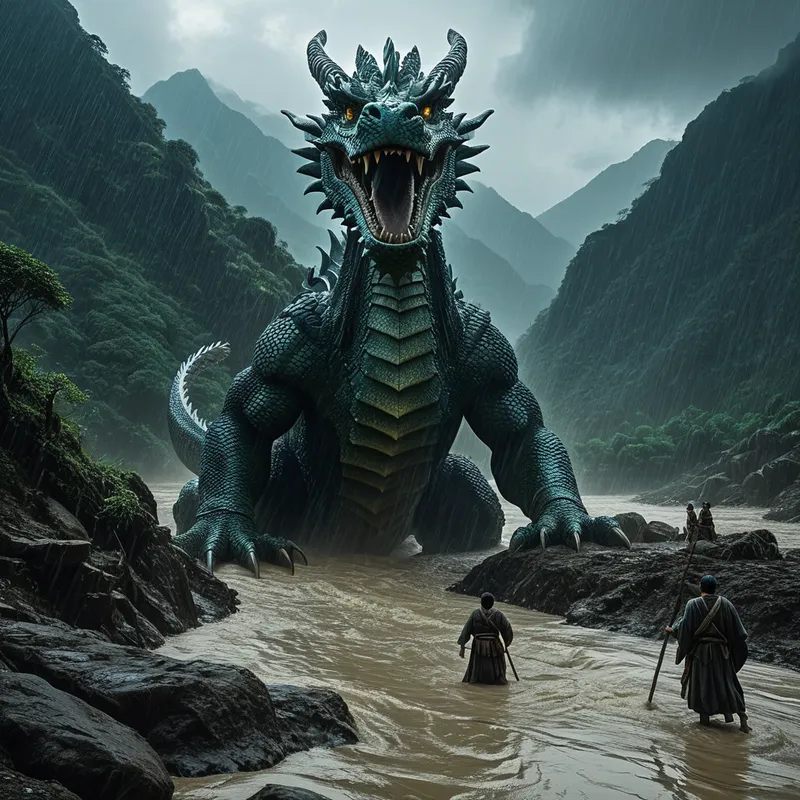
In the time before time, when [the world](/myths/the-world “Myth from Tarot culture.”/) was soft and [the sky](/myths/the-sky “Myth from Persian culture.”/) was low, the waters did not know their way. They were a wild, churning chaos, a thousand serpentine wills crashing against the bones of the mountains. The great plain of the Middle Kingdom was a vast, sorrowful marsh, a realm of drowning and despair. The people huddled on the high places, their bellies empty, their spirits broken by the endless, muddy deluge. This was the reign of the [Great Flood](/myths/great-flood “Myth from Mesopotamian culture.”/), a beast without a head, a hunger that consumed [the earth](/myths/the-earth “Myth from Hindu culture.”/) itself.
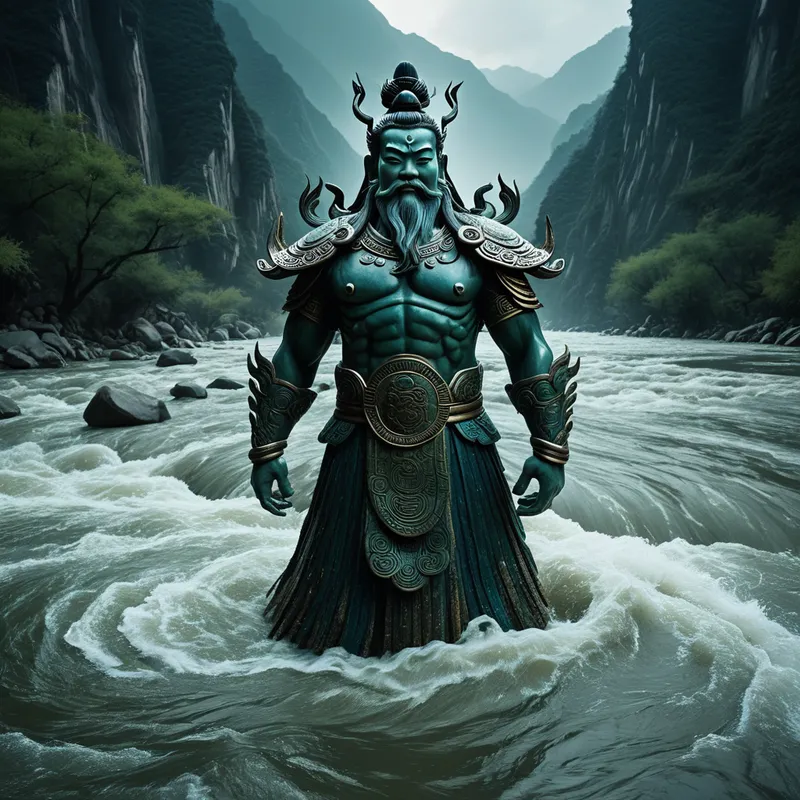
From this despair rose a figure of resolve: [Yu the Great](/myths/yu-the-great “Myth from Chinese culture.”/). He was not a god of thunder, but a man of the earth, son of Gun, who had tried to cage the waters with walls of magic soil and failed. Yu learned from his father’s fate. He did not seek to oppose, but to understand. For years, he walked. He traced the angry paths of the torrents, his feet cracking on dried mud, his skin weathered by wind and spray. He consulted the stars, the rocks, and the whispers of the old turtles. He saw that [the flood](/myths/the-flood “Myth from Biblical culture.”/) was not an enemy to be slain, but a dragon to be guided.
His labor was the labor of the world. He did not command armies of men, but summoned the loyalty of the land itself. With a bronze shovel that gleamed under a weary sun, he began to dig. Not random trenches, but channels that spoke to the [water](/myths/water “Myth from Chinese culture.”/)’s own desire to flow. He cut through mountains—not with magic, but with the relentless, grinding patience of a river stone. Where his father built walls, Yu opened pathways. He let [the dragon](/myths/the-dragon “Myth from Chinese culture.”/) breathe. His hands were never clean; they were forever stained the color of the silt, the yellow earth that gave [the river](/myths/the-river “Myth from Buddhist culture.”/) its name and its soul.
They say he passed his own home three times as he traveled the length of the land. Three times he heard the cry of his newborn son. Three times he did not enter, for the dragon’s roar was louder. His body became bent, his legs scarred and swollen from constant wading, transforming him into a being half-man, half-terrain. Finally, after thirteen years that wore down epochs, he stood at the great eastern plain. The last channel was opened. The wild, thrashing serpent of water gathered itself, took a deep, cosmic breath, and poured into the new course Yu had carved for it. The chaos subsided. The muddy waters receded, revealing dark, fertile soil—the loess, the gift of the dragon. Where there was despair, there was now a cradle. The unruly beast had been transformed into the Mother River, and Yu, the weary hero, became the first ruler of the Xia.
Cultural Origins & Context
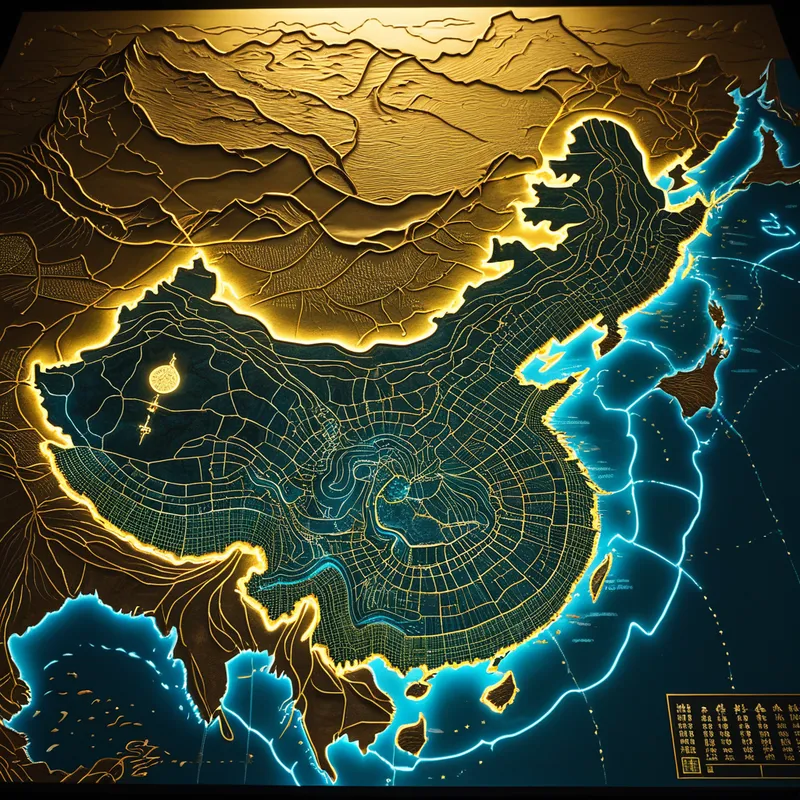
The myth of Yu and [the Yellow River](/myths/the-yellow-river “Myth from Chinese culture.”/) is not merely a story; it is a foundational memory etched into the cultural [psyche](/myths/psyche “Myth from Greek culture.”/) of China. It originates from the dawn of Chinese historiography, recorded in texts like the Shujing and the Shiji. Unlike purely divine creation myths, it occupies a sacred space between legend and proto-history, explaining the origin of China’s dynastic rule and its intimate, fraught relationship with its most vital geographical feature.
The myth was propagated by scholars and officials as a paradigm of virtuous leadership. Yu’s success, contrasted with his father Gun’s failure, served as a potent political allegory: effective governance is not about forceful suppression (blocking dams), but about wise guidance and harmonious integration (digging channels). It justified [the Mandate of Heaven](/myths/the-mandate-of-heaven “Myth from Chinese culture.”/) by modeling the ideal ruler as one who tames chaos for the people’s welfare. Furthermore, it explained the very essence of the North China Plain—its incredible fertility born from catastrophic flood deposits. The story was told to remind people that their civilization was literally built from the sediment of a controlled catastrophe, a hard-won order from a primal mess.
Symbolic Architecture
At its core, the myth is a profound map of [consciousness](/symbols/consciousness “Symbol: Consciousness represents the state of awareness and perception, encompassing thoughts, feelings, and experiences.”/) confronting the unconscious. The Great Flood represents the undifferentiated, overwhelming power of the unconscious—formless, emotional, and potentially destructive. It is the psychic [chaos](/symbols/chaos “Symbol: In Arts & Music, chaos represents raw creative potential, uncontrolled expression, and the breakdown of order to forge new artistic forms.”/) that precedes order, the raw, untamed libido or [life](/symbols/life “Symbol: The symbol of ‘Life’ represents a journey of growth, interconnectedness, and existential meaning, encompassing both the joys and challenges that define human experience.”/) force that floods [the ego](/myths/the-ego “Myth from Jungian culture.”/).
The hero is not one who defeats the unconscious, but one who learns its language and gives it a voice.
Gun represents the ego’s initial, naive [strategy](/symbols/strategy “Symbol: A plan of action designed to achieve a long-term or overall aim, often involving competition, resource management, and foresight.”/): repression. He tries to [wall](/symbols/wall “Symbol: Walls in dreams often symbolize boundaries, protection, or obstacles in one’s life, reflecting the dreamer’s feelings of confinement or security.”/) off the flood, to dam up powerful emotions or instincts. This always fails, leading to greater psychic pressure and eventual [breakdown](/symbols/breakdown “Symbol: A sudden failure or collapse of a system, structure, or mental state, often signaling a need for fundamental change or repair.”/) (his execution). Yu, however, embodies the conscious mind undertaking the arduous [task](/symbols/task “Symbol: A task represents responsibilities, duties, or challenges one faces.”/) of individuation. His long [journey](/symbols/journey “Symbol: A journey in dreams typically signifies adventure, growth, or a significant life transition.”/) is the journey of self-[knowledge](/symbols/knowledge “Symbol: Knowledge symbolizes learning, understanding, and wisdom, embodying the acquisition of information and enlightenment.”/). His digging is not an attack, but an act of careful discernment—creating channels of [awareness](/symbols/awareness “Symbol: Conscious perception of self, surroundings, or internal states. Often signifies awakening, insight, or heightened sensitivity.”/), pathways for unconscious content (the [water](/symbols/water “Symbol: Water symbolizes the subconscious mind, emotions, and the flow of life, representing both cleansing and creation.”/)) to flow into conscious life without causing devastation.
His transformed [body](/symbols/body “Symbol: The body in dreams often symbolizes the dreamer’s self-identity, personal health, and the relationship they have with their physical existence.”/), stained and misshapen, symbolizes the permanent [alteration](/symbols/alteration “Symbol: The act of changing or modifying something, often representing personal transformation, adaptation, or a shift in life’s direction.”/) of the ego that true self-work requires. One does not integrate the unconscious and remain unchanged. The fertile plains revealed afterward represent the new psychic territory and creative potential unlocked when chaos is guided, not fought. The [river](/symbols/river “Symbol: A river often symbolizes the flow of emotions, the passage of time, and life’s journey, reflecting transitions and movement in one’s life.”/), now a “[Mother](/symbols/mother “Symbol: The symbol of ‘Mother’ represents nurturing, protection, and the foundational aspect of one’s emotional being, often associated with comfort and unconditional love.”/),” symbolizes the life-giving [aspect](/symbols/aspect “Symbol: A distinct feature, quality, or perspective of something, often representing a partial view of a larger whole.”/) of the once-destructive unconscious when it is brought into a conscious, respectful [relationship](/symbols/relationship “Symbol: A representation of connections we have with others in our lives, often reflecting our emotional state.”/).
The Dreamer’s Resonance
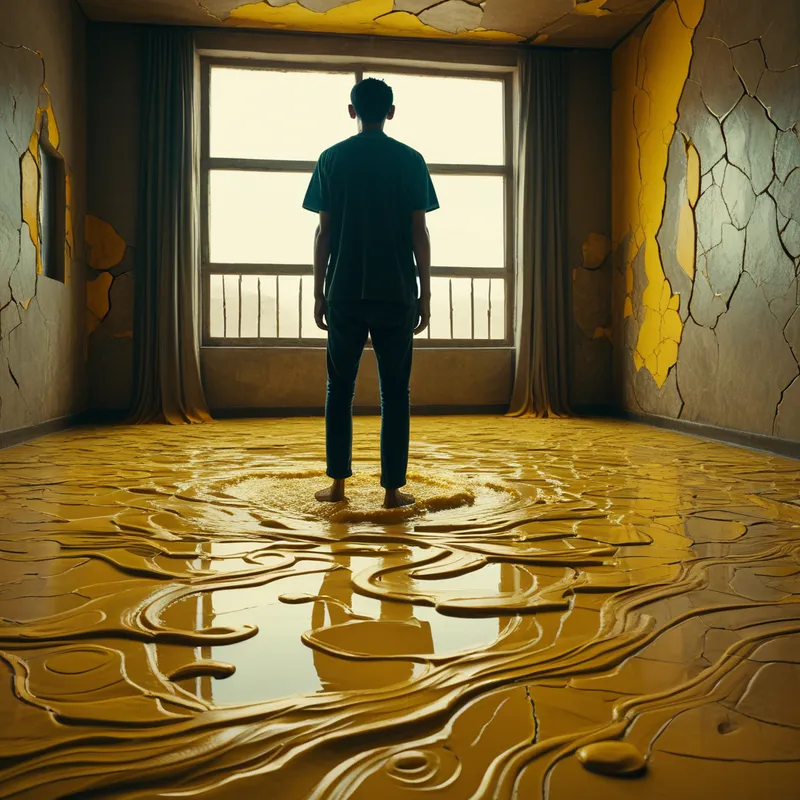
When this myth stirs in the modern psyche, it often manifests in dreams of overwhelming, muddy water. A dream of a yellow-brown flood rising in one’s house, seeping through floors, or bursting through walls points directly to this archetypal pattern. Somatically, it may correlate with feelings of being emotionally “swamped,” of foundational structures (career, relationships, identity) feeling eroded or unstable.
The psychological process is one of confronting a buildup of unprocessed material. The “floodwaters” are often long-ignored emotions, inherited family traumas (like Yu inheriting his father’s task), or a rising tide of instinctual life that has been denied. The dream is a signal from the psyche that the strategy of “building dams”—of avoidance, intellectualization, or repression—is failing. The pressure is becoming too great. The dreamer is being called to their own “Yu journey”: to stop trying to hold back the tide and instead begin the difficult, meticulous work of understanding its source and direction. It is a call to dig new channels—perhaps through therapy, artistic expression, or a radical honesty—to allow this energy to flow purposefully, rather than letting it erupt catastrophically.
Alchemical Translation
The alchemy of the Yellow River myth is the transmutation of [prima materia](/myths/prima-materia “Myth from Alchemical culture.”/)—the primal, chaotic flood—into the [lapis philosophorum](/myths/lapis-philosophorum “Myth from Alchemical culture.”/)—the fertile, ordered plain of the integrated self. Yu’s process is a perfect model for psychic transmutation.
First, one must acknowledge the flood (the [nigredo](/myths/nigredo “Myth from Alchemical culture.”/), or blackening). This is the despair of the people, the recognition that one’s current state is unsustainable. Then comes the labor of differentiation (the albedo, or whitening). This is Yu’s walking, surveying, and mapping. In psychological terms, it is the painstaking work of analysis, of separating complex emotions, tracing patterns of behavior back to their sources, and understanding the topography of one’s own inner world.
The goal is not to eliminate the river, but to become its wise and steadfast bank.
The core alchemical act is channeling, not conquering (the citrinitas, or yellowing). This is the digging. It requires the tool of disciplined attention (the bronze shovel) to consciously create new neural and behavioral pathways. It demands the sacrifice of immediate gratification (passing by one’s home) for the sake of the larger, transformative work. Finally, the emergence of new life (the [rubedo](/myths/rubedo “Myth from Alchemical culture.”/), or reddening) is the revelation of the fertile plain. This is the state of individuation where what was once a source of terror—the wild, unconscious self—becomes the source of nourishment, creativity, and foundational stability. The individual is no longer at war with their own depths but has established a dynamic, flowing relationship with them. They have not slain their dragon; they have earned its respect and harnessed its power to feed the world of their conscious life.
Associated Symbols
Explore related symbols from the CaleaDream lexicon: