Yellow Emperor's Pitch Pipes Myth Meaning & Symbolism
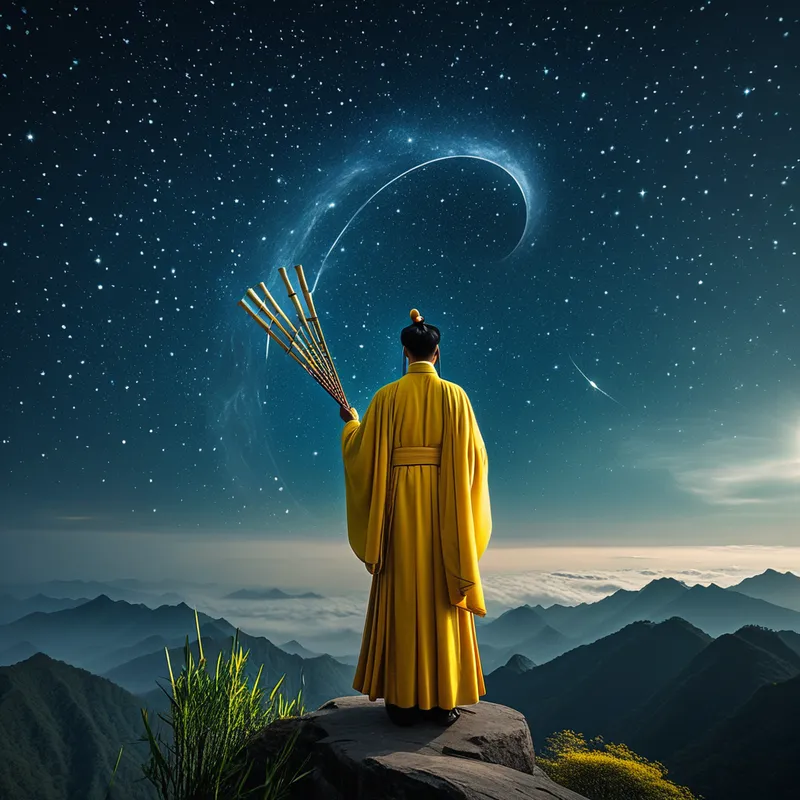
The Yellow Emperor crafts twelve bamboo pipes to measure the winds, capturing the fundamental tones of the universe and establishing harmony between heaven and earth.
The Tale of Yellow Emperor’s Pitch Pipes
In the dawn of time, when [the world](/myths/the-world “Myth from Tarot culture.”/) was still soft clay and [the sky](/myths/the-sky “Myth from Persian culture.”/) a sheet of unmarked silk, there was a great discord. The winds, those wild children of Tian, roamed without rule. They shrieked from the north, bringing bitter frost that cracked [the earth](/myths/the-earth “Myth from Hindu culture.”/). They sighed from the south, heavy with dampness that rotted the seed. They howled from the west, scouring the mountains to dust, and rushed from the east in unpredictable gusts that tore the thatch from roofs and scattered [the hearth](/myths/the-hearth “Myth from Norse culture.”/)-fire’s warmth. The people huddled in their dwellings, their lives a melody of fear, their crops failing, their spirits as unsettled as the leaves in a storm.
Upon the Kunlun peaks, the [Yellow Emperor](/myths/yellow-emperor “Myth from Chinese culture.”/), Huangdi, sat in meditation. He felt the world’s disharmony in his bones. He heard not just [the wind](/myths/the-wind “Myth from Various culture.”/)’s noise, but the weeping of the earth and the silent plea of the heavens for accord. He knew that to rule was not to command, but to listen; to bring order was not to suppress, but to find the inherent pattern.
He descended to a bamboo grove where the stalks, hollow and resilient, sang their own slender songs when the wind passed through. With sacred tools, he cut twelve lengths, each corresponding to a month of the year and a direction of the wind. He measured with the precision of the stars, his work a prayer in action. He placed them upon an altar of jade, facing the four quarters and the eight directions.
Then, he waited. He waited as [the moon](/myths/the-moon “Myth from Tarot culture.”/) waxed and waned. He waited until the day the great annual wind, the breath of Tian itself, began to shift. As the first gust of the new cycle swept down from the Zhong Lü direction, it entered the longest pipe. A sound emerged—deep, foundational, a vibration that seemed to still the very molecules of the air. It was the Huangzhong, the Yellow Bell.
One by one, as the year turned, the winds of each season and direction visited their designated pipe. The southern wind brought a vibrant, growing tone; the eastern, a rising, wooden note; the western, a metallic, descending call. Twelve distinct tones were born, each a perfect measure of its wind’s essence. [The Yellow Emperor](/myths/the-yellow-emperor “Myth from Chinese culture.”/) had not created music; he had captured the latent music of the cosmos. The wild, chaotic winds were now known, named, and given voice. Their power was not diminished, but channeled. The frost now came in its proper time to harden the soil; the rains fell to nourish, not drown; the warm breezes coaxed life from the earth. Harmony was not a silence, but a sublime and ordered symphony. The people felt the change in their spirits. Their hearts beat in time with a new, profound rhythm—the rhythm of a world in tune with heaven.
Cultural Origins & Context
This myth is primarily preserved in classical texts such as the Shiji and the Liji, framing it not as mere folklore but as a foundational narrative of statecraft and cosmology. It belongs to the corpus of stories surrounding the Yellow Emperor, a paragon of the sage-king who civilizes the world through wisdom and technological-magical innovation.
The myth functioned on multiple levels. For the imperial court, it provided a sacred mandate: the ruler’s primary duty was to maintain cosmic and social harmony, just as the pitch pipes ordered the winds. The establishment of the standard pitch (Huangzhong) was directly linked to standardizing weights, measures, calendars, and laws—all emanating from the same cosmic principle. For musicians and ritualists, it was an origin story that sacralized their art, making music a direct conduit of celestial order, essential for proper ritual and, by extension, the health of the state. It was passed down by historians, ritual masters, and scholars, a tale that explained why things are as they are, from the seasons to the very scales of music.
Symbolic Architecture
At its core, the myth is a profound [allegory](/symbols/allegory “Symbol: A narrative device where characters, events, or settings represent abstract ideas or moral qualities, conveying deeper meanings through symbolic storytelling.”/) for the imposition of conscious order upon unconscious, chaotic forces. The wild winds represent the raw, undifferentiated powers of [nature](/symbols/nature “Symbol: Nature symbolizes growth, connectivity, and the primal forces of existence.”/) and the [psyche](/myths/psyche “Myth from Greek culture.”/)—potentially destructive, but also the [source](/symbols/source “Symbol: The origin point of something, often representing beginnings, nourishment, or the fundamental cause behind phenomena.”/) of all [life](/symbols/life “Symbol: The symbol of ‘Life’ represents a journey of growth, interconnectedness, and existential meaning, encompassing both the joys and challenges that define human experience.”/) and [energy](/symbols/energy “Symbol: Energy symbolizes vitality, motivation, and the drive that fuels actions and ambitions.”/). The Yellow Emperor represents the emerging principle of [consciousness](/symbols/consciousness “Symbol: Consciousness represents the state of awareness and perception, encompassing thoughts, feelings, and experiences.”/), [the ego](/myths/the-ego “Myth from Jungian culture.”/) or the sovereign self, which does not fight the [chaos](/symbols/chaos “Symbol: In Arts & Music, chaos represents raw creative potential, uncontrolled expression, and the breakdown of order to forge new artistic forms.”/) but seeks to understand its inherent patterns.
The true ruler does not silence the storm; he learns its scale and key, transforming cacophony into composition.
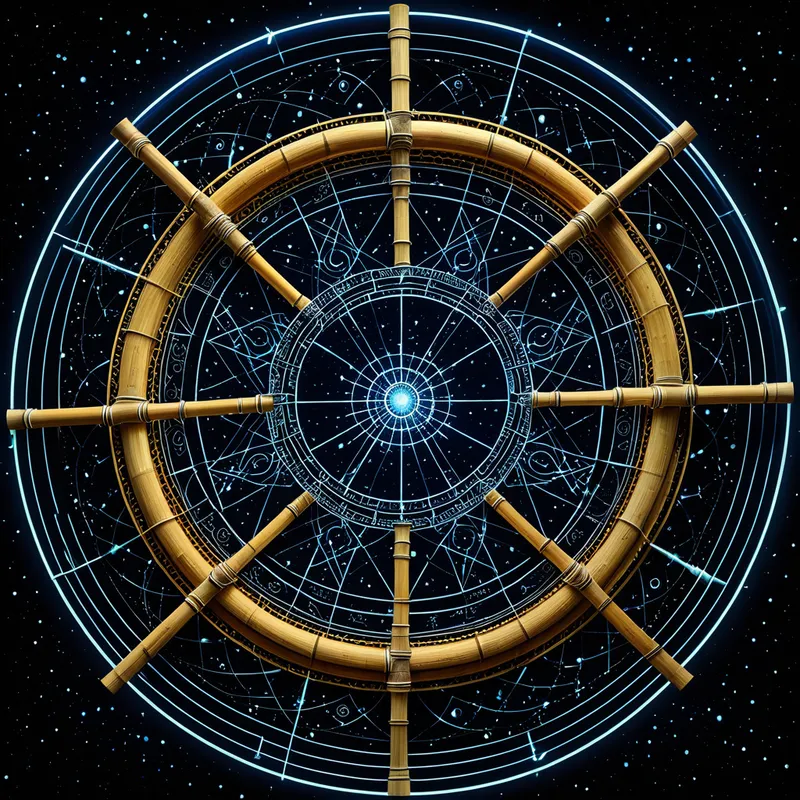
The twelve [bamboo](/symbols/bamboo “Symbol: A symbol of resilience, flexibility, and spiritual growth, often representing strength through adaptability and connection to nature.”/) pipes are the archetypal [vessel](/symbols/vessel “Symbol: A container or structure that holds, transports, or protects something essential, representing the self, emotions, or life journey.”/)—the disciplined [structure](/symbols/structure “Symbol: Structure in dreams often symbolizes stability, organization, and the framework of one’s life, reflecting how one perceives their environment and personal life.”/) ([bamboo](/symbols/bamboo “Symbol: A symbol of resilience, flexibility, and spiritual growth, often representing strength through adaptability and connection to nature.”/)’s hollow, segmented form) that allows the formless (wind) to become expressive. Twelve is a complete cosmological [number](/symbols/number “Symbol: Numbers in dreams often symbolize meaning, balance, and the quest for understanding in the dreamer’s life, reflecting their mental state or concerns.”/): months, directions, earthly branches. The act of measurement is sacred; to measure is to know, and to know is to integrate. The resulting [music](/symbols/music “Symbol: Music in dreams often symbolizes the harmony between the conscious and unconscious mind, illustrating emotional expression and communication.”/) is the [symbol](/symbols/symbol “Symbol: A symbol can represent an idea, concept, or belief, serving as a powerful tool for communication and understanding.”/) of achieved [harmony](/symbols/harmony “Symbol: A state of balance, agreement, and pleasing combination of elements, often associated with musical consonance and visual or social unity.”/), where the internal state of the individual or [kingdom](/symbols/kingdom “Symbol: A kingdom symbolizes authority, belonging, and a sense of identity within a larger context or community.”/) resonates perfectly with the external [cosmos](/symbols/cosmos “Symbol: The entire universe as an ordered, harmonious system, often representing the totality of existence, spiritual connection, and the unknown.”/). The [artifact](/symbols/artifact “Symbol: An object from the past carrying historical, cultural, or personal significance, often representing legacy, memory, or hidden knowledge.”/), the [pitch](/symbols/pitch “Symbol: Pitch symbolizes a rough, sticky substance often associated with barriers and obstacles, reflecting the idea of struggle and the effort required to achieve goals.”/) pipes, thus becomes a numen, a tool of mediation between [heaven](/symbols/heaven “Symbol: A symbolic journey toward ultimate fulfillment, spiritual transcendence, or connection with the divine, often representing life’s highest aspirations.”/) and [earth](/symbols/earth “Symbol: The symbol of Earth often represents grounding, stability, and the physical realm, embodying a connection to nature and the innate support it provides.”/).
The Dreamer’s Resonance
When this myth stirs in the modern unconscious, it often manifests in dreams of chaotic forces—relentless winds, disruptive noises, feelings of being psychologically “blown about” by unpredictable emotions or life circumstances. One may dream of finding a strange, intricate instrument or of trying to measure something immense and intangible.
These dreams signal a psyche grappling with a need for internal order. The “winds” are the affective storms—anxieties, passions, compulsions—that disrupt peace. The dream ego’s task, mirroring the Yellow Emperor’s, is not to suppress these storms (which is impossible), but to develop the “pipes”: the structures of awareness, reflection, and containment. This might involve creating routines (the measurement of time), engaging in therapy or journaling (giving voice to the inner winds), or finding an artistic outlet (the music). The somatic sensation is often one of tension seeking resonance, of chaos seeking a vessel to hold it and translate it into something meaningful.

Alchemical Translation
The individuation process modeled here is one of conscious cultivation. The initial state is participation mystique—a helpless identification with the swirling, autonomous complexes (the chaotic winds). The first step is the withdrawal to the mountain (Kunlun), symbolizing a retreat into reflective consciousness, an “inner altar” where one can observe the chaos without being consumed by it.
The cutting of [the bamboo](/myths/the-bamboo “Myth from Taoist culture.”/) is the difficult work of self-discipline and discrimination—identifying the different strands of one’s nature (the twelve pipes). The waiting is the patience required for the unconscious to reveal its patterns in its own time. The moment the wind sounds the pipe is the moment of insight, when a complex is finally understood in its pure form, its “tone” recognized.
Individuation is the craft of building an internal instrument perfectly calibrated to translate the soul’s weather into the music of a unique life.
The final harmony is not a static peace, but a dynamic, responsive state. The well-individuated psyche does not avoid emotional winds; it has constructed a resilient internal instrument—a coherent Self—that can receive them, measure them, and allow them to produce their specific tone within the greater composition of the personality. The modern seeker, like the Yellow Emperor, becomes the ruler of their inner kingdom by becoming the attentive listener and master craftsman of their own soul’s pitch pipes, turning latent, chaotic potential into the authentic melody of their existence.
Associated Symbols
Explore related symbols from the CaleaDream lexicon: