Yang Guifei Myth Meaning & Symbolism
A tale of a beauty whose love for an emperor brings a dynasty to the brink of ruin, culminating in a sacrifice that echoes through history.
The Tale of Yang Guifei
Hear now the story that still whispers through the Huaqing Pools and sighs in [the wind](/myths/the-wind “Myth from Various culture.”/) at the Mawei Slope. It begins not with a [thunderclap](/myths/thunderclap “Myth from Various culture.”/), but with a glance.
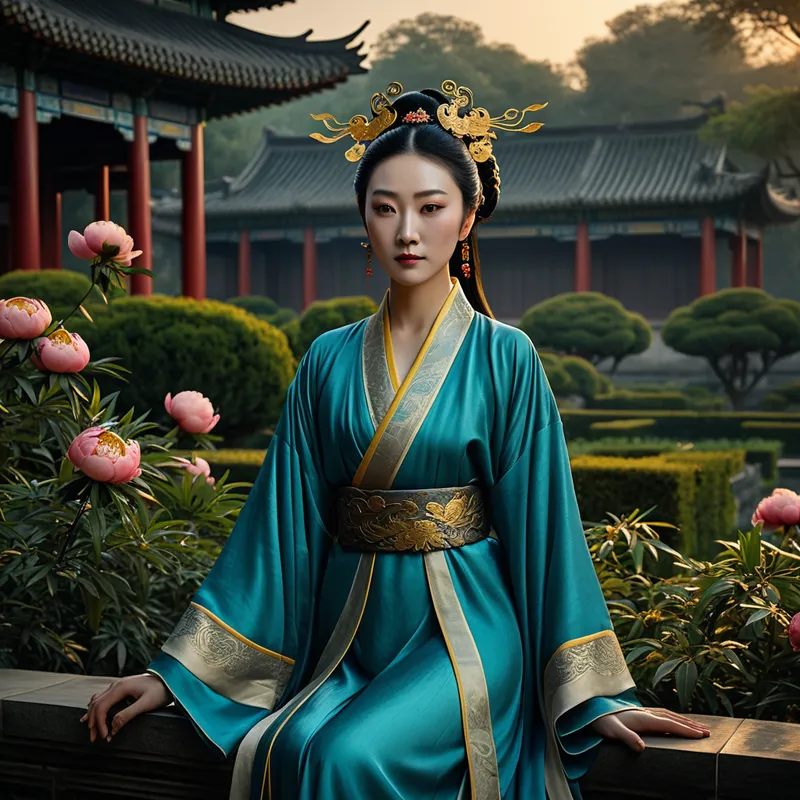
In the glorious, sprawling heart of the Tang Empire, under the reign of the aging Emperor Li Longji, a shadow had begun to creep over the splendor. The Emperor, once a brilliant ruler, now found his spirit weary, the affairs of state a dull echo in halls that felt increasingly empty. Then, at a palace banquet, he saw her. She was Yang Yuhuan, the wife of one of his own sons. [The world](/myths/the-world “Myth from Tarot culture.”/) seemed to still. Her beauty was not merely of form, but of presence—a warmth that filled the cold spaces of power, a laughter that sounded like the strings of the [guqin](/myths/guqin “Myth from Chinese culture.”/) he loved.
What followed was a transgression woven into legend. She was sent to a Taoist nunnery, a thin veil of propriety, only to be summoned back to the palace as his own. Renamed Guifei, she became his sun, his moon, his entire celestial orbit. The Huaqing Hot Springs steamed with their private world. He composed music for her; she danced the “Rainbow and Feather Garment Dance,” a vision of silk and grace that made the very gods envious. The scent of her favorite peonies filled the corridors, a perfume of intoxicating devotion.
Her family rose like a sudden, brilliant constellation. Cousins became generals; her sister, the Lady of Guo, rivaled the Empress in extravagance. The most luminous star was Yang Guozhong, whose ambition was as vast as his influence. But in the provinces, another power festered. An Lushan, the favored, adopted “son” of the Emperor and a rival to the Yang clan, watched the court’s decadence with a gathering storm in his eyes.
The rebellion, when it came, was a wildfire. The “An-Shi Rebellion” shattered the peace. The Emperor, the Consort, and the court fled the capital in disgrace, a gilded procession turned into a desperate, dusty exodus. The imperial guard, hungry, exhausted, and seething with rage, saw the cause of their misery not in distant rebels, but in the beautiful woman in the palanquin and the kin who surrounded the throne.
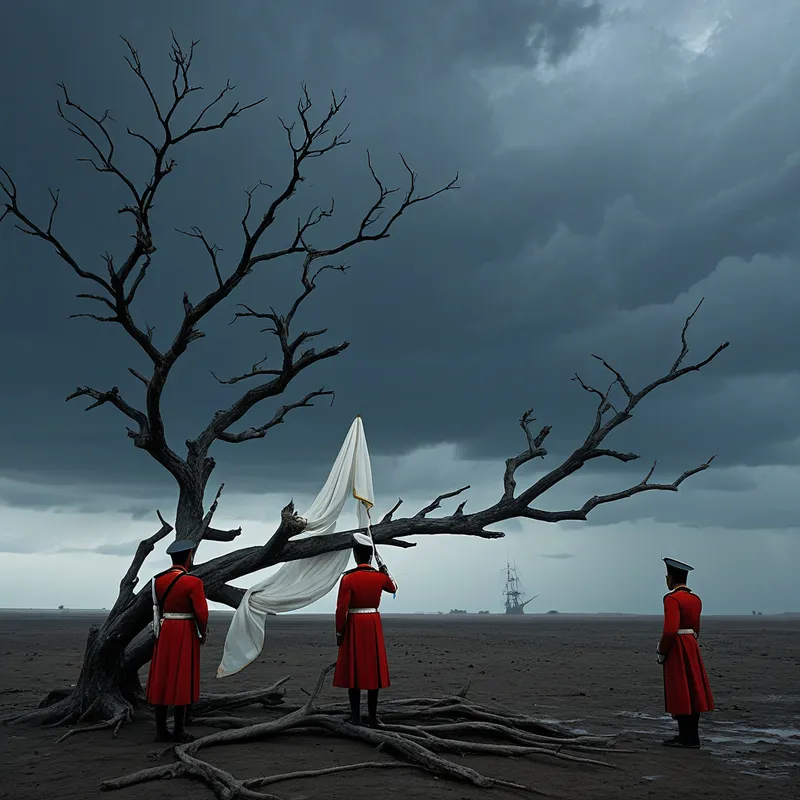
At the desolate Mawei Courier Station, the soldiers mutinied. Their demand was not for gold, but for blood. They would go no further until the Yang clan was purged. Yang Guozhong was cut down. Then, the spears and angry eyes turned to the silk-curtained carriage. The Emperor, broken, faced the unfaceable. To save the dynasty, to save his own life, he must sacrifice the heart of his world.
In a small Buddhist shrine, with the sounds of the mob a dull roar outside, the final act was played. A eunuch presented the white silk scarf. The story says she spoke no word of blame to her Emperor, only acceptance of the fate her beauty had wrought. The silk, symbol of the luxury she embodied, became the instrument of her end. They buried her hastily by the roadside. The rebellion was not quelled that day, but the dynasty, and the soul of the Emperor, was forever scarred. Legend says he later sent a Taoist necromancer to find her spirit, who reported she dwelt as an immortal on the mythical Penglai Island, forever out of mortal reach.
Cultural Origins & Context
The story of Yang Guifei is a powerful historical myth, rooted in the very real collapse of the Tang Dynasty’s [golden age](/myths/golden-age “Myth from Universal culture.”/) during the mid-8th century. It is not a tale from the misty Age of Gods, but a poetic crystallization of a national trauma. The primary sources are the brilliant, melancholic poetry of figures like Bai Juyi, whose epic “Chang Hen Ge” immortalized the tragedy in the cultural imagination, and the official histories compiled by later dynasties.
The myth served multiple societal functions. For Confucian scholars, it was a stark, moralizing parable: the danger of a ruler neglecting his duty (Dao) for personal desire, and the catastrophic consequences of allowing a woman (and her family) undue influence—a classic “beauty as a nation-toppler” trope. For the common people, it was a sublime tragedy of love and loss, humanizing the distant, celestial emperor. It was passed down not just through histories, but through operas, folktales, and paintings, each iteration layering more symbolism onto her figure, transforming a historical consort into an archetype of doomed love and sacrificial beauty.
Symbolic Architecture
At its core, the myth is a profound exploration of the [tension](/symbols/tension “Symbol: A state of mental or emotional strain, often manifesting physically as tightness, pressure, or unease, signaling unresolved conflict or anticipation.”/) between the personal and the political, the inner world of feeling and the outer world of order.
The ultimate sacrifice is often not of the body, but of the heart’s deepest attachment on the altar of collective survival.
Yang Guifei symbolizes the [Anima](/symbols/anima “Symbol: The feminine archetype within the male unconscious, representing soul, creativity, and connection to the inner world.”/) in its most captivating and dangerous form—the [soul](/symbols/soul “Symbol: The soul represents the essence of a person, encompassing their spirit, identity, and connection to the universe.”/)-[image](/symbols/image “Symbol: An image represents perception, memories, and the visual narratives we create in our minds.”/) that enthralls, inspires, but also possesses. She is not a [goddess](/symbols/goddess “Symbol: The goddess symbolizes feminine power, divinity, and the nurturing aspects of life, embodying creation and wisdom.”/) of [nature](/symbols/nature “Symbol: Nature symbolizes growth, connectivity, and the primal forces of existence.”/), but a goddess of culture, of refined [beauty](/symbols/beauty “Symbol: This symbol embodies aesthetics, harmony, and the appreciation of life’s finer qualities.”/), art, and sensual pleasure. Her beauty is her power and her fatal flaw. It represents the intoxicating, all-consuming [aspect](/symbols/aspect “Symbol: A distinct feature, quality, or perspective of something, often representing a partial view of a larger whole.”/) of Eros that can blind the Ruler (the Emperor) to his wider responsibilities.
The Emperor represents the conscious ego of a [kingdom](/symbols/kingdom “Symbol: A kingdom symbolizes authority, belonging, and a sense of identity within a larger context or community.”/). His initial union with the Anima (Guifei) brings a renaissance of art and feeling, a psychic flowering. But his identification with her—his [obsession](/symbols/obsession “Symbol: An overwhelming fixation on a person, idea, or object that consumes mental energy and disrupts balance.”/)—leads to a dangerous [inflation](/symbols/inflation “Symbol: A dream symbol representing feelings of diminishing value, loss of control, or expansion beyond sustainable limits in one’s life or psyche.”/) and a neglect of the [shadow](/symbols/shadow “Symbol: The ‘shadow’ embodies the unconscious, repressed aspects of the self and often represents fears or hidden emotions.”/). [The shadow](/myths/the-shadow “Myth from Jungian culture.”/), in the form of the neglected [military](/symbols/military “Symbol: The military symbolizes discipline, authority, and often the need for structure or control in one’s life.”/) and the resentful populace, coalesces into the brutal, explosive figure of An Lushan. The rebellion is the return of the repressed, the [shadow](/symbols/shadow “Symbol: The ‘shadow’ embodies the unconscious, repressed aspects of the self and often represents fears or hidden emotions.”/) demanding recognition.
The white [silk](/symbols/silk “Symbol: A luxurious natural fiber representing refinement, sensuality, and transformation from humble origins to exquisite beauty.”/) [scarf](/symbols/scarf “Symbol: The scarf symbolizes warmth, comfort, and personal expression, often serving to protect or adorn the self.”/) is the central, chilling [symbol](/symbols/symbol “Symbol: A symbol can represent an idea, concept, or belief, serving as a powerful tool for communication and understanding.”/). It is the beautiful, soft, luxurious object of the courtly world turned into the [instrument](/symbols/instrument “Symbol: An instrument symbolizes creativity, communication, and the means by which one expresses oneself or influences the world.”/) of its own purification. It signifies that [the thing](/myths/the-thing “Myth from Norse culture.”/) which intoxicates the [system](/symbols/system “Symbol: A system represents structure, organization, and interrelated components functioning together, often reflecting personal or social order.”/) must be strangled by the very essence of that system to restore balance.
The Dreamer’s Resonance
When this myth pattern stirs in the modern dreamer, it often signals a profound crisis of valuation in the [psyche](/myths/psyche “Myth from Greek culture.”/). To dream of being the adored yet doomed beauty, or the ruler forced to make an impossible choice, points to a deep internal conflict.
Somatically, one might feel a constriction in the throat (the scarf), a sense of being beautifully trapped, or the weight of a terrible, loving gaze that also demands everything. Psychologically, the dreamer is navigating the point where a cherished inner value—a creative passion, a deep relationship, a personal aesthetic—has come into fatal conflict with the demands of outer reality (one’s career, social obligations, or ethical boundaries). The “mutinous soldiers” in the dream could be ignored health needs, financial pressures, or moral conscience, rising up to demand the sacrifice of the beloved “indulgence” for the sake of the psyche’s overall stability. It is the process of confronting the shadow consequences of one’s own attachments.

Alchemical Translation
The alchemical journey of this myth is not one of heroic conquest, but of necessary, heartbreaking [separatio](/myths/separatio “Myth from Alchemical culture.”/)—the separation of elements that have become fatally fused.
The initial stage is coniunctio, the glorious and intoxicating union of the Emperor and Guifei, representing [the ego](/myths/the-ego “Myth from Jungian culture.”/)‘s fusion with a captivating complex. This brings warmth and color, but it is unstable. The rebellion is the [nigredo](/myths/nigredo “Myth from Alchemical culture.”/), the blackening, the chaotic dissolution where the shadow overwhelms the conscious order. The old, inflated identity must die.
Individuation sometimes requires us to be both the executioner and the executed, to sever a part of our own soul so the whole may continue.
The sacrifice at Mawei is the pivotal, transformative moment. It is the conscious, agonizing act of differentiating the ego from the complex that possesses it. The Emperor must reclaim his role as ruler, which means sacrificing his identity as lover. For the modern individual, this translates to the painful but necessary process of sacrificing a beloved identification—“I am this relationship,” “I am this artistic talent,” “I am this beauty”—to reclaim a more integrated, responsible Self. The silk scarf is the tool of this psychic surgery.
The final, haunting image of Guifei as an immortal on Penglai represents the outcome. The complex is not destroyed, but transformed and relocated. The beauty, [the passion](/myths/the-passion “Myth from Christian culture.”/), the Anima quality is no longer fused with the ego, causing inflation and disaster. It is restored to its proper place in the psyche: as a distant, guiding, archetypal image—a memory that inspires poetry and longing, but no longer holds the power to overthrow the kingdom of [the Self](/myths/the-self “Myth from Jungian culture.”/). The individual carries the scar of the sacrifice, but gains the sovereignty that comes from having faced the mutiny within and made the impossible choice for wholeness.
Associated Symbols
Explore related symbols from the CaleaDream lexicon: