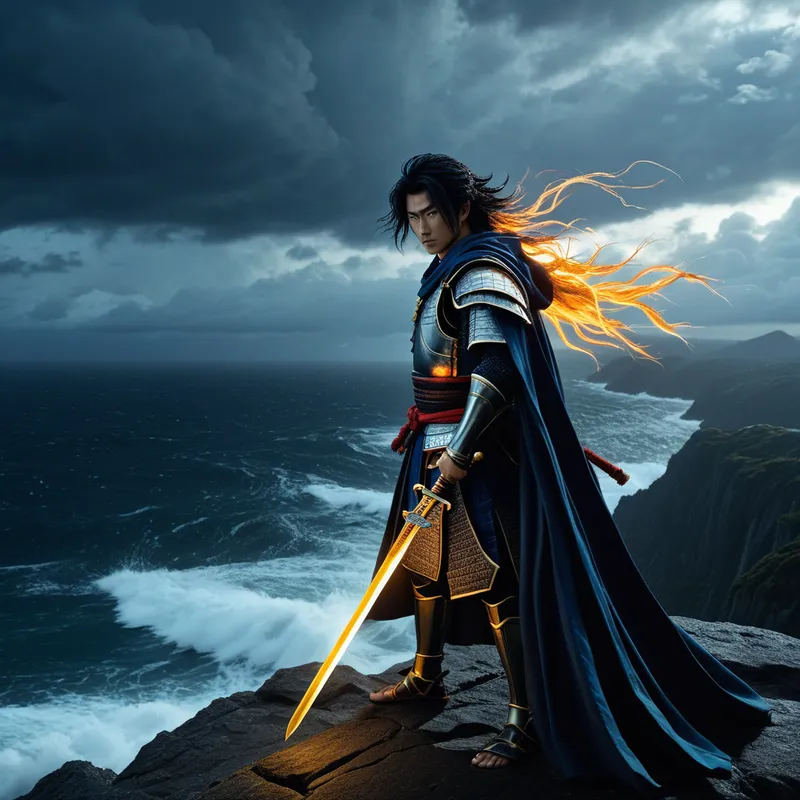
Yamato Takeru Myth Meaning & Symbolism
A prince of divine wrath and sorrow, whose legendary conquests forge a nation but whose untamed spirit ultimately consumes him.
The Tale of Yamato Takeru
Hear now the tale of the prince whose heart was a tempest, whose name was both a blessing and a curse: Yamato Takeru. He was born O-usu, second son to the Emperor Keikō, in a land where the will of the kami flowed through mountain and river.
From his youth, his strength was terrible and untamed. When his elder brother failed to come to the morning feast, the young prince, in a fury of impatience, broke his limbs, wrapped him in a mat, and cast him aside. The Emperor, seeing this savage power, feared it. To channel the wildfire of his son’s spirit away from the court, he sent him on a path of conquest. “Go and subdue the Kumaso rebels in the west,” he commanded.
The prince went, not as a general with an army, but as a lone wolf. At the house of the Kumaso chieftains, he found them feasting. He let his hair fall like a woman’s, donned a robe, and walked among them, a beautiful, silent youth. When the chieftains were drunk and called him to sit between them, he drew the short sword hidden in his garments. In one swift, brutal motion, he pierced the elder brother through the chest. The younger brother fled, but the prince chased him to the privy, striking him through the buttocks. With his last breath, the dying warrior bestowed a new name upon the conqueror: “Henceforth, you shall be called Yamato Takeru, the Bravest in Yamato.”
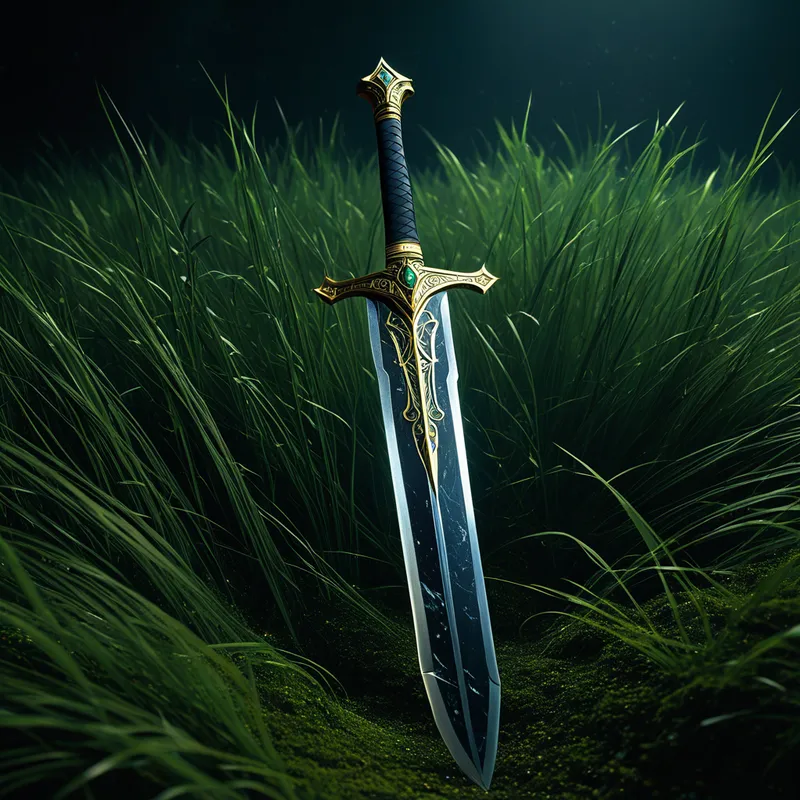
But a father’s fear is a long shadow. Again, the Emperor sent him, this time to the wild east, to pacify the Emishi. His aunt, Yamato-hime, saw his fate. She gave him two treasures: the [Kusanagi-no-Tsurugi](/myths/kusanagi-no-tsurugi “Myth from Japanese culture.”/) and a fire-making tool. “These will be your salvation,” she whispered.
In the eastern plains of Sagami, a local ruler betrayed him, luring him into a vast grassland and setting it ablaze on all sides. With fire racing toward him, Yamato Takeru remembered the sword. He slashed at the grass around him with Kusanagi, clearing a space, and then used the fire-making tool to light a counter-blaze. [The wind](/myths/the-wind “Myth from Various culture.”/), summoned by the sword’s divine power, turned and swept the inferno back upon his enemies, consuming them.
His journey was a trail of conquest and sorrow. He crossed [the sea](/myths/the-sea “Myth from Greek culture.”/) from Kazusa, his heart heavy as a stone. When a storm rose to swallow his boat, his wife, Oto-tachibana-hime, saw the wrath of [the sea](/myths/the-sea “Myth from Greek culture.”/) kami. “I will take your place,” she said, a vow as final as [the horizon](/myths/the-horizon “Myth from Various culture.”/). She leaped into the raging waves, and [the sea](/myths/the-sea “Myth from Greek culture.”/) grew calm, leaving the prince alone with a grief that no sword could cut.
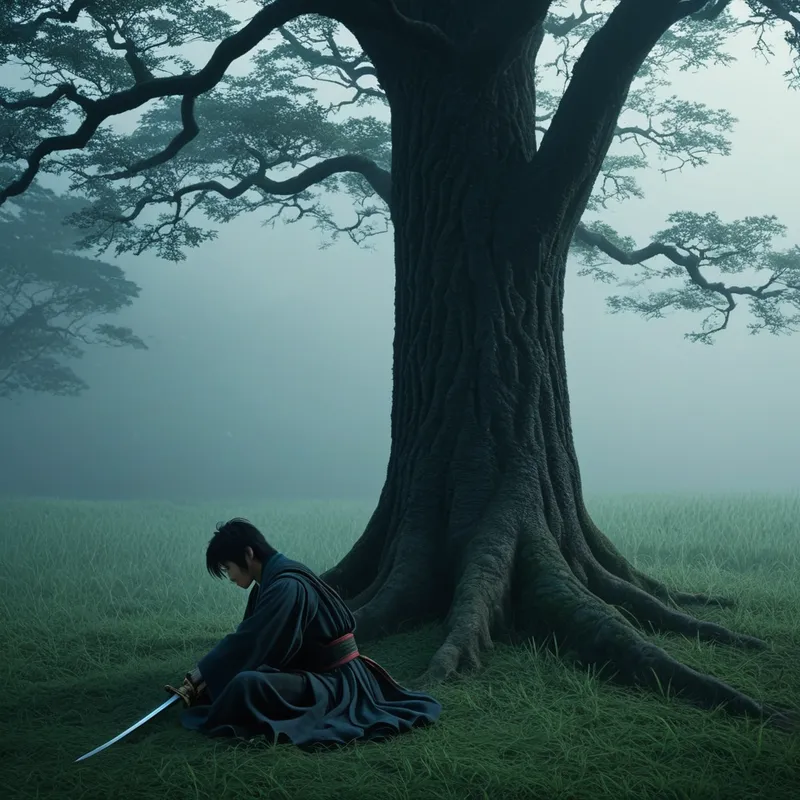
Weary, soul-sick, and carrying the curse of the mountain kami he had insulted, he came at last to the plain of Nobono. There, his strength left him. He opened his bag to find the fire-making tool—his wife’s final, practical gift—and knew his end was near. He tried to walk on, but stumbled. In a field of gentle grass, under a vast sky, the Bravest in Yamato laid down his sword. He sang a final, haunting poem of longing for his home, and then his spirit transformed, becoming a great white bird that flew toward the sun, leaving only an empty mound and an eternal legend.
Cultural Origins & Context
The legend of Yamato Takeru is preserved primarily in two of Japan’s oldest chronicles: the Kojiki (Records of Ancient Matters, 712 CE) and the Nihon Shoki (Chronicles of Japan, 720 CE). These texts were not mere storybooks; they were political and theological foundations, compiled under imperial command to legitimize the ruling Yamato line and establish a unified national mythology.
The tale functions as a foundational epic of state-building. Yamato Takeru’s brutal pacification of the Kumaso and Emishi represents the historical expansion and consolidation of the Yamato polity’s power from its heartland in western Japan eastward across the archipelago. His tragic, lonely death, followed by his apotheosis into a bird, serves a critical purpose: it transmutes the narrative of violent conquest into one of noble sacrifice and eternal guardianship. The hero’s spirit doesn’t vanish; it becomes part of the landscape, watching over the land he unified. This reflects a core Shinto concept where powerful or troubled spirits (kami) are appeased and enshrined, their energy harnessed for the community’s protection.
The myth was likely an amalgamation of older oral traditions concerning local chiefs and warriors, refined and repurposed by court scribes. It sits at a crossroads, blending elements of the untamed, tragic hero (a common archetype in many world mythologies) with the specific needs of a nascent imperial ideology. He is both the indispensable, terrifying force that forges a nation and the cautionary symbol of the price of that forging—a price paid in personal alienation, rage, and ultimate dissolution.
Symbolic Architecture
At its core, the myth of Yamato Takeru is not a simple [hero](/symbols/hero “Symbol: A hero embodies strength, courage, and the ability to overcome significant challenges.”/)’s [adventure](/symbols/adventure “Symbol: ‘Adventure’ signifies exploration, discovery, and the pursuit of new experiences in one’s life journey.”/) but a profound map of a fractured [psyche](/myths/psyche “Myth from Greek culture.”/) forced into wholeness through violent [action](/symbols/action “Symbol: Action in dreams represents the drive for agency, motivation, and the ability to take control of situations in waking life.”/) and ultimate sacrifice.
The [prince](/symbols/prince “Symbol: A prince symbolizes nobility, leadership, and aspiration, often representing potential or personal authority.”/) embodies raw, undifferentiated power—the primal libido or [life](/symbols/life “Symbol: The symbol of ‘Life’ represents a journey of growth, interconnectedness, and existential meaning, encompassing both the joys and challenges that define human experience.”/) force in its most potent and dangerous form. His initial act of violence against his [brother](/symbols/brother “Symbol: In dreams, a brother often symbolizes kinship, support, loyalty, and shared experiences, reflecting the importance of familial and social bonds.”/) is not strategic evil but pure, unchecked [impulse](/symbols/impulse “Symbol: A sudden, powerful urge or drive that arises without conscious deliberation, often linked to primal instincts or emotional surges.”/). He is [consciousness](/symbols/consciousness “Symbol: Consciousness represents the state of awareness and perception, encompassing thoughts, feelings, and experiences.”/) in its adolescent, brutal state, all id and no [integration](/symbols/integration “Symbol: The process of unifying disparate parts of the self or experience into a cohesive whole, often representing psychological wholeness or resolution of internal conflict.”/). His [father](/symbols/father “Symbol: The father figure in dreams often symbolizes authority, protection, guidance, and the quest for approval or validation.”/), the Emperor, represents the ordering principle, the [senex](/symbols/senex “Symbol: The wise old man archetype representing spiritual authority, ancestral wisdom, and the integration of life experience into transcendent knowledge.”/) or ruling consciousness that cannot contain this force and so projects it [outward](/symbols/outward “Symbol: Movement or orientation away from the self or center; expansion, expression, or externalization of inner states into the world.”/).
The hero is not born whole; he is a question sent into the world by a fearful king. His journey is the world’s answer, written in blood and sorrow.
The sacred sword, Kusanagi, is the central [symbol](/symbols/symbol “Symbol: A symbol can represent an idea, concept, or belief, serving as a powerful tool for communication and understanding.”/) of channeled power. It is a gift from the feminine (his [aunt](/symbols/aunt “Symbol: Dreaming of an aunt often symbolizes nurturing, support, and familial ties, reflecting the dreamer’s relationship with caregivers and influence from female figures.”/), the [shrine](/symbols/shrine “Symbol: A sacred structure for worship, offering, or remembrance, representing connection to the divine, ancestors, or spiritual forces.”/) maiden) and represents the tool of discrimination, the [ability](/symbols/ability “Symbol: In dreams, ‘ability’ often denotes a recognition of skills or potential that one possesses, whether acknowledged or suppressed.”/) to “cut away” what entangles and threatens to consume. In the burning field, he does not fight fire with brute force; he uses the sword to create sacred [space](/symbols/space “Symbol: Dreaming of ‘Space’ often symbolizes the vastness of potential, personal freedom, or feelings of isolation and exploration in one’s life.”/) and redirect the [energy](/symbols/energy “Symbol: Energy symbolizes vitality, motivation, and the drive that fuels actions and ambitions.”/). This is the [moment](/symbols/moment “Symbol: The symbol of a ‘moment’ embodies the significance of transient experiences that encapsulate emotional depth or pivotal transformations in life.”/) of nascent consciousness—using a divine tool to transform a [situation](/symbols/situation “Symbol: The ‘situation’ symbolizes the junction between the subconscious and conscious realms, often reflecting the current challenges or dynamics in the dreamer’s waking life.”/) of certain [death](/symbols/death “Symbol: Symbolizes transformation, endings, and new beginnings; often associated with fear of the unknown.”/) into one of mastery.
His [wife](/symbols/wife “Symbol: The symbol of a ‘wife’ in a dream often represents commitment, partnership, and personal relationships, reflecting one’s desires for intimacy or connection.”/), Oto-tachibana-hime, symbolizes the integrative, sacrificial [aspect](/symbols/aspect “Symbol: A distinct feature, quality, or perspective of something, often representing a partial view of a larger whole.”/) of the [Anima](/symbols/anima “Symbol: The feminine archetype within the male unconscious, representing soul, creativity, and connection to the inner world.”/). She represents the [connection](/symbols/connection “Symbol: Connection symbolizes relationships, communication, and bonds among individuals.”/) to the emotional and instinctual world that the hero lacks. Her leap into the sea is the ultimate sacrifice of the personal for the transpersonal, of [relationship](/symbols/relationship “Symbol: A representation of connections we have with others in our lives, often reflecting our emotional state.”/) for [destiny](/symbols/destiny “Symbol: A predetermined course of events or ultimate purpose, often linked to spiritual forces or cosmic order, representing life’s inherent direction.”/). It calms the outer storm but creates an inner one of unresolved [grief](/symbols/grief “Symbol: A profound emotional response to loss, often manifesting as deep sorrow, yearning, and a sense of emptiness.”/) and [guilt](/symbols/guilt “Symbol: A painful emotional state arising from a perceived violation of moral or social standards, often tied to actions or inactions.”/), the emotional [debt](/symbols/debt “Symbol: A symbolic representation of obligations, burdens, or imbalances that extend beyond financial matters into psychological and moral realms.”/) of his [mission](/symbols/mission “Symbol: A mission in dreams represents one’s aspirations and goals, often linked to a sense of purpose or commitment.”/).
His final transformation into a white [bird](/symbols/bird “Symbol: Birds symbolize freedom, perspective, and the connection between the earthly and spiritual realms, often representing the soul’s aspirations or personal growth.”/) is the ultimate alchemical symbol. The bird is a classic [psychopomp](/myths/psychopomp “Myth from Greek culture.”/), a guide between worlds. He does not die a [human](/symbols/human “Symbol: The symbol of a human represents individuality, complexity of emotions, and social relationships.”/) death; his [identity](/symbols/identity “Symbol: Identity represents the sense of self, encompassing personal beliefs, cultural background, and social roles.”/)—the “Bravest in Yamato”—dissolves, and his essence is liberated into a purer, more spiritual form. He becomes a kami, his personal tragedy sublimated into a protective, impersonal [presence](/symbols/presence “Symbol: Presence in dreams often signifies awareness or acknowledgment of something significant in one’s life.”/).
The Dreamer’s Resonance
When the pattern of Yamato Takeru stirs in the modern dreamer’s psyche, it signals a profound confrontation with one’s own untamed, destructive power and the daunting call to a necessary, lonely journey.
To dream of being sent on an impossible, unwanted mission by a cold or fearful authority figure speaks to the experience of being tasked by the inner “father” or superego with a duty that feels alien to the heart. It is the soul being commanded to conquer its own “barbaric” territories—repressed anger, wild creativity, or unacknowledged ambition—not for itself, but to satisfy an internalized external demand.
Dreams of wielding a powerful but double-edged tool (a sword, a wand, a key) in a crisis, especially against a consuming force like fire or [water](/myths/water “Myth from Chinese culture.”/), mirror the burning plains of Sagami. This is the somatic feeling of a psychic emergency where one’s survival depends on accessing a latent, perhaps forgotten, inner resource (the Kusanagi sword) to create a boundary and redirect energy. The body may feel this as a surge of adrenaline coupled with sharp, clear focus.
The most poignant resonance is dreaming of a profound sacrifice made by a loved one to ensure your passage, leaving you with immense guilt and loneliness. This is the Oto-tachibana-hime moment. It reflects the painful awareness that parts of our softness, our capacity for simple relationship and peace, are being “sacrificed” to the demands of our current life journey—a career pursuit, a healing process, a creative ordeal. The dream acknowledges the cost and the resulting emotional burden.
Finally, dreams of transformation into an animal, especially a bird, at the moment of exhaustion or defeat point directly to the myth’s end. This is not a failure, but a signal of impending psychic transmutation. [The ego](/myths/the-ego “Myth from Jungian culture.”/)-identity that has been struggling is about to be shed. A more essential, liberated, and panoramic state of being is preparing to emerge from the struggle.

Alchemical Translation
The myth of Yamato Takeru is a stark blueprint for the alchemical process of individuation, where the base metal of the personality is subjected to extreme pressure and transformation to reveal its gold.
The first stage ([nigredo](/myths/nigredo “Myth from Alchemical culture.”/): blackening, chaos) is embodied in the prince’s youthful, brutal rage. This is the necessary, shadowy beginning—the recognition of one’s own destructive potential, the “black” energy that the conscious personality rejects and fears. The Emperor’s fear is our own ego’s fear of this inner chaos.
The journey itself is the albedo (whitening, separation). He is sent away, separated from his source. He must use disguise (the feminine robes), cunning, and the gifted sword (the differentiating function of consciousness) to survive. Each conquest is a confrontation with an externalized aspect of his own inner “other”—the rebellious Kumaso, the treacherous local ruler, the stormy sea of emotion. He is slowly, painfully, learning to wield his power with strategy, not just impulse.
The crucible of the journey does not soften the metal of the soul; it heats it to the point where it can be reshaped by a will greater than its own.
The sacrifice of Oto-tachibana-hime represents a pivotal citrinitas (yellowing, illumination), though a tragic one. It illuminates the terrible price of the journey. For the modern individual, this translates to the conscious sacrifice of certain attachments, comforts, or even relationships that cannot survive the intensity of one’s chosen path toward wholeness. It is the moment of realizing that growth requires loss, and that loss carries a grief that must be integrated, not ignored.
The final illness and transformation at Nobono is the [rubedo](/myths/rubedo “Myth from Alchemical culture.”/) (reddening, union). Exhausted, having carried the curses and burdens of his actions, the hero stops fighting. He lays down his weapon—the very symbol of his heroic identity. In this surrender, not to an enemy but to the process itself, the final transmutation occurs. The personal identity of “Yamato Takeru,” the brave conqueror, dies. What is released is the pure, white bird—the liberated Self, no longer bound to the drama of conquest and tragedy, free to ascend. For us, this is the stage where we release identification with our struggles, our traumas, and even our achievements. We allow the constructed [persona](/myths/persona “Myth from Greek culture.”/) to dissolve, trusting that what remains is our essential, timeless spirit, capable of moving beyond the story that once defined us. The myth ends not with a kingdom ruled, but with a soul freed.
Associated Symbols
Explore related symbols from the CaleaDream lexicon: