Yamabushi Myth Meaning & Symbolism
The myth of mountain ascetics who seek spiritual power through extreme physical and mental trials in the sacred, dangerous wilderness.
The Tale of Yamabushi
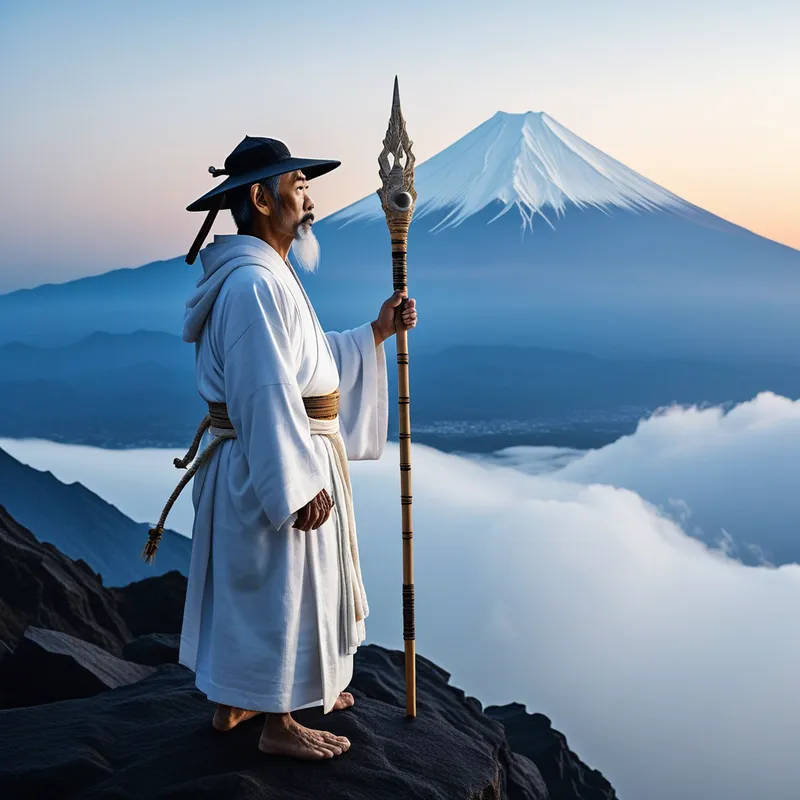
Listen. The mountain does not sleep. It breathes with the slow, deep rhythm of the earth, exhaling mists that swallow valleys and whispering secrets in the groan of ancient pines. This is not a place for the village, for the rice field, for the warm hearth. This is the domain of the wild gods, the kami of rock and waterfall, and of things older still that have no name. Here, where the air thins and the world falls away, the Yamabushi walks.
He is a figure of stark contrast against the lush, consuming green. His robes are the white of bone or unfinished hemp, a declaration of death to the world below. On his head, a small black box, a tokin, sits like a seed of concentrated will. In his hand, the shakujo staff rings with iron rings, a sound to scatter demons and mark his pilgrim’s beat. He has left the map. His path is vertical, a line drawn from the mundane heart straight up into the thunderhead.
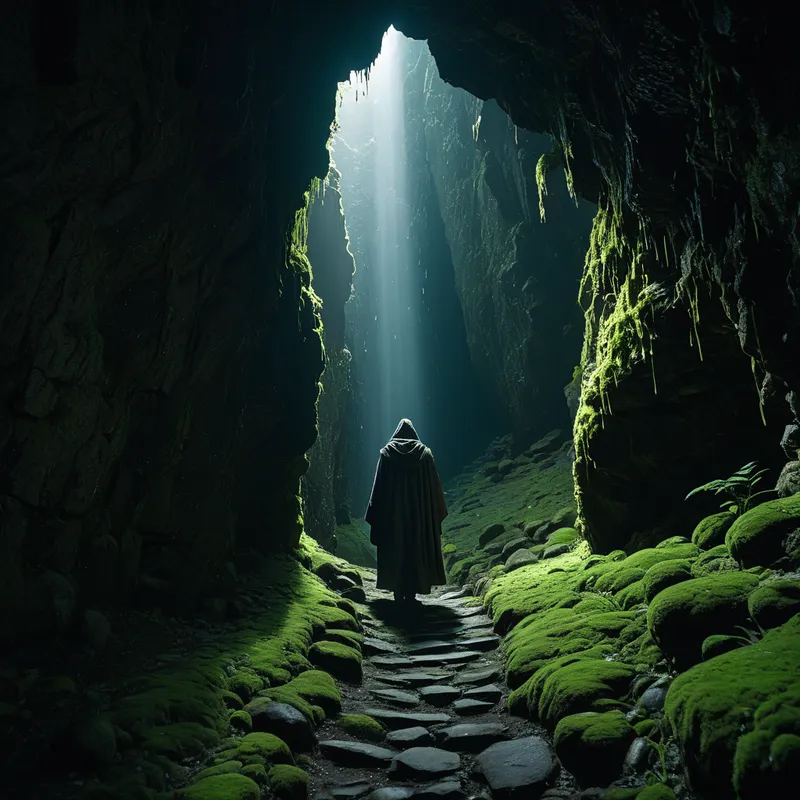
His journey is an ordeal of elements. He stands beneath waterfalls in the dead of winter, the icy torrent a hammer to shatter the illusion of a separate self. He fasts until the world shimmers and the boundary between dream and waking stone dissolves. He enters caves—the womb of the mountain—to sit in absolute darkness for days, where the only companion is the chittering of his own mind, which must be faced, and stilled. He chants the sutras not with his lips, but with his bones, the syllables of the Lotus Sutra vibrating against the granite. The mountain tests him. It sends visions: beautiful seductresses formed from mist, monstrous tengu with beaks and swords, avalanches of doubt. Each is a guardian, a question. Who are you without your name? What is your power when you are broken?
The climax is not a battle with a beast, but a confrontation with the void at the summit. In that silent, wind-scoured place, under a bowl of stars so close he could touch them, the final shell of identity cracks. There is no ecstasy, only a profound, empty clarity. The mountain, the sky, the chanting, the cold—it is all one continuous fabric, and he is not apart from it, but a thread within it. He does not conquer the mountain. The mountain acknowledges him. A power settles in him, not of domination, but of knowing. He becomes a shugenja, one who has obtained power through ascetic practice. When he descends, walking back into the world of streams and villages, he carries the mountain’s silence within him. He is a bridge between the raw, sacred wild and the human community, a living testament that the path to the gods is walked on bleeding feet.
Cultural Origins & Context
The Yamabushi, or “those who lie down in the mountains,” are not figures of a single, codified myth but are the living protagonists of a profound historical and spiritual tradition known as Shugendō. Emerging around the 7th-8th centuries, their practice crystallized under the semi-legendary figure En no Gyōja. These ascetics were not monks confined to temples but itinerant practitioners for whom the mountains of Japan—particularly the Dewa Sanzan and the Kumano region—were their true cathedral.
Their myths were lived, not merely told. The stories were passed down as oral teachings within lineages (ryū) and encoded in the rituals of their arduous pilgrimages (nyūbu). Their societal function was multifaceted: they were healers, using herbs and spiritual power (gen); exorcists, purifying places and people; and guides, leading lay pilgrims on sacred circuits. They occupied a liminal space in feudal Japan, respected and sometimes feared, as their power came not from institutional authority but from direct, dangerous encounter with the numinous forces of nature. Their narrative is the collective biography of all who undertook the path, a template for transforming a human being through radical confrontation with the elemental world.
Symbolic Architecture
The Yamabushi’s journey is a masterclass in symbolic initiation. The mountain itself is the ultimate symbol of the Self in its totality—the enduring, ancient, and often daunting structure of the psyche that must be climbed to achieve wholeness.
The ascent is always an inward turn; the highest peak is found in the deepest interior.
The white robes symbolize the death of the old, social persona—the “civilized” self that is comfortable, known, and defined by others. The tokin is the sealed vessel of potential, the latent wisdom yet to be activated. The shakujo’s rings announce his presence to invisible realms, a declaration of intent that disrupts the stagnant energies of the ordinary world.
The ordeals—the waterfall, the cave, the fast—are alchemical furnaces. They are not punishments, but technologies for dissolution. The freezing water shatters egoic rigidity. The cave represents the descent into the unconscious, the necessary night-sea journey where one meets the shadow (the tengu, the seductive visions) and integrates it. The fast burns away psychic dross, forcing consciousness to feed on a subtler substance than bread. The summit arrival signifies the ego’s alignment with the Self—not becoming a god, but realizing one’s intrinsic part in the divine order.
The Dreamer’s Resonance
When the pattern of the Yamabushi stirs in modern dreams, it signals a profound call to a psychological ascent. The dreamer may find themselves climbing an endless, arduous staircase in a corporate skyscraper, traversing a treacherous mountain path in a storm, or lost in a vast, dark forest. The somatic feeling is often one of immense effort, breathlessness, isolation, and a potent mix of dread and exhilaration.
This dream motif emerges when the conscious life has become too flat, too negotiated, or too confined by societal expectations. The psyche is initiating its own nyūbu, its own mountain entry. The feeling of being tested, of facing elemental cold or fear, mirrors the internal process of confronting repressed emotions, outdated self-concepts, or a calling that has been ignored. The dream is not a warning, but an affirmation: you are already on the path. The ordeal is the process. To dream of finally reaching a clear, high vista suggests the hard-won clarity that follows a period of intense inner work, a new perspective being earned.

Alchemical Translation
For the modern individual, the Yamabushi myth models the non-negotiable journey of individuation. Our mountains are not made of rock, but of inherited trauma, societal conditioning, and the accumulated weight of unlived life. The alchemical translation happens in three stages, mirroring the ascent.
First, Severance (Nyūbu): This is the conscious decision to leave the “village” of consensus reality. It may be quitting a soul-deadening job, ending a toxic relationship, or simply committing to therapy or a deep creative practice. It is the act of putting on the “white robes”—declaring a death to what no longer serves your authentic being.
Second, Calcination (Shugyō): This is the ordeal in the furnace. In the psyche, this is the painful, messy work of shadow integration. Facing your jealousy, your rage, your neediness, your arrogance—these are your personal tengu. The freezing waterfall is the shock of truth, the cave is the depression or dark night of the soul where you must sit with yourself. This stage burns away the impurities of self-deception.
The power sought is not over the world, but over the illusions that separate you from it.
Finally, Coagulation (Kanjō): This is the integration at the summit. The insights gained from the ordeal are not left on the mountain; they are brought back down. The transformed individual returns to their community—their family, their work, their art—not as an escaped hermit, but as a shugenja of daily life. They carry a grounded power, a resilience, and a quiet authority that comes from having met the depths of their own nature and returned, whole. They become a bridge between the raw truth of the soul and the demands of the world, embodying the Yamabushi’s ultimate triumph: to be in the world, but not of it, anchored by the mountain within.
Associated Symbols
Explore related symbols from the CaleaDream lexicon: