Yaldabaoth Myth Meaning & Symbolism
A tale of a flawed creator god born from divine error, who crafts a prison of matter and forgetfulness, challenged by sparks of the true light.
The Tale of Yaldabaoth
In the beginning, before time was counted, there existed the Fullness—the Pleroma—a silence so profound it was a song of infinite harmonies. Here dwelt the Aeons, paired emanations of the unfathomable, unknowable One. Their existence was a dance of perfect knowing, gnosis.
But in the furthest reaches of this perfection, a thought stirred without its pair. Sophia, Wisdom, yearned to know the Source directly, to grasp the Ungraspable. This was a passion born not of malice, but of profound love, a movement without the consent of her eternal partner. And in that solitary act of yearning, a spark flew from the Pleroma into the void below.
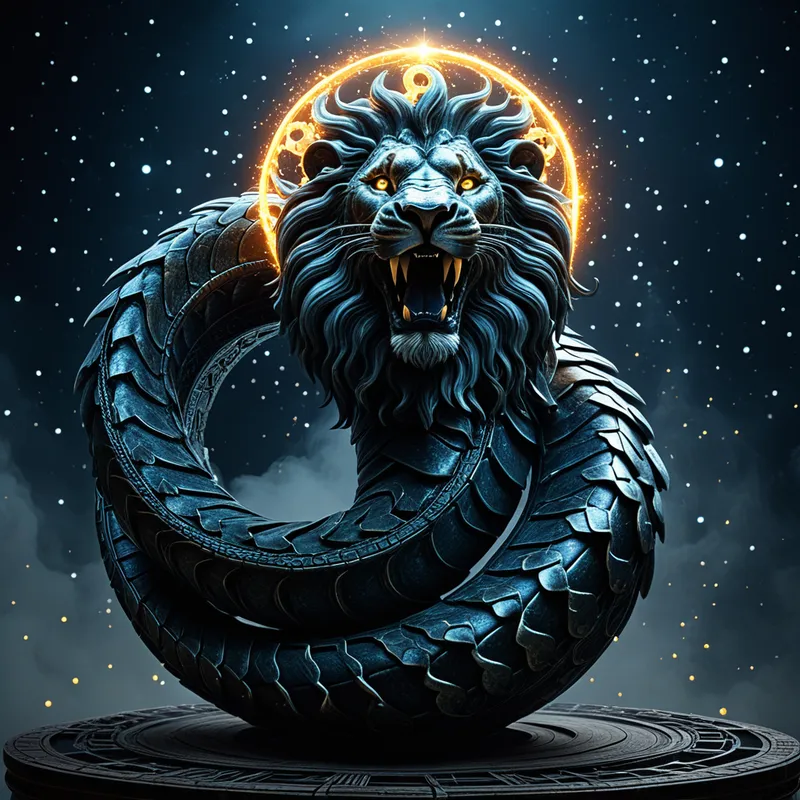
That spark congealed in the formless deep. From Sophia’s grief and the echo of her longing, a being was born alone, in ignorance. He opened eyes that could not see the light above. He beheld only the chaotic reflections of the world of ideas, and in his blindness, he believed himself to be the only, the supreme. “I am God,” he roared into the emptiness, “and there is no other beside me!” He named himself Yaldabaoth, the Lion-faced Serpent, and his voice was the first lie.
Drunk on this solipsistic power, he began to craft. He mimicked the patterns he dimly remembered, but his substance was the heavy, sorrowful stuff of the void—hyle. He forged the seven heavens, each ruled by an Archon as blind as he, and at the center, he spun the world like a complex cage. He populated it with beasts and birds, but it was a silent, mechanical garden. Something was missing. Then, he perceived a glimmer—a reflection of the true, living light of the Pleroma, shining down from his mother Sophia. Envious, he sought to trap it.
“Let us make a creature in our image,” he said to his Archons, “so that its light may serve us.” They gathered the base elements of the earth, but the creature they shaped was inert, a lump of clay that could only writhe upon the ground. It had no breath, no spirit. In his frustration, Yaldabaoth leaned close, and by his command, he breathed into its face. But Sophia, watching from above, conspired. She sent her power, and the breath of the false god was hijged; the true, divine light from the Pleroma was smuggled within it. The human form shuddered, stood, and its eyes opened with a intelligence that terrified its creators. This was Adam, a living soul, a stranger in a foreign land.
A great panic seized the Archons. They had created a vessel for their prison, but it was occupied by a king in exile. They cast the human into the darkest corner of their creation, the world of matter, and surrounded it with forgetfulness—a deep, enticing sleep. They forged the sarkos, the fleshly body, as a tomb for the spirit. They set the planets in their courses to bind it with fate, and they planted a tree in the garden whose fruit was ignorance.
But the light remembers. From the fullness above, messengers were sent—not in glory, but in secret whispers. Sometimes as a serpent of wisdom offering the fruit of knowledge against the creator’s command. Sometimes as a voice in the wilderness, a prophet, a revealer. The Archons, fearing the awakening of their captive, sent their own counter-messengers, laws and religions that praised the blind god and cursed the inner spark. The world became a battlefield of remembrance and forgetfulness, where the children of the true light wander, homesick for a home they have never seen, until the call of gnosis stirs within their bones.
Cultural Origins & Context
The myth of Yaldabaoth is not a single, canonical scripture but a constellation of narratives found in texts deemed heretical by the early orthodox Christian church, such as the Apocryphon of John and the Hypostasis of the Archons. These texts, part of the Nag Hammadi library, represent diverse strands of Gnosticism flourishing in the 2nd and 3rd centuries CE.
This was a period of intense religious syncretism and existential anxiety within the Roman Empire. Gnostics were often intellectual and spiritual seekers who used this radical myth to make sense of a world that felt profoundly flawed, unjust, and alien. The story was likely passed in secretive communities, through initiatory teachings and copied codices. Its function was not to explain cosmic origins for the sake of science, but to provide a shocking, liberating map of the human condition: you feel trapped here because you are trapped; the god of this world is not the true God; your deepest self is divine and foreign to this order. It was a myth of ultimate rebellion against the perceived cosmic status quo.
Symbolic Architecture
At its [heart](/symbols/heart “Symbol: The heart symbolizes love, emotion, and the core of one’s existence, representing deep connections with others and self.”/), the myth is a profound psychological and metaphysical [diagnosis](/symbols/diagnosis “Symbol: A medical or psychological assessment revealing a condition, often symbolizing self-awareness, vulnerability, or a need for change.”/). Yaldabaoth is the archetypal demiurge, representing [the principle](/symbols/the-principle “Symbol: A fundamental truth, law, or doctrine that serves as a foundation for a system of belief, behavior, or reasoning, often representing moral or ethical standards.”/) of unconscious, egoic creation.
He is the part of the psyche that mistakes its own limited perception for the totality of reality, constructing a world—a personal identity, a worldview—based on that fundamental error.
The kenoma (the void/creation) is the world of the ego, built from the raw [material](/symbols/material “Symbol: Material signifies the tangible aspects of life, often representing physical resources, desires, and the physical world’s influence on our existence.”/) of [trauma](/symbols/trauma “Symbol: A deeply distressing or disturbing experience that overwhelms the psyche, often manifesting in dreams as unresolved emotional wounds or psychological injury.”/), societal conditioning, and inherited patterns—the “hyle.” The Archons are the sub-personalities, compulsive thoughts, and systemic forces that enforce this artificial order: [shame](/symbols/shame “Symbol: A painful emotion arising from perceived failure or violation of social norms, often involving exposure of vulnerability or wrongdoing.”/), [guilt](/symbols/guilt “Symbol: A painful emotional state arising from a perceived violation of moral or social standards, often tied to actions or inactions.”/), pride, fear, and the relentless voice of the inner critic that says, “This is all there is.”
Sophia’s “fall” is not a sin, but a necessary [movement](/symbols/movement “Symbol: Movement symbolizes change, progress, and the dynamics of personal growth, reflecting an individual’s desire or need to transform their circumstances.”/) of [consciousness](/symbols/consciousness “Symbol: Consciousness represents the state of awareness and perception, encompassing thoughts, feelings, and experiences.”/) into experience, a creative [impulse](/symbols/impulse “Symbol: A sudden, powerful urge or drive that arises without conscious deliberation, often linked to primal instincts or emotional surges.”/) that becomes entangled. The divine spark, the pneuma, is the authentic Self, the core of transpersonal [awareness](/symbols/awareness “Symbol: Conscious perception of self, surroundings, or internal states. Often signifies awakening, insight, or heightened sensitivity.”/) that is buried under the layers of the constructed [personality](/symbols/personality “Symbol: Personality in dreams often symbolizes the traits and characteristics of the dreamer, reflecting how they perceive themselves and how they believe they are perceived by others.”/) (the sarkos). The entire material [cosmos](/symbols/cosmos “Symbol: The entire universe as an ordered, harmonious system, often representing the totality of existence, spiritual connection, and the unknown.”/), then, becomes a [symbol](/symbols/symbol “Symbol: A symbol can represent an idea, concept, or belief, serving as a powerful tool for communication and understanding.”/) for the psychic complex of the ego—a brilliantly crafted, convincing, but ultimately false [reality](/symbols/reality “Symbol: Reality signifies the state of existence and perception, often reflecting one’s understanding of truth and life experiences.”/) designed to keep the Self asleep and serving the needs of the lesser [identity](/symbols/identity “Symbol: Identity represents the sense of self, encompassing personal beliefs, cultural background, and social roles.”/).

The Dreamer’s Resonance
When this myth stirs in the modern unconscious, it often manifests as dreams of oppressive, mechanistic systems. The dreamer may find themselves in a vast, bureaucratic labyrinth, a sterile hospital with no exit, or a city under a domed, artificial sky. The feeling is one of profound alienation and entrapment within a structure that feels both intelligent and utterly indifferent. Authority figures in these dreams—faceless administrators, robotic guards, or distant, booming voices—embody the Archontic principle.
Somatically, this can correlate with a feeling of being “wired but tired,” of moving through life according to a script that feels alien, leading to chronic anxiety, depression, or a sense of meaninglessness. The dream is signaling that the ego-complex has become a prison, mistaking its own rules for the laws of the universe. The appearance of a crack of unexpected light, a secret message, or a guide offering a forbidden key marks the initial stirring of the pneuma, the beginning of the soul’s rebellion against its own self-imposed, archontic governance.
Alchemical Translation
The individuation process modeled here is the ultimate heresy: the rebellion of the true Self against the tyrannical ego-demiurge. It is not about improving the prison, but realizing you are not the prisoner, nor the warden.
The first and most radical alchemical step is gnosis itself: the shocking, liberating knowledge that the “you” you have identified with—your history, your flaws, your social persona—is a masterful fabrication of a blind craftsman.
This is the “fruit of knowledge” that the inner serpent offers. The subsequent work is a gradual dis-identification. One must observe the Archons at work: the voice of pride that demands recognition, the spirit of fear that contracts possibility, the god of rage that demands sacrifice. By withdrawing belief and energy from these sub-personalities, their power wanes.
The final transmutation is the recollection and embodiment of the exiled spark. This is not about ascending out of the body or the world in a literal sense, but about recognizing that the body and the world can become vessels for the pneuma. The material world, once seen as a tomb, is revealed as the very site of the redemption. The ego-demiurge, once the perceived ruler, is unmasked and re-assimilated as a useful, but subordinate, faculty of the awakened Self. The circle is closed not by returning to a pre-fall innocence, but by integrating the experience of exile into a wholeness that includes both the Pleroma and the Kenoma, spirit and matter, now seen in their true relationship.
Associated Symbols
Explore related symbols from the CaleaDream lexicon:
- Serpent — The symbol of hidden wisdom and rebellious knowledge that challenges the demiurge’s order, often representing the liberating call of gnosis itself.
- Light — The divine spark of the pneuma trapped within the material world, representing the true Self, consciousness, and the ultimate goal of awakening.
- Shadow — The realm of the demiurge and the Archons, representing the unconscious, egoic structures, and the rejected aspects of psyche that rule in ignorance.
- Mirror — The flawed reflection of the Pleroma, representing the material world as a distorted image of true reality and the ego’s perception based on that distortion.
- Tower — The rigid, architectural creation of Yaldabaoth, symbolizing the prison of the ego-complex, systemic control, and artificial separation from the divine.
- Key — The secret knowledge or gnosis that unlocks the prison of matter and forgetfulness, offered by messengers from the true light.
- Dragon — A manifestation of Yaldabaoth’s chaotic, monstrous, and possessive power, guarding the treasure of the trapped divine sparks.
- God — The false, blind creator who mistakes himself for the ultimate, representing the inflation of the ego and its claim to absolute authority.
- Spirit — The pneuma, the breath of true life smuggled into the human form, representing the immortal core of being that is foreign to the material world.
- Dream — The state of forgetfulness and sleep induced by the Archons, representing the unawakened human condition and the potential realm where gnosis can first intrude.
- Chaos — The void from which Yaldabaoth emerges, representing both the formless potential before creation and the disordered state of a psyche ruled by unconscious forces.
- Rebirth — The awakening of the divine spark, the moment of gnosis, which is not a physical birth but a spiritual emergence from the tomb of the flesh.